A reading companion
Wool
A chapter-by-chapter companion with clear summaries, character notes and key terms. Spoiler-free up to the chapter you are on.
0 of 83 chapters read
Theme
Text size
Font
Line width
Line spacing
A reading companion
A chapter-by-chapter companion with clear summaries, character notes and key terms. Spoiler-free up to the chapter you are on.
0 of 83 chapters read
Part 1 · Holston
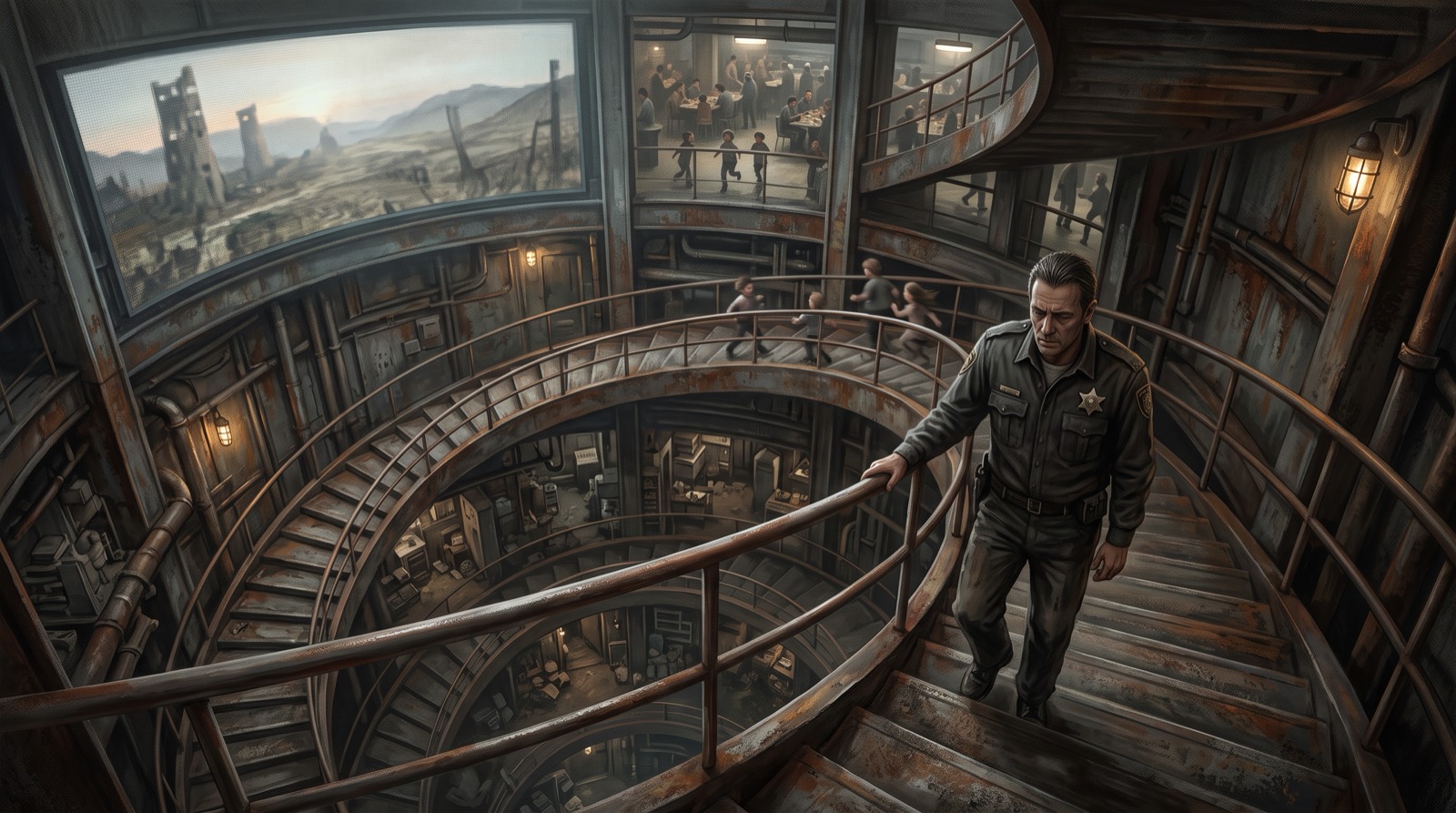
Holston is climbing a long spiral staircase. The very first line tells us he is climbing "to his death." Above him, children are playing and laughing. He climbs slowly. He notices how worn the steps and railing are. Centuries of hands and feet have rubbed the steel smooth. He thinks the stairs look like they were built for emergencies and a few dozen people, not for thousands walking up and down every day.
He passes floors of homes and remembers being a child here. Back then the silo felt endless, full of homes, workshops, gardens and pipe rooms to explore. That was over thirty years ago. Since then he has been the sheriff for most of his life. For the last three years he has lived a quiet, secret third life. He has been waiting for something that he now knows will never come. The chapter doesn't say what it is.
At the top he reaches the cafeteria and lounge, the biggest rooms in the silo. The children are running around. Emma is picking up chalk. Her husband Clarke is handing out juice and cookies. Clarke waves, but Holston has no energy to wave back. One whole wall of the cafeteria shows the outside world. It is a blurry picture of hills at dawn that look lifeless. Past the hills, what look like the tops of old, rotting towers catch the light. People suspect humans once lived up there, but nobody knows for sure.
A little boy, Susan's son, bumps into Holston's knees and runs off. This makes Holston think of his wife, Allison. In the year she died, they had won the lottery. That meant they could try for a baby, but only for one year. Her implant was taken out, and they tried every silly trick for luck, from garlic over the bed to dimes under the mattress. Before the year was over, Allison was gone, and the chance passed to another couple. He still carries the ticket everywhere.
He walks to his office, which sits between the cafeteria and the airlock. Three years ago Allison struggled right here, in what he calls her "sudden madness." He knows that if he followed a crease up the hill on the big screen, he might see her body lying out there. He pictures her curled up, worn away by the air and the poisons he believes are out there. But the picture is so blurry that he can't be sure. He chooses not to look.
In the office, his deputy Marnes greets him cheerfully. Holston asks for the key to the holding cell. While Marnes turns away, Holston quietly puts his sheriff's star on the desk. Marnes is confused and asks if he needs the mop, because they only go in the cell to clean it. Holston walks into the cell, locks himself in, and hands the key out through the bars. Then he tells Marnes to fetch the mayor and tell her he wants to go outside.
The chapter tells us the ending first: Holston is climbing to his death. That swaps the question "what will happen?" for "why is he doing this?" The rest of the chapter answers in small pieces: his grief, his empty three-year wait, and the spot near his office where Allison struggled.
Wear is everywhere. The steps, the railing and the paint are all rubbed thin. Holston ties this straight to people: each life wears the stairs down a little, while the silo wears that life down. He feels worn out himself, a man in the third and emptiest stage of his life.
The laughing children are a contrast. They don't yet feel buried, and Holston does. The book is probably showing how silo life slowly squeezes the hope out of people as they grow up (my guess, because Holston's memories move from wonder as a child to emptiness now).
The screen matters too. It is the only window on the outside, and it can't be trusted. Holston himself thinks there is a lot to doubt in what it shows. Even his wife's body is only a "maybe."
Part 1 · Holston
Holston spends his last day in the holding cell. One wall of the cell is a big screen showing the outside, and this view is clearer than the cafeteria's. He wonders why. Maybe each condemned "cleaner" takes extra care with this camera, as a gift to the next person who sits in this cell. He likes that idea, because it makes him think of Allison.
The view shows brown hills and a dull gray sky, the same sky as in his father's and grandfather's time. Only the clouds move. Up close, he sees bright white dead pixels on the screen, like tiny windows to somewhere brighter. Allison called them "stuck" pixels. He imagines a future where most pixels die, and people think the world is on fire. Then he wonders if they are already fooled like that now.
Mayor Jahns arrives. She admits she sometimes sits in the empty cell at night to enjoy this view. Holston thinks of the children's books, the only books that survived something called the uprising. Most people doubt the bright greens and blues in them, but Holston feels they are truer than the screen. Jahns offers him his pick for a last meal, as tradition says. He cuts her off. Three years ago he served Allison her last meal in this same cell.
Holston bitterly asks if Jahns misses Allison, or only hates how long the blur has had to build up. Jahns says she doesn't want this, but rules are rules. Holston admits he enforced those rules most of his life, even after deciding they were nonsense. Jahns says no mayor since the uprising, about 150 years ago, has sent more people to cleaning than she has. She takes no pleasure in it. Holston says they will all enjoy a clear sunset tomorrow. She reminds him he broke the law, knowing he was breaking it.
Jahns admits that some people are nervous. Everyone in the cell says they won't do the cleaning, yet they always do. Holston hasn't said either way, and that worries them. Holston thinks most people sent outside were caught doing something and want revenge. He and Allison are different. They came here because, in a strange way, they wanted to see what is beyond the screens. He tells Jahns everyone cleans, so there must be a reason. Secretly, the why of the cleaning has haunted him for years. He doesn't mind if his silence hurts the people he blames for his wife's death.
Jahns says Marnes will sit at the desk all night, as is tradition. Holston tears up. He did that duty when Donna Parkins and Jack Brent were sent out, and he spent the night on this floor, broken, when Allison went. As Jahns leaves, he corrects her: Marnes is Sheriff now, not Deputy. She tells him to eat something.
This chapter names the silo's harshest rule: cleaning. Breaking the law gets a person sent outside to wipe the camera lenses, and nobody expects them to come back. The ritual has its own small traditions, like the last meal and the all-night watch, which make it feel ordinary and accepted.
The dead pixels are a key image. Each is a tiny bright window that seems to point to a better place. Holston turns them into a big question: what if the screens are lying, and the true picture is the one that looks broken? The book probably wants us to doubt the screens too (my guess, because Holston keeps coming back to the idea, and the children's books show colors nobody believes).
Jahns is not a villain here. She is tired and sad, and she hides behind the idea that rules are rules. Holston has hidden behind the same idea for most of his life, and he admits it.
The chapter also shows the silo's hidden selfishness. A cleaning means a clear view for everyone else, and Holston bitterly points out that they will all enjoy it.
Part 1 · Holston
This chapter jumps back three years. Holston and Allison are at home in their apartment, which has room for luxuries like desks and a wide bed. Holston is sorting through piles of case files on the bed. Allison sits at her computer. She works with the silo's old servers, rebuilding data that was deleted and written over long ago. Holston doesn't understand how she does it.
Allison announces a discovery: there was more than one uprising. She has pieced together an old report that was deleted during the last uprising. It lists revolts about every twenty years, going back over a century. She reads out the gaps between them: twenty years, eighteen, twenty-four, and so on. Holston isn't surprised, since crimes are rarely original. He guesses the old revolts came before the silo had a system for cleaning the sensors, or before the lottery.
Allison has another theory, and she lowers her voice to share it. Everyone has always been told that the rebels wiped the servers during the great uprising. She thinks the silo's own ancestors did it instead. Wiping all the backups would take a big, careful effort, not an accident or a fire. Holston asks why she thinks "the good guys" did it. She asks who says they are the good guys. Holston goes stiff. Talk like that is close to treason, and treason can lead to cleaning. She says she's kidding.
Then she lays out her strongest point. There were revolts every generation, but there has been none since the servers were wiped. Holston, who thinks of detective work as his job rather than hers, works it out: someone erased the past to stop people from repeating it. Allison goes further. Maybe something on those drives caused the revolts. It might be old history, data about the outside, or the reason people moved into the silo. Maybe that knowledge built up a pressure that drove people stir-crazy, or made them want out.
Holston eyes the monitor with distrust and asks her to stop. She refuses. The truth is always good, she says, and better they find it than someone else. Anyway, she has already published a guide on how to recover deleted files, and the IT department is sharing it around.
Holston looks back at his files. It has been five years since anyone was sent to cleaning. The view is getting worse, and he feels growing pressure, as sheriff, to find someone. People get jumpy when a cleaning feels due, and nerves make someone slip up. He wishes he could find a case worth sending someone out for, just to release that steam. He feels Allison is poking a needle into an overfull balloon, and he wants to let the air out first.
The flashback changes how we see Allison. She is not a random victim of madness. She is a sharp, curious expert who has started pulling hidden history back out of the silo's computers.
Her discovery is the first real crack in what the silo tells its people. The official story is that rebels wiped the past. Her evidence points the other way: the wipe was careful and thorough, and the revolts stopped right after it. If she is right, someone in charge chose to erase history to keep people calm.
Holston and Allison stand for two attitudes. She believes the truth is always good. He believes some truths are dangerous, and that order matters more. His job has trained him to keep the peace, even to the point of wishing for someone to send out.
The chapter's last images, steam building up and an overfull balloon, show the silo as a pressure cooker. Cleaning works as the release valve. This probably explains why the silo needs cleanings, beyond just wiping the lenses (my guess, because Holston links the rising tension directly to the time since the last cleaning).
Part 1 · Holston
We are back in the present. Holston sits on a steel bench inside the airlock, numb from no sleep. Nelson, the head of the cleaning lab, is helping him into a white protective suit. Nelson says they have improved the joint seals and added a second spray-on lining. He thinks the suit should give Holston more time outside than anyone has had before.
That makes Holston remember watching Allison's cleaning. The top floor is usually empty during cleanings. Most people can't bear to watch, or would rather enjoy the clear view later without seeing the cost. Holston watched. Through her silver-masked helmet he couldn't see her face, but he knew her walk. She scrubbed the lenses with her wool pads and did a careful job. Then she looked into the camera, waved at him, and walked away toward a hill and the crumbling city beyond. Partway up the hill she fell, clutching her helmet and twisting. Holston believes the poisons ate through the linings, then the suit, then her. He didn't move the whole time.
Nelson keeps working. Holston wears a black carbon undersuit against his skin, and he pictures it melting off him outside. He has seen this routine twice before. Jack Brent fought and swore all the way, so Holston had to stand guard. Allison got ready quietly while he watched through the porthole. Holston always wondered why people go along with it. Now he thinks he knows. It doesn't feel real enough to fight.
Nelson zips up two layers, seals the Velcro, and checks the helmet. He insists on going over the procedure "by the book," glancing at the door, where someone is probably watching. Holston knows there is no actual book. The suit makers and cleaning techs pass their skills down by word of mouth, almost like a cult, and everyone gives them space. They keep the view of the outside alive.
Nelson explains the steps. There are wool scrubbing pads stuck to the front of the suit. Two squirts from the cleaning bottle, then scrub with the wool, then dry with a towel, then put on special films last. The pockets are numbered, labeled and color-coded, and printed upside down so the wearer can read them.
For the first time, Holston looks Nelson in the eye and sees fear. He realizes Nelson is afraid that Holston will walk out without cleaning. Or maybe Nelson fears his team's precious, hard-made gear will just rot outside for nothing. The gear is made with secrets handed down from before the uprising. Holston thinks about the rules that doomed him: rules against dreaming of a better place.
Nelson asks if anything is too tight. Holston thinks his life, his skin and the walls are all too tight, but he only shakes his head. He whispers that he is ready, and he truly is. He suddenly remembers how ready Allison was too.
This is the first time we see the cleaning up close, and it is calm and orderly, which makes it more chilling. Nelson's step-by-step instructions treat a death sentence like a routine job.
The memory of Allison's cleaning is the emotional center. She did the job well, waved goodbye, and then walked toward the hill and the city before falling. The detail that others did the same thing makes the walk feel like a pattern, not just one person's choice.
The wool scrubbing pads are worth noticing. The book is called Wool, and here wool is the tool that keeps the silo's view clear. The title probably points to this act of cleaning (my guess, because this is the first time wool appears and it is tied to the book's central ritual).
The chapter also answers why people go along with their own cleaning, at least in Holston's view: it doesn't feel real enough to fight. Yet there is a second possibility in the air. Nelson's fear and the watching eyes at the door suggest the silo isn't fully sure cleaners will cooperate.
Finally, Holston names the crime that doomed him: dreaming of a better place. That makes the silo's law about thoughts and hopes, not only actions.
Part 1 · Holston
Back to three years earlier. Marnes radios Holston in a panic about Allison. Holston sprints to the cafeteria and finds her on the floor, held down by Connor, Percy and another food worker. She was running for the airlock, shouting over and over that she wants to go out. Holston begs her to stop, but he knows it's too late. Everyone heard. For one second her wild eyes go calm and clear, almost calculating, then the wildness comes back. Holston has her carried to the holding cell. At the end of the hall, the bright yellow airlock door waits.
In the cell, Allison goes calm at once. She sits and stares at the wallscreen and won't speak. Holston paces outside, crying and begging, while Marnes and the mayor handle the paperwork. The silo prepares for a cleaning. Techs size a suit, tools are readied, and a gas called argon is loaded into the airlock. Allison refuses her last meal.
Late at night, when everyone else has gone, she whispers that it's not real. Holston hopes she has snapped out of it. She says nothing they see is real and asks him to sit beside her. It is long past visiting hours, and entering could get him sent to cleaning too. He unlocks the cell and goes in anyway.
Allison touches the screen. It could be morning now and they'd never know, she says. There could be people outside watching them. She doesn't seem crazy now, only her words do. Holston asks what she found. She says lots of recent data was deleted too, not just from the uprising. And she found programs that can make pictures on screens look real. IT knows a secret that only they know. She promises to come back for him, so they can go over that hill together, if the hill is really there and green.
She explains her new idea. There was never really an uprising, just a slow leak of people who know the truth and want out. They get exactly what they ask for. She says she knows why cleaners clean even when they say they won't. And she won't wait out there like the others. She will come back.
She says every uprising was driven by doubt, the feeling that the outside isn't as bad as it looks and the silo is the bad place. Maybe it was young people wanting to explore, or couples denied children, or old people wanting to make room. That is why saying you want to leave is the "great offense." Holston recites the saying drilled into him since childhood: you get what you ask for. His parents warned him never even to think about leaving.
Holston asks why she didn't come to him or tell people. She laughs. That would start the next uprising. She is only coming back for him. He says nobody comes back. She asks why he thinks cleaners pick up their wool and clean. He says no one knows. She says they now know something new, she will know for sure tomorrow, and one day he will too.
This is the turning point of Part 1. The "sudden madness" from Chapter 1 now looks very different. Allison's brief calm look in the cafeteria, and how clearly she talks at night, suggest her outburst may have been at least partly a choice.
Her theory reframes the whole silo. If the screens can be faked, the dead world might be a lie, and the silo itself might be "the bad place." The uprisings stop looking like random violence. They look like people acting on a suspicion the silo works hard to crush, and the great offense, simply saying you want out, exists to stop that suspicion spreading.
The saying "you get what you ask for" is chilling once you see it from both sides. To the silo it is a warning. To Allison it is a promise: ask to go out, and they will let you.
Holston is caught between his two roles, husband and sheriff. He breaks the rules to sit with her, which shows where his heart really is.
Her promise to come back sets up Holston's three-year wait and explains his decision. He has probably come to believe she was right (my guess, because he chose cleaning himself after waiting for her).
Part 1 · Holston
Back in the present, we learn about Holston's three years. In the first year, he believed Allison's theory and waited for her to come back. On the first anniversary he scrubbed the cell and the yellow door, listening for her knock. When she didn't come, he read through her computer files until he felt half mad himself. He came to believe his world was a lie. By the second anniversary he had the forbidden words in his mouth, but he swallowed them. He calls that his year of cowardice. Now, a year later, he has finally said them.
He stands alone in the airlock. He had always expected to die inside, his body going into the soil of the eighth-floor dirt farm like his parents'. A klaxon (a loud alarm) warns everyone away. Argon gas fills the room and squeezes the suit tight. Plastic curtains line the walls. They will be burned inside the airlock while he cleans, to destroy anything that leaks in. The outer doors open only partway. Holston squeezes through, glad to see the world once rather than burn with the curtains. The doors close behind him.
He is surprised to find a concrete ramp leading up. At the top, he sees green. Through his visor there are green hills, grass, a blue sky like the children's books, white clouds and living things flying. He whoops with joy. He remembers Allison turning slowly in the same spot, and now he thinks he knows why everyone cleans.
Behind him is a small concrete tower, eight or nine feet tall, with a ladder, antennae and four wide fish-eye camera lenses. He begins to clean. He waves at the cafeteria, though he knows no one is watching. He wonders whether Allison's wave was a secret message. He doesn't clean in anger. He cleans with pity for the people inside, and pure joy. He decides she was right: the screens inside turn this green into gray. He thinks the dirt is real but simple, not poisonous.
As he works, he wonders who knows about this lie, and why anyone would keep it. Maybe to stop the uprisings, or to control people, or even to limit children. Around the corner, the distant city comes into view. There are more buildings than he knew, and they look whole and shining, not broken. He imagines Allison coming over the hill, then decides he must go to her.
He is tempted to tear off his suit and run. But he keeps up appearances, as all cleaners before him did. He feels part of a secret club now. He follows the numbered pockets on all four lenses and packs everything away neatly. Then he turns his back on the silo and walks up the crease in the hill, in Allison's footsteps. He believes her body is no longer there, and that it was just another lie on the screens.
This chapter seems to deliver everything Holston hoped for. Through his visor, the world is green and alive, just like the children's books. Allison seems right, and the silo seems to be the prison.
The book puts us inside Holston's joy so fully that we believe it with him. That is deliberate. The reader is fooled in the same way the cleaner is (my guess, because the chapter gives no hint that anything is wrong).
Look at how Holston cleans. He isn't forced, and he isn't angry. He cleans with pity for the people left inside. The silo's rule says you get what you ask for, and here that seems to come true in the kindest way.
His sense of joining a secret club, the out group, also explains why every cleaner keeps up the act. Each one believes they share a wonderful secret with the cleaners before them.
There are small warning signs, though. Holston never sees with his own eyes. Every bit of green comes through the visor. And the boulder on the hill, he decides, must have been a lie, which is a big leap based on one helmet's view.
Part 1 · Holston
Holston is a dozen steps up the hill, still amazed by the green grass and bright sky, when a cramp grips his stomach. He thinks he is rushing too much. He wants to keep the suit on until he is over the hill and out of the cameras' sight. He slows down and tells himself thirty flights of stairs should make this easy. He remembers he hasn't eaten or used the bathroom since yesterday.
The cramps get worse. He retches, his knees give out, and he falls. His stomach and chest burn. He crawls on toward the top of the hill, which is the last clear goal in his mind. White flashes fill his view, like lightning. His arm bumps into something in front of him and he falls onto his shoulder. Then everything goes black.
He realizes he isn't blind. The blinking light is inside his helmet. It is his visor that has gone dark. He fears he has run out of air and is choking on his own breath. Why would they give him more air than the cleaning needs? The gloves are too bulky to open the helmet latches, and the suit can't come off without help. Trapped, he feels more closed in than the silo ever made him feel.
His hand finds a jagged rock. He calms himself, the way he calmed others as sheriff. He thinks about cutting off his gloves with it, but fears his air won't last that long. He bangs the rock against the latches until one clicks open, then the other. The helmet comes free.
He tries to breathe the fresh air, but it hits him like a punch. He throws up. With his own eyes, the world is brown grass and gray sky. There is no green and no blue. He looks at the helmet. The outside of the visor is coated silver, but the inside isn't glass at all. It is a dark screen with wires, showing dead pixels. The green world was a picture played inside his helmet, probably by one of the programs Allison found.
Seen with his own eyes, the land is bleak and empty, just as it always looked from the cafeteria. He believes the poisons are now eating him from the inside, and he knows he is dying. He turns to see what he bumped into while crawling. It is a boulder-like shape that his visor never showed. It is Allison, or what remains of her. He touches her, and his white suit flakes away like crumbling rock. He curls up beside his wife on the dark crease of the brown hill, under the rotting city. With his last breath, he wonders what his death looks like to anyone who chose to watch.
The twist turns Part 1 upside down. The green paradise was a picture inside Holston's helmet. To his own eyes the world is as brown and dead as the screens always showed, and he dies on the hill next to Allison.
This explains the silo's great puzzle. Cleaners clean because their visors show them a beautiful world, so they think the silo is the one being fooled. It also explains why they walk to the hill, and why no one ever comes back.
The irony is painful. Allison found programs that fake pictures and concluded the silo's screens lie. The lie was real, but it was in the helmet, pointed at the cleaner. Holston dies holding the "sleeping boulder" he refused to look at in Chapter 1.
The trick raises darker questions. Someone built helmets that lie, on purpose, so the condemned will happily clean before they die. That points to people in the silo who know far more than they let on (my guess, because the helmets are made inside the silo, by the cleaning lab).
The last line turns the question back on the watchers: what did this look like from inside? Probably like every other cleaner, waving, walking and falling (my guess, because Holston watched Allison do exactly that).
Part 2 · Proper Gauge
Part 2 opens with Mayor Jahns, early in the morning after Holston's cleaning. She sits alone in the cafeteria, knitting. Her wooden needles are old relics, like the children's books, that survived the uprising and something called "the purge." She picks her needles carefully, because the right gauge (size) matters. Too small makes a tight sweater, and too big leaves holes you can see through. Her cotton yarn came from the dirt farms, where the dead are buried. She notices her mind keeps turning to death as she gets older.
On the wallscreen, gusts of dust blow down the hill toward the two bodies lying in the crease. Dust hitting the freshly cleaned lenses pains her, especially the day after a cleaning.
Deputy Marnes brings her three folders on candidates for sheriff. Jahns offers to promote him instead, but he laughs. He has been deputy almost as long as she has been mayor, and he plans to stay that way until he dies. Both are old, and their talk drifts to death. Marnes says the other two candidates are just filler. His pick is Juliette, who prefers "Jules." She is a shift foreman down in Mechanical, deep in the silo. He and Holston met her a few years ago while working a death case down there. She was sharp, good with details and good with people. She has never married and keeps to herself. When Marnes praises her, Jahns feels a stab of jealousy and regrets her tone. Another candidate is Peter Billings, a clerk in Judicial. Marnes adds that a woman sheriff would be popular with an election coming. Jahns says that won't be the reason.
A small dust tornado sweeps over the sensors and leaves a dirty film on the view. Jahns decides she wants to go down and meet Juliette in person. Marnes would rather bring her up, since it's a long climb. But Jahns hasn't been below the fortieth floor in a long time. She wants to see her people quietly, not campaign. It's a getaway for her, she says. Maybe they have both been up top too long.
After breakfast, Marnes leaves Terry, a big security worker from IT, in charge of the office. Terry's "shadow" is Marcha, a teenage girl training in IT. About half the workers in the silo have a young shadow learning their job. Marnes warns that people get rowdy after a cleaning, as if anything goes for a while.
Jahns and Marnes push through the celebrating crowd. People drink juice and homemade alcohol, wish her luck and promise to vote. Older faces silently beg her to keep the silo going. Jahns doesn't feel like celebrating. Her friend lies dead on the hill, and she thinks no two better people ever chose cleaning. She admits to herself that she doesn't really understand what holds the silo together. Like knitting, it works if you follow the rules, but one cut could unravel it all. She fears the silo won't last long without her.
Part 2 switches viewpoint to the person at the top: Mayor Jahns. After Part 1's shock, we see the silo's leader as tired, lonely and unsure, not a scheming villain.
Knitting is the chapter's big image, and it explains the title of Part 2. "Proper gauge" means choosing the right needle so the sweater is neither too tight nor full of holes. That mirrors her job of running the silo. Too tight and people suffocate; too loose and things fall apart. It also describes her trip, getting the proper gauge of Juliette. Her fear that one snip could unravel everything is probably a warning of what's coming (my guess, because she says it so directly and Part 2 is named for it).
The celebration after the cleaning is uncomfortable. The crowd parties while two good people lie dead on the hill. Jahns sees the ugliness in it: the people inside are relieved it wasn't them.
There are hints of feelings between Jahns and Marnes. She is jealous when he praises Juliette, and they share a long history. Two old people who have outlived many others now set off on a hard journey together.
Part 2 · Proper Gauge
Jahns and Marnes start down the spiral staircase, with Jahns's walking stick ringing on each step. Everyone else is climbing up to see the clear view. Their hands brush on the railing. Jahns briefly imagines Marnes carrying her down in his arms, then feels guilty, as if her late husband's ghost were watching. A young porter named Connor pushes past with a heavy load, annoyed by all the extra traffic.
Jahns plans to cover about half the silo today, with a stop at the nursery on floor 20. Juliette's father works there. Jahns's secretary, Alice, found something odd. Juliette has never used a single vacation chit and has no visitors. In nearly twenty years, she and her father have never visited each other.
They pass a happy family with two children, exactly what the lottery aims for. Jahns thinks about her nightmares of drowning and falling, oddly, since she has never seen deep water. She feels these dreams hint that people weren't meant to live this way. In the busy garment district, food shops are emptied by the crowds. Jahns realizes the cleaning also boosts the silo's economy, giving people a reason to travel, trade and reunite.
They reach the nursery after twenty floors in about two hours. Signs demand silence, and even the hinges are oiled. A stern nurse, Margaret, makes them wear white robes. Marnes admits he never learned to tie a knot, and Jahns finds it cute. In the waiting room, Jahns touches the implant in her hip. It was put in at birth and never removed. She gave up having children for her work.
Dr. Peter Nichols, Juliette's father, is tall, fit and coldly calm. He says he hasn't seen Juliette since she became a shadow twenty years ago. Then he explains. When Juliette was thirteen, her mother, a delivery nurse, gave birth early to a baby boy, Nicholas. He was tiny, and the old incubator failed. The baby died. Juliette first blamed the nurse, Rhoda. Later she blamed the rotting, poorly kept equipment. A week later, Juliette's mother killed herself. Dr. Nichols wrote a false cause on the death certificate, but Juliette knew. Marnes is outraged, but too much time has passed to charge him.
That is what drove Juliette away. She demanded to move to Mechanical as a shadow, a year younger than allowed, and her father signed off. He thought it would be good for her. He has seen her only once since, at her mother's funeral. She marched up, hugged him, and marched straight back down. A colleague down deep sends him news now and then. He says she grew up to be like him, all focus. When told why they came, he says she won't agree to be sheriff.
As the father talks, Jahns finds she is holding Marnes's hand, the first time they have touched in decades. Leaving, she wonders whether Marnes's judgment about Juliette is clouded by feelings, and whether her own is too.
This chapter builds Juliette's story before we meet her. We learn about her through her father, which keeps her a mystery while making her very human. She suffered a terrible double loss at thirteen.
The detail that matters most is what she came to blame: not a person, but the rotting state of the equipment. That points to someone who cares about machines working properly, and who is angry at decay. It probably helps explain why she chose Mechanical (my guess, because her father links her blame of the broken incubator directly to her move).
The descent itself is meaningful. Jahns compares it to drowning, a pull downward that she can't climb back from. Her dreams of water and falling hint that humans weren't made for life in a buried tube.
Jahns also notices something unpleasant: cleanings help the economy. The silo's cruelest ritual brings trade, travel and reunions. This adds to the idea from Part 1 that cleanings serve the silo in hidden ways.
The nursery visit is quietly painful for Jahns. Her implant was never removed. Holding Marnes's hand during the father's story shows how lonely the two leaders have been.
Part 2 · Proper Gauge
Jahns and Marnes keep climbing down, eating cornbars on the move like porters. Jahns's respect for porters grows as they rush past with heavy loads. Around the thirtieth floor, doubt sets in. Every step down is a step she will have to win back. They pass the upper water treatment plant on 32, and Jahns realizes she hasn't been this deep in a lifetime. Walls have been repainted and repairs made since.
Then come the IT floors, the quietest in the silo. Fewer than two dozen people work there, mostly men. The servers fill almost a whole floor, slowly filling up again with recent history after being wiped in the uprising. They use so much power that budget meetings often fight over it. But IT gets a lot of freedom. It makes the cleaning suits, and the outside is a feared, forbidden topic. Jahns thinks there is also a secret hope behind it. Many people quietly hope IT and its suits might one day let their descendants live outside. Even thinking this makes her shiver.
On the landing of 34, Marnes swaps canteens so he can carry her water and share his own. Jahns explains this stop. Mayors before her, Humphries and Jeffers, always got IT's informal okay on new judges and lawmen. IT has never rejected one of hers. Marnes calls it a "fact-finding raid." At IT's entrance, even their own silver-clad staff get searched with a wand by IT's own security. Jahns and Marnes are put in a large, fancy conference room with oiled, rolling chairs. Jahns feels watched.
Bernard Holland, the head of IT, hurries in. He is short, plump and bespectacled, with crooked teeth, and Jahns thinks he looks smart. He reports on yesterday's data. Some seal sensors improved, and of the toxins measured in the outside air, eight fell slightly, two rose, and most stayed the same. Jahns thinks of Holston, who she once hoped would become mayor after her.
When Jahns brings out her folders, Bernard produces his own. Inside is an already signed contract from Peter Billings, the Judicial clerk, accepting the sheriff's job. Only Jahns's signature is missing. Bernard dismisses the second candidate, Murphy, as too old. He says Juliette won't do. He calls her department "Maintenance" as if the word disgusts him. He accuses her of "creative" supply requests: rerouting items meant for IT, claiming false priority, and using more than her share of electricity. He has complained to Deagan Knox, head of Mechanical. Marnes asks if it's a formal accusation and gets out his notepad. Bernard backs down and says no.
Jahns folds the contract and puts it away. Since there's no formal complaint, she takes that as approval to interview Juliette. In the foyer she scolds Bernard for telling Peter about a confidential list, but forgives him for the sake of their long, peaceful partnership. Bernard apologizes and offers food. She accepts only water. As Jahns and Marnes hand each other's canteens over to be filled, Bernard watches closely.
This chapter introduces the silo's quiet power center. IT is small and closed off. It has more space, better paper and nicer furniture than the mayor's office. Its power use is huge, and it is guarded even against its own workers. All of this fits Allison's claim in Part 1 that IT keeps a secret.
Bernard is a new kind of opponent. He is polite on the surface but tries to make the decision for Jahns, arriving with a signed contract. His attack on Juliette is vague: odd requisitions and extra electricity, but nothing he will put in writing. He probably wants a sheriff he can control (my guess, because he picked Billings before seeing Jahns's list and pushed so hard).
Jahns shows real backbone here. She is tired and old, but she refuses to be pushed and reminds Bernard that the people elected her.
The sensor report is worth noting. Bernard speaks of toxin levels in the outside air as plain facts. After Part 1, a reader may wonder how far IT's data can be trusted.
The final image, Bernard watching the canteen swap, suggests he is noticing the closeness between Jahns and Marnes. He may use what he sees (my guess, because the chapter ends on his watching eyes).
Part 2 · Proper Gauge
Jahns and Marnes are nearing the fifties, and Jahns is stewing over Peter Billings's contract in her pack. Between the father's warning and Bernard's pressure, the trip feels hopeless. But now she is even more determined to win Juliette over, if only to prove Bernard wrong. She realizes she has stayed mayor partly by never making a fuss. Now she worries she has signed off on too many of Bernard's choices for judge. How long before he controls the whole silo, pulling strings like a puppet master? Marnes has to tell her to slow down.
They reach the upper gardens, the hydroponic farms. A porter carrying sacks of fruit holds the door. Jahns wonders about the porters' lives. Do they even have families, or are they like the priests? Workers in green overalls tend plants among white pipes and dripping water, and the smell of oranges and tomatoes is wonderful. Marnes tucks their bags into one cubby together, which Jahns finds sweet.
Jahns teases Marnes about "the heist of the century" four years ago, when vegetables kept vanishing from the gardens. Marnes is embarrassed. He grows serious remembering how Holston pushed hard for a bust back then, wiring every night for updates. Marnes thinks Holston wanted to "let the air out" of the silo, almost as if he sensed something was coming with Allison. Everyone was on edge before her cleaning. Jahns apologizes for bringing it up. When she rests a hand on his shoulder, she pictures him kissing it and pulls away. The thief, it turned out, was a single rabbit. Nobody knows how it got in. Marnes says he was never the greatest lawman. Jahns knows he means Holston.
After a big dinner with strong wine, they go down to the guest rooms. The gardens are one of about a dozen private businesses in the silo, and the rooms are packed after the cleaning. Jahns suspects others were moved to give them separate rooms. Secretly, she wishes they'd been more "inconvenienced."
Marnes invites her to his small room to talk. She sits on the bed rubbing her sore feet. He promises she'll feel stronger tomorrow, and says they will take it slowly, four days instead of two. They sit in comfortable silence, no badge and no office, just two people.
Marnes asks if she sees a priest. She doesn't. He is thinking about it, partly to learn where they say Holston's soul has gone. Then he asks about Donald, Jahns's late husband. She has been married to his ghost longer than to him, she says, and she feels him watching her, pushing her to be good. Marnes says he feels Donald watching too. Donald was Marnes's best friend. Marnes asks whether Donald would want her to be happy "in all things." Jahns asks what he thinks. He says Donald only ever wanted her happy. Jahns quietly wipes away tears, picks up her boots and says goodnight. She thinks she will be sore in the morning, but stronger in the end.
This is a quiet, tender chapter between two harder ones. Its heart is the slow love story between Jahns and Marnes. For decades they have held back, out of loyalty to Donald's memory. Marnes's question, whether Donald would want her happy "in all things," is as close as he comes to a confession.
The gardens are a sharp contrast to the gray world outside. They are green, wet and full of smells, much like the children's books. Life in the silo depends on these farms and on the porters, who Jahns now sees as essential but taken for granted.
The rabbit story is played for laughs, but it turns dark. Holston pushed hard during that case because he felt the silo's pressure building before Allison's cleaning. This links back to his wish in Chapter 3 to release the steam.
Jahns's worry about Bernard becomes more serious here. She realizes that by never making a fuss, she may have let IT place its own people in power. Her stubbornness about Juliette is now about the silo's future, not just one job.
The final line hints at growth: sore now, but stronger later. It is about her legs, and probably about her heart too (my guess, because it comes right after the talk about Donald).
Part 2 · Proper Gauge
On the second day, the descent becomes routine. Jahns's knee stops hurting and she tucks her walking stick under her arm. Past the smelly pig farm in the nineties, she thinks of the rabbit. It escaped another farm and climbed twenty floors unseen. The silo has 144 floors in three sections of 48, but to Jahns, floor 100 feels like the real milestone.
Floor 100 is a busy bazaar where people trade chits for goods. Jahns and Marnes share bread, cheese and apple on the landing with their legs dangling, like kids skipping school. She feels young and happy. She wonders aloud whether people who once lived in the old buildings above ground moved around more than silo people do. Marnes says he doesn't think about such things, and she takes the hint. Talk about the outside is risky. Deep down, she senses this will be her last trip.
At floor 140 they reach the gate to Mechanical, full of workers in stained blue overalls. They wait in line like everyone else. The guard recognizes them, chalks their names on a slate, and writes "Sheriff" for Marnes. Juliette won't be off the generator for an hour or two, so Jahns asks to watch her work. They meet Knox, the huge, bearded head of Mechanical. He growls an order, and a small shadow with bright orange hair leads them on.
Mechanical's corridors are tight and dim, with pipes and wires overhead. On 142, Jahns sees a huge moving arm and asks if it's the generator. Marnes laughs. It's an oil pump. The oil is processed a few floors down and burned for power. The generator room is deafening, and they put on wireless ear protectors. Beside two giant machines, a young woman in overalls and a hard hat leans on a wrench almost as long as she is tall. This is Juliette, brown braided hair, muscular and fearless around the roaring machine.
In the quiet control room, Juliette adjusts dials without looking. She sincerely tells Marnes she is sorry about Holston. Then she explains the danger. A coupling is two millimeters off, shaking the generator apart. One day it could explode, leaving only backup power. She could fix it if the backup weren't torn down for repairs and the silo could run on half power for a week. But there's a mandate for full power, signed by Jahns. The goal shouldn't be lasting through one term, she says. If the goal isn't forever, they might as well pack their bags. Jahns and Marnes stiffen, because that sounds close to treason.
Jahns offers a "power holiday" in memory of the cleaners. Juliette says good luck getting IT to power down. IT has three floors out of 144 but uses over a quarter of all the power, and servers don't feed anyone. Jahns sees in her the bold woman she used to be, and what Marnes saw in Jahns long ago, before she married his best friend.
Marnes grumbles that they came to recruit her. Juliette says she told them not to bother, because she's needed here. She checks a wristwatch as if it still works. She agrees to meet them after dinner at the bunkhouse.
We finally meet Juliette, and she lives up to the build-up. She is introduced at work, dwarfed by a roaring machine yet completely at ease. The book shows her skill before she says a word.
Her speech about the generator is about more than machines. She argues for fixing problems at the root instead of patching them to get through one term. Her line that the goal must be "forever" makes Jahns and Marnes nervous, because it touches on whether the silo can last, a forbidden idea. Juliette probably thinks in the long term in a way few silo leaders do (my guess, because she openly challenges Jahns's own mandate).
The chapter flips the interview. Jahns came to judge Juliette, and Juliette ends up schooling her. The mayor realizes how little she knows about the silo she runs.
Juliette's complaint about IT echoes Bernard's complaint about her. Each says the other wastes power. That sets the two departments up as rivals.
Small details are worth remembering: the broken watch she checks, and the shadow with orange hair. The descent itself mirrors the silo's social layers. The top has the view, the bottom has the machines that keep everyone alive, and few people ever see both.
Part 2 · Proper Gauge
A friendly mechanic named Marck leads Jahns and Marnes to the mess hall. Marnes keeps walking ahead as if he knows the way, guessing wrong at turns while Marck laughs and corrects him. Jahns walks with Marck and likes him. He is kind and confident, steadies her when a cart rushes past, and greets everyone. He works on Juliette's shift and says he knows her like a sister. Down here, he says, they are all family. Jahns notices that people in the down deep seem to say exactly what they think, the way their pipes and wires hang out in the open.
In the noisy mess hall, food is served at the tables: soup, bread and water with lime. Mechanics wipe their mouths on the greasy rags from their pockets. Marck suspects the visitors have already made up their minds about Juliette, but he agrees to talk. Then his wife, Shirly, sits down. Her knuckles are stained dark from work. She jokes about whether there's been a crime. When she hears they want Juliette to move up top, she laughs. If Jules moves anywhere, she says, it'll be further down into the mines.
Marck tells a story. He was born down here and was shadowing in Electrical under an old electrician called Walker, or Walk. Marnes knows Walker as a crafty man who never leaves his workshop now. When Juliette arrived at thirteen, skinny as a pipe, she was given a test meant to break her. She had to haul ten heavy pumps, maybe twice her weight, up four flights to Walk's shop, so their motors could be rewound. Probably only two even needed it. Marck, Walk and Shirly bet on how fast she'd quit and run home. Shirly gave her a week.
Instead, Juliette finished all ten in six days and asked Knox, then a shift manager, for a day off. Nobody knew how she'd done it. Knox nearly blew a fuse asking, but she just shrugged. Years later, she told them, and Shirly laughed harder than ever before. She only ever carried one pump up the stairs. On the first night, she swept Walk's shop while asking endless questions and watching Marck work. Then she hid that pump around the corner and brought it back each morning as if it were a new one. Marck rewound the same motor ten times. Meanwhile, she spent her nights four floors down, teaching herself to rewind the other motors, keeping pace with him.
Marnes slaps the table laughing. Jahns calls her a smart girl. Marck says "too smart." Asked what she did with her day off, Marck says she spent it in Walk's shop, sweeping and asking how everything worked. He ends with a warning. Be careful giving Juliette a job, because she will do it, even when you don't expect her to.
This chapter is a character portrait told as a funny story. Marck's tale of the ten pumps shows Juliette's key traits: cleverness, stubbornness, a hunger to understand how things work, and a willingness to bend the rules to beat an unfair system.
Notice that her trick wasn't laziness. She did more work, not less, teaching herself a whole skill in secret while seeming to just haul pumps. She turned an impossible task into a chance to learn. That says a lot about how she might handle bigger problems later (my guess, because the chapter ends with a warning about giving her a job).
Marck's closing warning works on two levels. It is praise, but it also hints at danger. A person who will finish any job, even one nobody expected to be finished, could uncover things others want left alone.
The down deep is shown as a warm, honest community. People are open, call each other family and share food at the table. That contrasts with IT's guarded, secretive floors in Chapter 10. The silo's layers have very different cultures.
Shirly's joke that Juliette would sooner move down into the mines than up tells us her loyalty is to Mechanical. Convincing her won't be easy.
Part 2 · Proper Gauge
After dinner, Marck and Shirly kiss goodbye, since one is ending a shift as the other starts. Marnes gets a cot in the bunk room, probably too short for him. Jahns gets a small apartment. Juliette knocks, hair still wet from a shower, and gets straight to the point. When can they announce the power holiday? Jahns asks when she can start as sheriff.
Juliette refuses. Nobody could replace her down here. Her machines keep the silo alive. They recycle the oxygen and pump away the poisons people breathe out, and oil makes plastic, rubber and cleaners as well as power. Jahns answers that the machines will be pointless without the people. For the first time, Juliette flinches.
Jahns asks why she never visits her father. Juliette says her work log has no room. She insists she cares about everyone, and that the eight "forgotten" floors of Mechanical are her family. She asks why her father never visits her. Jahns, who knows from experience, talks about how days pile into years. People stay angry just to justify an old mistake, each waiting for the other to look back first.
Jahns says if it isn't Juliette, the job goes to someone she can't trust, who would take orders from the thirties (IT) rather than from her or from "the Pact." This gets Juliette's attention. She asks about Holston. She remembers him from when he and Marnes came down to investigate George's death. At first she thought he was flirting, but he only talked about his wife. They were in the lottery then. She says she only knows how to fix things. Marnes says it's the same thing: seeing how pieces fit and spotting clues others miss. People aren't so different from machines.
Juliette asks practical questions. The office is on level one, near the airlock, and the pay is better. Then Marnes raises IT's complaint. Juliette guesses it's about heat tape. When a heat exchanger leaked, Supply said all the tape was spoken for. A porter told her it was going to IT, which had miles of it for the skins of its test suits. So she had some intercepted. She adds that what IT supplied was terrible quality, as if designed to fall apart. Jahns accepts her side and promises emergency waivers, made retroactive, to make the transfers official, as long as everything was truly needed. Juliette insists it was. She offers to bring IT some better tape as a peace offering "on our way up."
With that, she has agreed. She needs a week to sort out the generator, and she holds Jahns to the power holiday. She will always be Mechanical at heart. She is taking the job because she has seen what happens when problems are ignored. If the silo is one big engine, Mechanical is the dirty oil pan nobody looks after. She shakes Jahns's hand and says she's their man. Marnes calls her "boss." She says not to get ahead of themselves.
This is the chapter where Jahns wins. The argument between the two women is about machines versus people. Juliette says the machines keep everyone alive. Jahns says the machines mean nothing without the people. Both are right, and Juliette's flinch shows the point lands.
Jahns also gets personal, talking about the father and daughter who each wait for the other to visit. Her words about days piling into years seem to come from her own life (my guess, because she almost admits she is still piling them up herself).
The heat tape story clears Juliette's name and casts IT in a worse light. IT hoards material for its "test suits" while Mechanical can't get basic supplies. Then Juliette mentions that IT's tape was so bad it might have been designed to fall apart. That is a striking detail, given that the cleaning suits are made with these materials. It may be a clue about why suits fail outside (my guess, because the suits are wrapped in this tape and every cleaner's suit breaks down).
"The Pact" appears for the first time, as something that guides a sheriff. Its meaning isn't given.
Juliette's reason for saying yes fits her character. She sees the silo as one engine, and the neglected parts need attention. She is taking her preventive-maintenance mindset to the top.
Part 2 · Proper Gauge
The climb back up happens during the power holiday, under dim green emergency lights. Going up is far harder than coming down. Each landing number hangs in view forever. Jahns and Marnes walk side by side, their arms brushing now and then. Jahns feels the trip didn't go as planned. She wanted to feel young again, and instead found old ghosts and sore knees. She wonders whether the silo even needs her.
She now sees the silo in layers. The top worries about the view and takes its breakfast juice for granted. The farm floors live in their world of soil and plants. The down deep lives among machines, where the outside is just a rumor. To them, people exist to keep the machines running. Jahns had always seen it the other way around. On floor 57, a girl sits alone reading a children's book in a plastic cover, and never looks up.
That night they stay at the midlevel deputy station. Jahns gets a couch in the office, and Marnes a cot in the holding cell. Lying awake, she thinks about their talks that day, how Donald's name kept coming up between them. For the first time, she grieves the decades she spent alone. She once saw that as her calling. Now it feels like a curse, her life squeezed out for a silo that hardly knows her. She admits a big reason for the trip was escaping the sight of Holston and Allison together on the hill. Now she understands why a few people volunteer to clean. It's better to join a ghost than be haunted by one.
The door creaks. Marnes comes quietly to her bed, and she pulls him in beside her. They hold each other and share a few trembling kisses. She cries like a lost child, first from fear, then with joy and sadness at all the lost time. She falls asleep in a man's arms for the first time in decades. In the morning the bed is empty, but her heart is full.
On the fourth day they reach IT. The flickering backup lights remind Jahns of a bad bulb from her first term. McLain, the head of Supply, smuggled her a new one and asked why she didn't just finish breaking the old one. Jahns never thought of that, and came to take pride in it. Inside IT, the lights are bright. IT is exempt from the power cuts under clauses in the Pact. Juliette called this weakness, and Jahns called it compromise.
Bernard is waiting, furious. He calls Jahns "Marie" as a deliberate insult and ignores Marnes. He accuses her of using the power holiday to get back at him. His servers' cooling comes from Mechanical, and they may have to slow down. Jahns reminds him the Pact gives her the choice of sheriff. Marnes steps between them, hand on his gun. Bernard refuses to sign. Jahns says next time she won't ask. Bernard asks, with a smile, whether she thinks she'll outlive another sheriff. He orders a young tech, Lukas, to sign the paperwork. He tells someone named Sims to fill their canteens, then storms off.
The climb up is slow and dark, and so is the chapter's mood until its tender middle. Jahns sees the silo as three separate worlds stacked on each other. Each layer barely understands the others, and the bottom sees people as servants of the machines.
Her biggest realization is about Holston. She admits she ran from the image of the two lovers on the hill, and now understands why someone might volunteer for cleaning: better to join a ghost than to be haunted by one. This gives Holston's choice new meaning, and it shows how close Jahns herself has come to that kind of despair.
The night with Marnes answers that despair. After decades of loneliness, the two old friends finally hold each other. The book treats it gently, as release and grief as much as romance. Waking to an empty bed but a full heart suggests their time is precious and limited (my guess, because the book keeps reminding us of their age and of death).
The scene with Bernard turns sinister. He insults Jahns, refuses to sign, and asks whether she'll outlive another sheriff. That reads as a threat. The bright lights in IT during the brownout show how much power, in both senses, IT holds under the Pact.
The McLain lightbulb story is a small picture of Jahns's character: she follows rules so strictly that cheating never even occurs to her.
Part 2 · Proper Gauge
As they near home, Jahns and Marnes hold hands openly on the dark, quiet stairs. They only let go so Jahns can drink from his canteen. They have gotten used to drinking each other's water, since it is easier to reach across than behind. Jahns wonders whether things will change once they are back in their offices. Will last night start to feel like a dream? Will old ghosts return? She doesn't ask. She only talks about small things. When will Juliette start, which of Holston's cases come first, how do they calm Bernard, and how will Peter Billings take his disappointment?
The trip has been a success. They have a strong new sheriff, and Jahns imagines Juliette might one day be mayor. Jahns feels fired up about the election and has dreamed up dozens of short speeches on the climb. Biggest of all is what has grown between her and Marnes. She suddenly suspects the real reason he always refused promotion. As deputy, there was enough distance for him to keep hoping. As sheriff, he would be too close to her as his boss. The thought fills her with sadness and awe at all he quietly gave up.
Her stomach churns and she needs the bathroom badly, so they stop at the nursery on floor 20. Jahns says she'd like to see Juliette's father too, and Marnes smiles at the excuse. A nurse lets them in, mentions two births since their last visit, and calls the power holiday "this generator mess." Marnes corrects her. In the dark bathroom, Jahns's stomach burns and her legs shake. She thinks she pushed too hard on the climb and wonders if she should rest overnight in a delivery bed.
Back in the waiting room, she sits down heavily beside Marnes. He looks down and asks in horror what just happened. Something is wrong, near her legs. She tells him to lower his voice, but he screams for the doctor and nurse. Lights come on. Dr. Nichols rushes in. There is talk of blood, and someone examines her legs. Marnes is crying into his mustache, holding her hand and shaking her shoulders.
Jahns's mouth is terribly dry. She asks for water, and Marnes holds his canteen to her lips, but she can't swallow. They lay her on the bench. The doctor checks her ribs and shines a light in her eyes, but everything is growing dark. With great effort, she holds his wrist and tells Marnes she loves him, that she always has. Her tired mind is letting go of its secrets.
Then she sees him look at the canteen in his hand, the canteen he carried. She realizes it was the water. The poison was meant for him.
The chapter begins in hope and ends in horror. Jahns has a new sheriff, new energy for the election and new love with Marnes. The book piles up her happiness just before taking everything away.
The shared canteens, a sweet habit across several chapters, become the murder weapon. Because she drank from his water, she took the poison meant for him. The romance and the plot meet in one small object.
The clues point at IT. Bernard watched them swap canteens in Chapter 10. In Chapter 15 he had Sims fill both canteens and asked whether Jahns would outlive another sheriff. The poison was probably put in at IT (my guess, because that was the last place the canteens were filled). Why Marnes was the target isn't clear yet. One possibility is that removing Marnes would weaken Jahns and her choice of sheriff (my guess, based on how fiercely Marnes defended Juliette against Bernard).
Jahns's realization about why Marnes never accepted promotion makes the loss sharper. He gave up his career to stay near her, and now he must watch her die from water he carried.
The proper gauge theme returns darkly. Jahns feared one cut could unravel the whole silo. This is that cut.
Part 2 · Proper Gauge
Down in Mechanical, the generator room is crowded but strangely silent. Mechanics stand three deep behind the railing to watch. The generator is off for the first time in Juliette's life. Old Knox remembers it shutting down once in an emergency, when he was a shadow, but for everyone else its rumble has been constant, like a heartbeat.
Juliette leans over a tall platform she built herself, covered in mirrors and tiny slits. It bounces light onto mirrors fixed to the generator and the dynamo, the machine that turns its spin into electricity. She wants the shaft between them lined up to within a thousandth of an inch. Everything they've done is new, planned in rushed all-night sessions while the backup generator ran. They've fitted new gaskets and seals and polished the cylinders, with young shadows crawling inside the machine. It's day four of the power holiday. The generator must start by morning and reach full power by the next evening. Juliette feels huge pressure. This was her idea. She reminds herself that the worst case now is a longer holiday, far better than a disaster years from now.
Marck's team tightens the bolts on new rubber floor mounts. Juliette checks her wristwatch. Its ticking second hand comforts her, not for the time, but because she fixed it herself. It took years of cleaning and setting parts almost too small to see. Whenever she doubts a job, the watch reminds her she has done harder things.
In the control room, Shirly, the small, spirited second-shift foreman, has reset all the gauges to zero for a fresh start. Then she steps back so Juliette can have the honor of starting the machine. This may be the last thing Juliette fixes down here. She feels the move up top frightens her more than this repair. But at least she'll have allies up there, Jahns and Marnes.
With a hand trembling from exhaustion, she presses the starter. A small motor whines and whines. Someone outside waves frantically, and Marck tells her to shut it off. But Juliette hears a smooth, powerful hum. The generator is already running. The starter was simply louder than the rebuilt machine. The mechanics cheer and throw their ear protectors in the air. Shirly and Marck hug. Workers climb the railing to touch the generator in awe. Juliette's throat tightens with relief. The railing that used to rattle is now still under her hands. The success gives her confidence for her new life above.
She is so caught up that she doesn't notice a young porter rush in, pale and gasping from a long run. The news spreads from mouth to mouth. The celebration dies into a different silence, filled with sobs, gasps and grown men crying. Something has happened, something terrible that has nothing to do with her generator. The chapter doesn't say what. It is probably news of Mayor Jahns (my guess, because of how Chapter 16 ended).
Part 2 ends with a sharp contrast. Juliette's careful work succeeds completely. The generator, which was shaking itself apart, now hums so quietly that nobody can tell it is running. It is the triumph of preventive maintenance, her whole philosophy.
Her watch is revealed as more than a quirk. She repaired it herself, part by tiny part, over years. It stands for her patience and skill, and it's why she trusts herself with impossible jobs.
The timing is cruel. Just as Juliette feels ready for life up top, comforted that Jahns and Marnes will be her allies, the news arrives. The chapter never names what happened, but after Chapter 16 the reader can guess. The last line ties it together: something has fallen out of alignment, and it isn't her machine.
Part 2's title, proper gauge, now has several meanings. There is Jahns's knitting, Juliette's precise alignment, and Jahns's judgment of people. The chapter suggests that the silo's machines can be fixed with care, but the silo's people and politics may be far harder to align (my guess, because the chapter sets the perfect machine against the human disaster).
Part 3 · Casting Off
Part 3 opens with a shock. Juliette is standing in the airlock, wearing a cleaning suit and helmet.
She looks down at the numbered pockets on her chest. She realizes they are printed upside down so that only she can read them. The door behind her has just been sealed. In front of her is the other door, the forbidden one, waiting to open.
She feels lost in the space between the two doors. The airlock is full of brightly colored pipes, all wrapped in plastic shrouds. She hears argon gas hissing into the room. She knows this means the end is near. The pressure builds, squeezing the plastic tight against the bench, the walls and the pipes. She can feel it pressing on her suit, like a gentle invisible hand.
She knows what comes next. Part of her wonders how she ended up here. She is a girl from Mechanical who never cared about the outside at all. She only ever broke minor laws. She would have been happy to spend her whole life in the deepest part of the silo, covered in grease and fixing broken things, with little thought for the dead world outside.
The chapter is very short and ends there, mid-thought. It doesn't explain how she got here. The book seems to jump ahead in time, then go back to show the events that led here (my guess, because the chapter's last line asks how she got here, and Part 2 ended with her still in Mechanical).
This tiny chapter is a hook. Part 3 opens with the new sheriff in the airlock, in the very position Holston was in during Part 1. The reader immediately wants to know how she got here.
The details deliberately echo Holston's chapters: the upside-down pocket numbers, the hiss of argon, the plastic crinkling against the walls. The book is setting up a mirror. We know what happened to Holston, so we fear for Juliette.
Her thoughts sharpen the irony. She never cared about the outside and only broke minor rules. She is the last person we'd expect to be sent out. Something big must have happened between her arrival up top and this moment. The chapters that follow probably go back in time to show it (my guess, because this one ends by asking how she got here).
The title of Part 3, Casting Off, also takes on a dark meaning here: being cast out of the silo.
Part 3 · Casting Off
The story goes back a few days. Juliette has been sheriff for three days. She sits on the floor of the holding cell, studying the view and wondering what the fuss is about. To her, the outside is a useless gray wasteland. The future is below, in the oil, minerals and mines. The open space frankly frightens her. She loves the silo's walls.
Around her lie Holston's unfinished case folders. Her star sits on her knee, not yet pinned on. Marnes's canteen lies in an evidence bag. Mayor Jahns is dead, and someone killed her. Marnes clings to that case folder, its pages smeared with tears. His rage drove Juliette to work in the cell instead of across from him. She remembers Jahns telling her people are like machines. Being sheriff, she thinks, is preventive maintenance too.
She rereads an old closed case: the death in Mechanical years ago that Holston and Marnes investigated. It looked like murder but turned out to be a chain of unlikely accidents. Reliving it hurts. Then she opens Holston's own folder. His crime takes half a page: he went to the cell and expressed an interest in the outside. Under it is Jahns's note asking that he be remembered for his service, not as just another cleaner. For the first time, Juliette asks forbidden questions. Why are they underground? What's over the hills? Why would a reasonable man like Holston want to leave?
Someone knocks on the bars. It's Bernard Holland. Under the Pact, he says, he is now acting mayor until a vote. Juliette is shocked he got past Marnes. Here is their prime suspect, on the wrong side of the bars. Bernard smiles that people say the mayor simply wore herself out climbing down to see Juliette. Juliette says they are treating it as murder, and the guilty party will be whoever gained the most, "Mayor." He tells her to keep him posted about everything, and leaves.
Juliette's fist has squeezed the star so hard it cut her palm. The star shows the silo's three triangles under the word Sheriff. Bernard's smugness hardens her, like a stuck bolt she refuses to give up on. She pins the star on. For the first time, the job feels like hers.
She walks to the yellow airlock door and imagines Holston inside. Maybe cleaners feel something no one else can imagine, like a brand-new color. She thinks the real shame of the taboos is that people can't even thank or mourn the cleaners.
We learn Juliette's secret. The man who died in that old case was her lover, in a relationship kept off the books against the Pact. She told Holston, the only one who knew. He just said he was sorry and hugged her. She suspects Marnes, too, grieves a hidden love.
At five o'clock, Marnes shuffles out, clutching the folder. Alone, Juliette pecks out a message on a keyboard with hand-inked letters. She asks Mechanical for help. She can't do Holston's job until she understands why he left it. He knew her deepest secret, and she means to uncover his.
This chapter rewinds to Juliette's first days as sheriff and sets up the rest of Part 3. Jahns is dead and murdered, Marnes is shattered, and Bernard, the prime suspect, is now acting mayor. The man Jahns feared might become a puppet master has been handed the top job.
Juliette starts as an outsider to the silo's obsession with the view. She sees nothing worth wanting outside. The future, to her, is below. But sitting in Holston's cell with his folder, she begins asking the forbidden questions anyway. Her curiosity isn't about the outside itself. It's about Holston: why did a sensible man throw away his life?
Her secret, a lover kept off the books, adds depth. It explains her bond with Holston, who kept her secret with simple kindness, and her sense that Marnes also hides a lost love. It also shows she has already broken the Pact once for love.
The confrontation with Bernard is tense. Her line about the "party with the most to gain" is a direct accusation. Gripping the star until it cuts her shows how hard she holds her anger in. Pinning it on afterward is her choice to fight.
Her plan to dig into Holston's secrets with help from Mechanical is probably what leads to the airlock scene of Chapter 18 (my guess, because Chapter 18 showed her there and this is the first step on a dangerous path).
Part 3 · Casting Off
It's after ten at night when Juliette finally leaves her desk, eyes sore from her monitor. She realizes she has missed dinner for the third night in a row, focusing on a job she barely knows how to do. The smell of rabbit stew from the cafeteria next door makes it worse.
She crosses the dark cafeteria. A teenage couple is leaving after stealing a few moments in front of the wallscreen before curfew. She calls after them to get home safely, because it feels like a sheriff thing to say, and they giggle. Adults usually let such romances slide. Juliette feels like a hypocrite, because as an adult she too loved someone without official permission.
A lone man sits close to the wallscreen, staring up at the black night sky. It looks like the same man who sat there the night before. Juliette has become wary from reading case files all day. She walks right behind him, jangling her keys, but he never turns. She lets herself into the kitchen, pours juice, scoops some cold stew, and eats in the shadows, watching him. He holds something out at arm's length toward the screen, then she hears charcoal squeaking on paper.
When she walks over, he teases her about raiding the kitchen. "Must be nice to have the keys," he says. Juliette makes a note to lock up. He offers her a chair, and she pulls it a little farther away. He points into the darkness and tells her two clouds are about to part. She wonders if he is mad or drunk. Then she sees it: a tiny flash of light, like a torch far away across a dark room. She jumps up. "A star," he says. Juliette knew the word, but she has never seen one before.
He switches on a flashlight covered in red plastic, which glows softly without ruining their night vision. On his lap is a big sheet of paper covered in dots, grid lines and tiny notes. He is mapping the stars. The problem, he explains, is that they move. A star seen tonight will be in a slightly different place at the same time tomorrow. It took him a long time to work that out. In the light, she sees he is young and handsome, probably in his late twenties.
Juliette asks what the point is, and his smile fades. She realizes she has asked the wrong question. She also wonders whether recording things about the outside breaks any taboo, and makes a note to ask Marnes.
He introduces himself as Lukas. He already knows she is the new sheriff. He lives in the upper mids and works on computers during the day. A man on his floor who works the dinner shift up top tells him when the clouds look thin. Lukas says mapping the stars will take lifetimes. He hopes to "infect" a shadow with his passion to carry it on.
As Juliette leaves, he takes her hand in both of his and holds it a moment longer than expected. "Pleasure to meet you, Sheriff," he says, smiling. She mumbles something she can't understand herself.
After the heavy grief of the last chapters, this one is quiet and warm. Juliette, exhausted and lonely in a job she is still learning, meets someone who looks at the same view as everyone else and sees something different.
The star is a big moment. For the first time in the book, someone inside the silo sees something beautiful and real in the outside world. It isn't a fake image in a visor. It's a pinprick of real light through real clouds. It quietly challenges Juliette's belief from Chapter 19 that the outside is a dead, useless wasteland.
Lukas is a dreamer and a patient record-keeper. He works on a map he knows will outlive him and hopes to pass it on. That links him to the book's interest in long-term thinking, like Juliette's "forever" in Chapter 12.
The teen couple and Juliette's sense of hypocrisy remind us that love in the silo is regulated. She has already broken those rules once. The handshake that lasts too long, and her flustered mumble, hint at a new romance (my guess, because the chapter ends on her being caught off guard by him).
There is a small worry too: Lukas works on computers, probably in IT (my guess, from Chapter 15), the department at the center of the silo's secrets.
Part 3 · Casting Off
After about four hours of sleep, Juliette arrives early to find a package on her desk, wrapped in paper and bound with white electrical ties. She carefully unclips the ties instead of cutting them. Long ago, old Walker yelled at her for wasting one. Years later she passed the same lesson on to her own shadow, Scottie, scaring him so much he was nervous around her for months. They grew close, and he became a whiz with electronics. A few years ago, IT recruited him up to the thirties. Knox said he was "too smart for Mechanical." Her request to Mechanical has clearly reached him.
Inside is a plastic parts box filled with Mama Jean's oatmeal and cornflour cookies, the smell of home. Juliette tears up. She plans to share them with Marnes, with Pam from the cafeteria, who helped her settle in, and with Alice, Jahns's grieving secretary. At the bottom is a small data drive.
On it is an unsigned note from Scottie. He warns her not to get caught. The drive holds everything from Holston's work and home computers over the past five years, every keystroke, sorted by date. He tells her to keep the ties, and admits he took a cookie. Juliette deletes the note at once, even emptying the trash. It's far more data than she could read in a lifetime. Still, she feels better knowing the answer to Holston's choice now fits in her palm.
She spends hours going through it. Up top, everyone keeps a strict schedule, unlike the round-the-clock shifts in Mechanical. Juliette's habit of little sleep gives her extra time. She needs it, because Marnes has been too depressed to teach her the job.
Then she notices the clock: it's 8:10, and Marnes is late. In less than a week, she has never seen him late. It feels to her like a machine developing a knock. She hurries out past the breakfast crowd, where a child points at her and gets scolded. People have been gossiping about the new sheriff from the down deep. She rushes down the stairs to Marnes's apartment, a small place at the back of the level. Alice once said he never wanted more than second fiddle.
She knocks and calls out but gets no answer. A neighbor, Gloria, says she saw him on the landing last night, looking beaten. The door is unlocked. Inside, Juliette finds that Marnes has hanged himself with his belt from the top of the bathroom door. She shouts for a doctor and lifts him, and Gloria's husband helps her free him and lay him on the bed. Gloria runs for Doctor O'Neil. Juliette loosens the belt and feels for a pulse. She remembers finding George just as still. Marnes is dead, the second body she has ever seen. She wonders whether this job will make sure he isn't the last.
The chapter moves from comfort to shock. It opens with a package from home: careful electrical ties, Mama Jean's cookies and a secret gift from Scottie. These details show the loyalty of Juliette's Mechanical family. They will do risky favors for her overnight. Scottie's note to not get caught shows that copying Holston's records breaks IT's rules.
Then the routine breaks, and Juliette reads it like a mechanic. Marnes being late feels like a machine developing a knock. Her instinct is right. His death is the final cost of Jahns's poisoning. The poison meant for him killed the woman he loved, and grief finished what the poison missed.
The book has now taken away all three of the people who brought Juliette up top: Holston, Jahns and Marnes. She is alone in a job she was barely trained for, facing an acting mayor she suspects of murder.
The parallel with Jahns's thought in Chapter 15, that it's better to join a ghost than be haunted by one, is painful. Marnes probably chose to follow Jahns (my guess, because his grief was described as total in Chapter 19).
The last line raises the stakes. Juliette wonders whether this job means more bodies to come.
Part 3 · Casting Off
Juliette spends the day dealing with Marnes's death. She fills out reports, learns he had no family, speaks with the coroner at the dirt farm, and answers nosy neighbors' questions. Then she climbs eight flights back to her empty office. She can't concentrate. Marnes's absence feels even sadder than his moping did. She feels almost angry that he brought her up here and then left her. She knows that's a selfish thought.
She keeps glancing at the wallscreen, wondering if the clouds are thin enough for stars. Secretly, she hopes the star hunter will come back. She feels terribly alone, though she prides herself on needing no one. Lunch and dinner come and go, and once again she forgets to eat. Late in the evening, Pam from the cafeteria brings her soup and a biscuit and refuses payment. Pam's eyes are red. The cafeteria staff were close to Marnes.
Juliette thinks of one more way to search Holston's data. She runs a spell-check across all of it, hoping to catch names that might be clues. While it runs, she takes her soup to a table by the wallscreen to look for stars.
Lukas appears and sits beside her without a word. They share a long, peaceful silence. Finally, he says he is sorry about her partner. He tells her there will be no stars tonight, because these are the worst kind of clouds. Then he "confesses" that he knew that and came up anyway. Juliette smiles in the dark and jokes that the Pact doesn't say much about such trickery. His laugh already feels familiar. She feels a sudden urge to hug him and cry, out of loneliness and the horror of holding Marnes's body, but she holds still.
Lukas asks about the funeral. It's tomorrow. Since Marnes left no will, Juliette has chosen to bury him near the mayor. She says she thinks they were secret lovers, or just as close. Lukas wonders why they would hide it. Juliette guesses they were respecting Jahns's late husband. Lukas can't imagine loving in secret. Juliette can't imagine needing permission from the Pact or a girl's father to love someone. Lukas says openness is part of the lottery, a celebration, with a man asking the father's permission.
Juliette asks if he is with anyone. Not yet, he says. His mother keeps counting the lotteries he has missed, but he is only twenty-five. When he asks about her, she almost tells him her secret. Then she lies that she never found the right one. Relieved, she realizes he was only asking her age. She is thirty-four.
She feels younger and less lonely beside him. She thinks they are both misfits, like an odd-sized washer that fits no bolt. He hunts stars at the top of the silo, while she spent spare hours at the very bottom, in the mines, hunting pretty rocks. She says it's not a productive night for either of them. He says that depends on what you came for. Across the room, her computer beeps. The search is finished.
This is a chapter about loneliness. Juliette, who has always prided herself on needing no one, is suddenly alone up top. Her guilt about feeling abandoned by Marnes, and about hoping to see Lukas, shows how raw she is.
The talk with Lukas holds the chapter's ideas. Juliette and Lukas see love very differently. To Lukas, love should be open, celebrated and approved, the path to the lottery. To Juliette, needing permission to love feels absurd. Her secret relationship with George, and her lie to Lukas, show that she still hides that part of herself. She is probably afraid of how a rule-follower like Lukas would react (my guess, because she nearly tells him and then lies).
Their shared silence matters as much as their talk. Two misfits at opposite ends of the silo, one hunting stars at the top and one hunting rocks in the mines, find a quiet comfort in each other.
Juliette's guess about Jahns and Marnes gives them a kind of dignity. Burying them side by side honors a love they kept hidden.
The chapter ends on the computer's beep. Her search of Holston's data is done, pulling the story back toward its central mystery.
Part 3 · Casting Off
Juliette goes down five floors to the upper dirt farm for Marnes's funeral. He is buried in the soil beside Jahns's fresh mound, so that both will one day feed the plants. A priest and his shadow, dressed in red, chant and hand out ripe tomatoes. Juliette eats hers but can barely taste it. At the end, mourners throw their leftover fruit into the grave. Juliette notices childless couples holding hands and quietly doing the math, because deaths open up lottery places. The ceremony's message is that life is a cycle. The best anyone can hope for is to be remembered "two shadows deep."
Back at her office, there is a pile of gifts and notes for Marnes, including crayon cards from schoolchildren, which upsets her. Inside, a stranger sits at Marnes's desk, and Bernard steps out of the holding cell holding Holston's folder. Juliette snatches it back. Bernard reminds her that she reports to him. The stranger is Peter Billings, just sworn in as her new deputy. Juliette thinks he seems more the IT type than a judge's shadow.
Bernard announces a "forgiveness moratorium" to calm the silo after so many deaths. All the small cases will be wiped clean. He tosses two folders about a feud over a pet rat into the recycling. "Forgive and forget" will be his election motto. He is running for mayor while staying head of IT. Juliette realizes that wiping old cases could also bury Jahns's murder, where he is the prime suspect.
After training Peter late into the evening, Juliette checks her search results. Instead of names, it found huge blocks of strange coded text, gibberish with odd punctuation, indents and stray real words. They appear on Holston's home computer starting just over three years ago. They are hidden many folders deep, with many copies, as if someone feared losing them. She sends a copy to Mechanical, hoping Walker can make sense of it.
She traces Holston's last years like a mechanical breakdown, starting with Allison's death, like a cracked seal. Holston spent his nights investigating his wife, just as Juliette investigates him. Allison found something on the old servers using her method for recovering deleted files. Every trail leads back to the coded text. Allison kept it open for hours, as if she could read it. Juliette rejects the idea that Allison simply went mad and Holston died of grief. She believes the same thing drove both of them out, and fears it could drive her mad too.
She rereads Marnes's suicide note: It should have been me. The poison was in his canteen. Under silo law, Jahns's death counts as manslaughter, an accidental killing, worth only five years' probation and service. Only the failed attempt on Marnes could earn cleaning. Juliette thinks this crooked fairness, and knowing he carried the poison himself, wore him down. She blames herself for missing the signs.
Then a message arrives from Scottie: "Come now." Juliette grabs the data drive and briefly considers taking Marnes's old gun. She leaves it hanging and hurries out.
The funeral shows how the silo turns death into food and new life. The dead feed the plants, and mourners eat the fruit. It is meant to comfort, but Juliette notices the uncomfortable side: childless couples counting lottery places. Life in the silo is a closed loop where one death makes room for one birth.
Bernard's moves are clever and alarming. He installs his preferred deputy, takes control of the case files, and announces a "forgiveness moratorium" that sounds generous. It could also quietly erase the investigation into the death he is suspected of. "Forgive and forget" works as an election slogan and as a cover-up (my guess, because Juliette makes exactly this connection).
The coded text is the chapter's big discovery. It is hidden many folders deep, in many copies, and Allison stared at it for hours. Juliette's reasoning is mechanical and sound: when two machines fail the same way, look for a shared cause. Holston and Allison were probably both driven out by whatever this text reveals (my guess, following Juliette's own logic).
Marnes's note and the legal rule about manslaughter add bitterness. Even if the poisoner is caught, Jahns's death can't be punished like murder. That injustice, plus his guilt as the poison's porter, explains his despair.
Scottie's "Come now" ends the chapter with urgency, and suggests the coded text has stirred something up.
Part 3 · Casting Off
Juliette races thirty-three floors down to IT, so fast she grows dizzy. She grumbles that the other deputy stations sit in the middle of their sections, while her office is at the very top, beside the airlock and the silo's harshest punishment. In the high twenties, she nearly knocks over a man and grabs him to stop them both falling. It's Lukas, his star board on his back, heading up. He smiles, then frowns when he sees she is rushing the other way. She apologizes and keeps running.
At IT on floor 34, she straightens her star and checks the drive in her pocket. Through the conference room window, she sees a late-night meeting and hears Bernard's nasal voice. At the security gate, her ID card is rejected again and again. A young guard in silver asks if she has an appointment and hints that her powers don't reach IT. Juliette grabs him by the straps of his overalls and nearly pulls him over the gate. She tells him she reports to Bernard, his boss. He lets her through, trembling, and points the way. She notes that the tone that worked on mechanics works up here too.
Scottie whispers through his door before letting her in, then locks it and asks if she was seen. He has a cot in his office and looks like he hasn't left. He holds up a printout. It's the coded text Juliette wired to Knox, who passed it on to Scottie. Scottie says he could get in serious trouble. He didn't look at what he was copying for her before. He begs her to take the printout away. He isn't "cleaning material," he says.
Juliette makes him sit. She tells him this text caused the last two cleanings, stating her theory as fact to steady him. She also tells him, falsely, that he can't get in trouble for answering the sheriff's questions. He finally explains. It's a computer program for a display, using an enormous amount of color, far more than anyone needs. It could make a screen like the wallscreen look real. Juliette doesn't understand. Isn't that what the screen does, show what the sensors see? No, Scottie says. Passing an image through would take a dozen lines of code. This program makes images. It can create brand-new views. It can show you anything you like.
Juliette sinks to the floor, stunned. It never occurred to her that the view could be faked. And why would anyone fake it? She imagines Allison finding this. Juliette knows she herself would have had to look closer. Maybe Allison's madness was an act, a veil to protect her husband. Did Holston take three years to figure it out, or three years to find the courage to follow her? Juliette realizes she has an advantage: she has Scottie, and a trail of bread crumbs others already followed.
Scottie says he has deleted all his copies, and begs her to do the same. He asks her to help him transfer back to Mechanical. He doesn't want to be up here anymore. Juliette promises to try. She tucks the printout into her overalls, guilty for dragging him into this.
This is the moment the mystery of Part 1 returns. Juliette learns what Allison learned: the hidden code is a program that can create realistic images out of nothing. The reader knows from Chapter 7 that something faked Holston's view. Juliette doesn't, and her first thought is the wallscreen itself. That creates dramatic irony: we know more than she does, but not everything.
Scottie's terror shows how dangerous this knowledge is. He is a capable young man reduced to sleeping in his office, deleting files and begging to go home. His fear suggests he believes IT would punish anyone who reads this code (my guess, because he says he isn't "cleaning material" and asks if she was seen).
Juliette's handling of Scottie shows her new skills. She steadies him with authority, even bending the truth about immunity to protect him. At the gate she uses the same voice that controlled mechanics.
Her reasoning about Allison is sharp. Allison's madness may have been an act to shield Holston. Holston took three years either to understand or to find courage. Juliette has an advantage they didn't: a friend inside IT and a trail already laid.
The brief moment with Lukas on the stairs is a small sadness. In her rush, she leaves behind the one person who comforts her.
Part 3 · Casting Off
The next morning, Juliette arrives late and exhausted after a sleepless night. She worries she has opened a box better left closed. She thinks of the two cleaners lying together on the hill and wonders if they died chasing the same thing she is chasing now. Scottie's fear makes her wonder if she is being careful enough. Across the desk, her new deputy, Peter Billings, is typing up notes from a folder.
She asks about his past. He wasn't a judge's shadow but a court assistant. Before that, he shadowed in the mids' deputy office and wanted that job, but no opening came up. He grew up in the mids. His father, a plumber in the hydroponic farms, died a few years ago, and his mother, Rebecca, works in a nursery. Juliette knows Rebecca. She was a shadow at the nursery when Juliette was a child. Peter admits he kept quiet because he knows Juliette and her father aren't close. She tells him her father is still her father, and to say hi to his mom.
Then she asks something that puzzles her. Why is it cheaper to have a porter carry a paper note than to send a wire by computer? Peter says it costs a quarter chit per character to wire. Servers, power, cooling and wire upkeep all cost money, while porters are already walking that way. Juliette points out that a wire weighs nothing. It's just information. She isn't convinced. She wonders aloud whether it's made expensive on purpose, to make people talk to each other less and keep their thoughts to themselves. Peter asks why anyone would want that. Remembering she can no longer trust everyone, Juliette calls it a silly thought.
An emergency alert flashes on her screen, another one. Juliette wonders whether people really die this often, or whether she just never heard about it with her head inside machines. The code means suicide. No name is given, but she recognizes the office address on floor 34. It's Scottie's office. Juliette grips her desk. She pushes away so hard she knocks over the recycling bin, spilling Bernard's pardoned folders across the floor. The hidden printout rolls out of her lap among them. Dizzy, she staggers toward the door, picturing Scottie hanging by electrical ties.
Peter, looking at his own screen, calls after her. He has received a private wire. He catches her arm with a firm grip and says, unsure of himself, that he's supposed to take her into custody. Juliette can't believe it. She has a friend she needs to see to. Peter says he's just doing his duty: the computer says she is a suspect. He snaps the cuffs onto both her wrists. Juliette stares down at them, stunned, unable to shake the image of her young friend.
The chapter starts calm and ends in a trap. The friendly chat with Peter gives us his background and makes him seem harmless and even likable. Then he cuffs Juliette on the orders of a private wire, which shows how easily the system can turn people against each other.
Juliette's question about wire costs is one of the book's sharpest ideas. Messages that weigh nothing cost a quarter chit per letter. She wonders whether that is a deliberate way to keep people apart and keep their thoughts private. If true, it fits the pattern of control seen throughout the book: wiped history, forbidden words, and now limited conversation (my guess, because she raises it right after learning the view can be faked).
The reported suicide at Scottie's office is chilling. He was terrified the night before of being caught with the code. A suicide right after that is suspicious. It follows Marnes's death, but it may not be what it seems (my guess, because the timing is so convenient for whoever wanted the code buried).
The arrest is the turning point that probably leads to the airlock scene in Chapter 18 (my guess, since Juliette is now a suspect in custody).
The printout rolling among the pardoned folders is a small, important detail. The dangerous evidence is now on the floor of her office.
Part 3 · Casting Off
Juliette sits alone in the holding cell, now a prisoner herself. Bernard comes to the bars. He says Scottie committed suicide, upset by recent tragedies and unsuited to his new job. So why is she held? Bernard lists charges: entering floor 34 without permission, threatening an IT worker, meddling in IT business, and removing IT property. Juliette says she was invited. Bernard says Peter has taken her computer as evidence, for IT to examine. She points out the Pact says he can't be both mayor and IT head. He says that will be voted on, and the Pact is designed to change. She accuses him of wanting her gone, and Peter slinks out of sight.
Bernard says he only wants people "in their place." Scottie didn't fit in IT, and Juliette doesn't fit up top. He lets a sentence hang about those who hoped to ease her into the job, and Juliette pictures two fresh graves. If she goes back to Mechanical and checks in with deputies on the way, he will drop the charges, as part of his "forgiveness holiday." Juliette has never punched anyone. Only the fear of hitting the bars stops her now.
After about a week up top, she leaves in borrowed blue overalls. Peter walks her to the stairs, staring at his feet, her star pinned on his chest. On the long walk down, she blames herself for all that happened. She is sure Scottie didn't kill himself. She knew him too well. She wonders if Marnes didn't either. She passes her father's nursery without stopping, out of shame this time. She passes IT, knowing she'd never be allowed near Scottie's office. She notices IT sits as far as possible from every deputy station, then scolds herself for paranoia.
She checks in with the mids' deputy, then Hank, the down-deep deputy on 120. In Mechanical, Knox lifts her in a crushing hug. Friends slap her back and joke about calling her sheriff. Shirly walks her home, chatting about the generator as if Juliette had been on vacation. Juliette collapses on her bed, too tired to cry.
She wakes at 2:14 a.m. and notices how grimy her room is, seeing it with new eyes. Her inbox holds over a dozen wires, a rare and costly kindness. There's a smiley face from Knox, and warm notes from Shirly and others, sent to comfort her up top while her computer was already gone.
The last is from Scottie, sent before he died. He lied about deleting the files. He found more. The tape he got her? Her joke was true, he writes. The tape really was made to fail. And the program isn't for the big screen. The pixels are packed far too densely, a huge number of them in what might be a tiny screen, maybe eight inches by two. He doesn't trust porters, so he wired. He needs a transfer, because he isn't safe.
Juliette is sure now that he didn't plan to die. He was killed. She copies the message by hand with charcoal and deletes it. Something in the silo is badly out of alignment, and she is the only one who can hear it. Fixing it will mean cutting power from somebody, and it won't be a holiday.
Bernard's victory looks complete. Juliette is jailed, charged and sent home, Peter wears her star, and Bernard plans to change the Pact so he can rule both IT and the mayor's office. His talk of putting people "in their place" sounds kind, but it means keeping everyone where they can't cause trouble.
The walk down is a mirror of Jahns's walk in Part 2, but in shame instead of hope. Juliette's observation that IT sits as far as possible from every deputy station is the kind of pattern she was trained to notice. She dismisses it as paranoia, but the book keeps proving her suspicions right.
The welcome in Mechanical is touching. Friends spent precious chits on messages meant to reach her up top. That generosity contrasts with the cold, controlling world above.
Scottie's last message changes everything. It confirms two things. The tape was deliberately made to fail. And the image program is meant for a tiny, dense screen, not the wallscreen. Readers who remember Holston's visor in Chapter 7 can connect the dots before Juliette can: the program probably runs inside the cleaning helmets, and the tape probably makes the suits break down (my guess, because both details match what happened to Holston).
Juliette's conclusion, that someone killed Scottie, sets her on a dangerous course. Her mechanic's instinct says the fix will mean cutting someone's power.
Part 3 · Casting Off
At five in the morning, Juliette visits Walker's electronics workshop. He is already awake, soldering, and greets her warmly. She notices how old he has become. When she mentions Scottie, Walker chokes up. He urged Scottie to take the IT job, afraid the boy would stay out of loyalty to him. Now he feels he pushed him away. Juliette tells him no one thinks that. Walker says Scottie looked up to her enormously.
Juliette asks him to keep what she says secret. Then she tells him she doesn't believe Scottie killed himself. Walker breaks down sobbing. He knew it, he says, and demands to know who did it. Juliette hints that the killer didn't have far to travel. Walker curses IT.
She explains that Scottie said the code makes highly detailed images, like the view of the outside. Walker doesn't flinch at the forbidden word. He is old and lonely enough to be past such fears. She shows him her charcoal copy of Scottie's last message. Walker explains that pixels are the tiny dots that make up a picture. A screen eight inches by two might be a readout on a server, he says. But nobody would pack pixels that densely. Your eye couldn't tell one from the next, even right at the end of your nose.
Then they decode the line about the joke. Scottie once got Juliette some heat tape. It was so bad that the exhaust pipe they wrapped nearly caught fire. She wrote back joking that it couldn't have self-destructed better if it had been engineered to. Scottie's message says the joke was true.
Juliette admits that what she wants to say next could get her sent to cleaning. Walker walks away. She thinks she has made a terrible mistake. But he locks the workshop door and turns on a noisy air compressor, letting it hiss so no one can overhear. Then he signals her to go on.
She describes the hill outside: two bodies, husband and wife, and a dozen other shapes of cleaners, most long since rotted away. For hundreds of years, she says, the suits have supposedly been improving, yet no one ever gets further. And yet every cleaner always has just enough time to clean. Walker understands. The heat tape is engineered to fail. Juliette adds that some seals from IT, once delivered to Mechanical by mistake, were just as bad. They always mocked IT as fools. Now Juliette thinks Mechanical were the fools.
It feels good to say these ideas aloud. She is sure now that wires cost so much to stop people sharing ideas. Thinking alone is fine. Working together is not. She doesn't think Mechanical is at the bottom just to be near the oil. She thinks IT keeps anyone with mechanical sense as far away as possible, with two secret sets of parts being made, and no one daring to ask why.
Walker asks if she thinks IT killed Scottie. Juliette says it's worse than that. She thinks they kill everybody.
This is the chapter where Juliette says the unsayable. With Walker's help, she pieces together a theory that explains much of the silo's darkest puzzle. The cleaning suits are not failing by accident. IT engineers them to last just long enough for the cleaning and no longer.
Her reasoning is that of a good mechanic. For centuries, suits supposedly improve, yet cleaners never get further. And yet they never fail before the cleaning is done. A pattern that perfect is unlikely to be chance. The bad seals and the self-destructing tape are the evidence.
Walker is a moving figure. His guilt over Scottie and his explosive grief show how close the bond between caster and shadow can be. His compressor trick, drowning out their voices, shows that even in Mechanical, people fear being overheard.
Juliette also connects the wire costs to a larger plan. Keeping people from talking keeps them from organizing. Keeping skilled mechanics far away keeps them from noticing the bad parts.
Her final line, that they kill everybody, is a huge claim. The reader knows from Chapter 7 that Holston's suit and visor did exactly what she suspects. That makes her theory very likely right, at least in part (my guess, because Holston's visor faked the view and his suit broke down soon after cleaning).
Part 3 · Casting Off
Juliette reports for first shift at six. The techs applaud her return, and Knox just glares, back to his gruff self. She can barely focus on the job board. She keeps picturing Scottie being choked by someone much bigger, his body soon to be buried with its evidence. She thinks of Holston and Allison on the hill, never given a chance to get further.
She is tempted to tell her coworkers everything: Megan, Ricks, Jenkins and Marck. She imagines rallying an army of mechanics to storm the upper floors. The silo is rotten, she thinks, with an evil acting mayor, a puppet sheriff, and the good people gone. Then she wonders whether this is how an uprising begins, one fiery woman stirring up a crowd. She keeps quiet.
She takes an easy job: a broken pump in one of the deep pits that keep the silo from flooding. Caryl, a transfer from third shift, is patching cement nearby. The backup pump sprays water from cracked seals, and the basin is nearly nine feet full. She works out there's a day before boots get wet.
As she strips the pump, she rethinks everything. The priests teach that a caring God made the silo and provided all they need. Juliette doubts it. She once helped drill past ten thousand feet to new oil, and she has seen the clouds and even a star. Why would a god make so much rock below and sky above, with only a small silo between? She thinks of the rotting city and the children's books. The priests call the city a warning against going too far, and the books mere fantasies by writers, a class done away with for causing trouble. But as a child Juliette read those books over and over. Their animals all seem built on the same design, like the silo's pumps. She believes they must exist somewhere, or once did.
Her new theory is that the silo wasn't made by a god. It was probably designed by IT. IT controls the important parts: cleaning is the highest law and deepest religion, both centered there. Mechanical is kept far away, the deputy stations are spread out, and the Pact practically shields IT. Now there's a secret supply of parts made to fail. IT built the silo, she thinks, and IT keeps them in it.
Spotting an old ribbon of heat tape on a steam pipe, she realizes what she must do: a project to pull the wool back from everyone's eyes. Others would do the work. She'd only need to convince them, which she is good at. A list of parts forms in her head.
After two full shifts, she scrubs her nails clean and heads for dinner. In the entrance hall she sees Knox talking with Deputy Hank, both staring at her. She fears something has happened to her father. Hank reaches for his cuffs and recites formal words. She is under arrest for grave crimes against the silo, to be judged under the Pact. If found guilty, she'll be given a chance at honor and banished, her sins "scrubbed away." Hank cries as he speaks. Knox looks ready to fight. Juliette tells him to let it go.
In this chapter Juliette's suspicions grow into a full worldview, and the silo strikes back. Fixing a pump on autopilot, she questions the priests' story of creation and reads the evidence like a machine. The children's book animals share a design, as pumps do, so they must exist somewhere. The silo's layout, laws and religion all seem to point to IT.
Her temptation to rally the mechanics is important. She sees how easily an uprising could start, and she holds back. This links back to Allison's discovery in Chapter 3 that uprisings came every generation.
The phrase "pull the wool back from everyone's eyes" connects to the book's title. Wool cleans the lenses. Wool pulled over the eyes means being fooled. Juliette's secret project, which needs only a few parts and some persuading, is probably meant to undo the deception she suspects (my guess, because she sees heat tape and thinks of how it fails).
The arrest is brutal in its formality. Hank's ritual words promise judgment and a "chance at honor," the silo's polite language for cleaning. His tears and Knox's barely held rage show that the down deep loves her. Juliette's calm "let it go" shows her protecting others, even now.
This arrest probably explains Chapter 18's opening, with Juliette in the airlock (my guess, because the words promise banishment).
Part 3 · Casting Off
By the rules, Juliette's climb back up takes three days. First a night in Hank's cell, then Deputy Marsh of the mids escorts her fifty floors to his station. She is numb, counting the lives lost, some because of her. Hank has taken her watch. She is sad it will stop and become just a trinket.
At the mids station, she has a visitor: Lukas. Her emotions nearly burst. He says her friends are collecting signatures to fight this. She tells him it won't work and that he doesn't really know her. He says he was on his way up to ask her out that day, and he has told his mother about her. She tells him to find someone else and not wait like she did. He says he thought he had found someone. She turns away and tells him to go, and they both cry as he leaves.
On the last day she reaches her old cell up top. Peter Billings charges her with conspiracy. Evidence lies in plastic bags: the data drive, blackened but rescued from the incinerator, a half-pulped printout, and records of her computer searches. Much of it is really Holston's data. A judge in black overalls stands by, but Juliette knows the decision was made already. Scottie's name comes up, and she wonders if they'll blame his death on her. Bernard never appears. She feels like a worn cog about to be swapped out.
Pam brings her favorite breakfast. Notes from Mechanical pour in all day. Knox's is a simple apology. Shirly reports the generator is fine, and all will be well, largely thanks to Juliette. Walker's note puzzles her: No fear. Now is for laughing. The truth is a joke and they're good in Supply.
In the night she wakes to see a tall man at the bars. When she stirs, he pulls away, his wedding ring ringing on the steel. She calls "Dad?" but he hurries off into the dark without turning.
At a beautiful sunrise, she thinks of IT building her suit to last just long enough. She decides she won't clean. Every cleaner says that, she knows, but she has no one up top to clean for. She tells Peter so as he leads her to the yellow door. As an IT tech suits her up, she sees the weak points with a mechanic's eye. The washers and seals are like pump parts, but built to fail, and the skin of heat tape is deliberately poor. She could build a better suit in her sleep. She repeats Walker's words, no fear, and wonders why he capitalized Supply. She laughs at how pointless it all is. They should bury her in the farms where she'd do some good.
The helmet goes on. The tech warns her to leave quickly before the fire. Alone, she considers staying to burn rather than risk being changed by whatever makes cleaners clean. But as argon fills the room, she finds herself shuffling forward. The doors open. She steps out, determined to leave the world on her own terms. Looking through her visor, she suddenly realizes it is about eight inches by two.
This chapter brings Part 3 full circle to the airlock scene of Chapter 18, now that we know everything that led there. It is full of farewells. Lukas confesses he meant to ask her out. Friends send notes. Her father comes in the night but can't face her. Each goodbye shows a life cut short just as it was opening up.
The trial is a show. A judge stands by, the evidence is laid out, and Juliette knows the verdict came from elsewhere. Bernard's absence says more than his presence would.
Juliette's mechanic's eye makes the suiting-up scene powerful. She sees exactly what Holston couldn't: seals and washers built to break, a skin of deliberately poor heat tape. Knowing the suit is designed to kill her, she vows to be the first to refuse to clean.
Walker's riddle is a puzzle to keep in mind. It mentions jokes, truth and Supply. Since Juliette's joke about the tape turned out true, his note probably hints that someone in Supply has done something about it (my guess, because "the truth is a joke" points back to the tape and Supply is the department that makes parts).
The final realization is chilling for readers who remember Chapter 7. Her visor is the same size as Scottie's mystery screen. Juliette now knows the image program runs inside her own helmet.
Part 3 · Casting Off
Bernard watches Juliette's cleaning alone from the cafeteria. He always does. His techs pack up and hurry downstairs, and he is a little ashamed of the fears he encourages even in his own men. Juliette stumbles up the ramp. Bernard sips his juice and waits to enjoy her reaction to what her visor is showing her: a bright, clean world with grass, birds and a shining city beyond the hills.
He has watched about a dozen cleanings and loves that first spin as cleaners take in the fake view. Some dance and wave, some grab at birds, and one even went back to bang on the door. To Bernard, it all proves the system works. However they react, false hope makes them clean. Jahns could never bear to watch, and had no idea what cleaners saw. Bernard cherishes this delusion that he and the IT heads before him perfected. The lenses are barely dirty, but he knows from past double cleanings that she will scrub them anyway. No one has ever refused.
He glances at Peter's office. He has high hopes for the boy, sheriff now and maybe mayor someday. Bernard plans to be mayor only briefly. He belongs in IT, where his other duties are far harder to replace.
When he turns back, he nearly drops his juice. Juliette is already walking up the hill. She hasn't cleaned. He leaps up, knocking his chair over. She pauses over the two bodies, and he checks the clock, waiting for her to collapse. But she keeps climbing, strong and steady, up to the crest. She stands there, looking at who knows what. Then she disappears over the top, out of sight.
Bernard races down the stairs, sticky with juice, and throws his crushed cup at his techs. At IT he bursts through the gate to the most heavily guarded door in the silo, the server room. It is hot inside, and he walks among the humming machines, sweating and afraid. His top orders are to protect the data on these servers, and never to let anyone out of sight. He fears what this failure will cost.
He curses the cooling vents, controlled from Mechanical, and the power holiday that overheated his servers, all because of Juliette. He thinks with disgust of Mechanical's noisy machines. He went down there only once, we learn, to kill a man. He thinks lovingly of his servers, slowly being refilled with everything deleted in the last uprising.
At the last server, he unlocks the back panel with a key from around his neck. Hidden inside is a headset. He reassures himself that she can't survive. He is mayor and IT head, Peter is his man, and people love things staying the same. He plugs in. It beeps, and someone silently picks up. Bernard, sweating and needing to pee, speaks: "Silo one? This is silo eighteen." He admits they might have a slight problem.
Part 3 ends with the book's biggest revelations so far. Told from Bernard's point of view, it confirms what the reader has pieced together. IT knowingly shows cleaners a beautiful fake world so they will clean. The trick has been "honed to perfection" by generations of IT heads. Jahns never knew. Bernard watches every cleaning and enjoys it as proof the system works.
Then the system fails. Juliette, who saw through the suit and vowed not to clean, walks past Holston and Allison and over the hill, still strong. Something made her suit last longer. Walker's riddle about Supply probably explains it (my guess, because his note hinted that people in Supply had helped).
The chapter drops three bombshells. First, Bernard once went to Mechanical to kill a man, which may connect to George's death. Second, his top orders are to protect the server data and never let anyone out of sight. Third, he reports through a hidden headset: "Silo one? This is silo eighteen." Their whole world is one silo among many, and someone above Bernard is in charge.
Bernard's panic is satisfying after his smugness. The puppet master is himself a puppet, sweating and afraid of what silo one will say.
The title of Part 3, Casting Off, now has two meanings: Juliette cast out of the silo, and Juliette casting off the silo's control by refusing to clean.
Part 4 · The Unraveling
Part 4 opens with a memory from Juliette's early childhood, under the heading of an old play: "The Tragic Historye of Romeus and Juliette." She is five years old. Her parents take her on a long trip down the silo. To her young mind it feels like weeks. She rides on her father's shoulders, ducking under the stairs above, rust dust falling in her eyes. When his back gets sore, she rides on her mother's hip and dozes off.
The trip is a blur of naps. She remembers squealing pigs, a garden, a sweet-smelling meal, and sleeping the night beside a cousin she doesn't know in an apartment much like her own. The next day they keep going. At last they reach floor 100. Her parents hold her hands as she takes the last steps. This is the "down deep," they tell her, the bottom third. She stares at the big painted number with its two round zeros, like wide eyes. She proudly says she can count that high. Her father tells her she's so smart.
The bazaar is loud and happy and seems to go on forever, with narrow side passages full of stalls. She clings to her father, afraid of getting lost, while her mother buys lunch. Her father persuades a man to let her touch a rabbit through a fence. Its fur is so soft it feels like nothing. She snatches her hand back when it turns its head, but it just chews and looks bored.
They climb square steps, the first she's ever seen. Her father pays chits to a gatekeeper in colorful clothes and a floppy hat with bells, who pulls a funny face at her. They spread a sheet on a bench above an open area called a stage. Before the play, jugglers in bright costumes toss an impossible number of balls and hoops, then chase each other and fall about. Juliette laughs and squeals, tugging her parents' sleeves. She could watch them forever.
Then the lights dim and the play begins. A sword fight starts it off well, but then it's mostly a man and woman gazing at each other and speaking a strange old language. Juliette falls asleep and dreams of flying through the silo surrounded by balls and hoops. She wakes to applause.
Afterward, her parents take her onto the stage to meet one of the actresses, a woman with braided, curled hair and a flowing dress. Her father introduces them: "Juliette, meet... Juliette." Her mother explains they saw this play when they first started dating, and planned to name their first child Romeus or Juliette. The actress jokes that they should be glad they had a girl. When her father asks for an autograph, the actress brings out a small handmade script held together with brass pins. She signs it in big curly letters and gives it to the little girl. Her parents protest that it's too much paper, but she insists.
Flipping through, Juliette sees one word circled again and again in the notes. She can read it. It's her own name. Now she understands why her parents walked so far. She thanks the actress, then adds that she's sorry she fell asleep.
After the cliffhanger of Part 3, the book surprises us by stepping back into Juliette's childhood. This is a deliberate pause. We don't learn what happened beyond the hill yet. Instead we see who Juliette was before her losses.
The memory is warm and full of family. Her father carries her, her mother holds her hand, and they travel together for days. Knowing from Chapter 9 that her brother and mother will die, and that she will cut off her father, makes this happy scene bittersweet.
The child Juliette is already herself: stubborn ("I can do it"), proud of her counting, delighted by the jugglers' skill and bored by romance. Her love of the jugglers, with their impossible control of moving parts, hints at the mechanic she will become (my guess, because she cares more about how the hoops float than about the love story).
The play matters for its title. "Romeus and Juliette" is a tragic love story. Naming the chapter after it, at the start of Part 4, suggests that love and tragedy will shape what comes next (my guess, because Lukas has just confessed his feelings and Juliette has walked out of the silo).
The signed script with her circled name is a lovely detail. Paper is precious in the silo, so this is a real gift. It is a reminder that people make art there, in a world where authors were done away with.
Part 4 · The Unraveling
The chapter opens with four sad lines from the old play about a gloomy morning, pardons and punishments. Then we switch to Lukas, on the morning of Juliette's cleaning. It's a paid holiday, but he considers going to work just to feel normal. He sits on his bed holding one of his star charts. One "star" on it isn't a real star. It's the outline of a sheriff's badge, drawn while Juliette talked to him one night. He remembers how she turned away from him in her cell to protect his feelings.
He has cried all night and hasn't eaten in two days. He tries to think about work. He works in the server room, where tower number eight keeps failing. His coworker Sammi suggested swapping a control board, but Lukas suspects a bad cable. Numbly, he dresses and walks out to his apartment landing, on floor 50. He feels the usual pull to climb to the cafeteria and look for her. Then he realizes he still could. Her body will be out there in a shiny new suit. He pictures himself decades from now, a lonely old man drawing the same sad landscape again and again, like Marnes. He remembers Juliette begging him not to end up alone.
He leans over the railing and looks down the stairwell. He pictures himself falling. Most jumpers prefer floor 82 for its long clear drop, he thinks, but this would be enough. A rush of fear makes him step back. He reflects that only children drop things from landings. Adults learn to hold on, until something else slips away.
A porter races past, barefoot, his face twisted with worry. Lukas senses something happened up top at the cleaning. A seed of hope sprouts. Maybe the cleaning was called off. Mechanical sent up a petition with hundreds of risky signatures. Whispers spread in the porter's wake. Lukas's aching legs suddenly feel fine, and he starts to climb.
Behind him, Deputy Marsh's radio squawks. Marsh is sweaty and clutching a small cardboard box, complaining that Bernard is running him ragged. Lukas asks about the cleaning. Marsh says he was ordered to rush Juliette's things to floor 34. Hank nearly killed himself carrying them partway up. When Lukas presses, Marsh whispers that the cleaning didn't go through. For a moment Lukas feels he could fly. Then Marsh explains: she went out, but she didn't clean. She wandered over the hills, out of sight.
Lukas offers to carry the box to 34 himself, since he's going there anyway. He claims that he and Bernard are good friends, just as he and Marsh have always been. The exhausted deputy agrees. Lukas promises to guard it with his life. He realizes Juliette isn't coming back, but at least no one will ever have to watch her waste away on that hill. He hurries upward, ahead of the crowds coming to celebrate, her belongings rattling in the box against his chest.
The view shifts to Lukas, and the chapter is a close look at grief and despair. The badge he drew among his star charts says it all: Juliette arrived in his life as unexpectedly as a break in the clouds.
The book handles his dark moment at the railing honestly. His thought that only children drop things, while adults hold on until something else slips away, is a quiet, painful image. What pulls him back is Juliette's own plea not to end up alone, and then the sight of a worried porter.
The news that she walked over the hill reaches him in two stages: first that the cleaning failed, then that she went out without cleaning. His joy turns to something more complicated. She is gone, but she didn't die in front of the cameras, and no one will have to watch her rot on the hill.
The chapter also tells us that Lukas works in IT's server room. That matters now, because Bernard wants Juliette's belongings brought to IT in a hurry. Lukas talking his way into carrying the box, claiming friendship with Bernard, puts him right at the center of things. He is probably going to look inside, or keep something from Bernard (my guess, because he promises to guard it with his life).
The opening lines from the play, about pardons and punishments, frame Part 4 as the tragic part of the love story.
Part 4 · The Unraveling
Another short line from the old play opens the chapter: old groans still ringing in ancient ears. We are in Walker's workshop in Mechanical. Walker is sixty-two. He wears a big magnifying lens on a hoop around his head, as he has for most of his life. He has stayed up all night removing burned-out chips from a green circuit board, melting the solder around each of the chip's tiny metal legs and sucking it away. It's a way to keep his mind off Juliette's cleaning.
He hears the patter of a young porter's feet in the hallway. Walker drops his tools and leans out of his doorway, calling for news. The boy grins and says it will cost a chit. Walker grumbles but digs in his pockets. He recognizes the boy as Samson, who shadowed under a porter named Gloria. Gloria used to take pity on a lonely old man and bring him news for free, Walker says. Gloria's dead, the boy replies, holding out his hand.
Walker pays. "No cleaning, Mr. Walker!" the boy announces. Walker's heart skips. He asks if she's been set free. No, the boy says. She refused. No one has refused to clean in the boy's lifetime, or in Walker's, maybe ever. Walker feels a surge of pride in his Juliette.
The boy hints there's more, and glances at Walker's pockets. Disgusted at this generation, Walker pays another chit. "She's gone!" Samson says. Walker fears she's dead. No, the boy explains. She walked right over the hill and out of sight, with no cleaning. Gone to the city, and Bernard watched the whole thing. Samson slaps Walker's arm with excitement and runs off along his route.
Walker is stunned. He grips the doorframe as if he might tumble out. He looks at the dirty dishes he left outside, the cot he never slept in, and the smoking soldering iron, which he unplugs before it starts another fire. He wonders whether Juliette got his note in time, and whether it eased the fear he felt for her.
The down deep is waking for first shift. Walker feels a powerful pull to go out and be part of this unheard-of event. He could wait for Shirly, who will bring breakfast and take his dishes. But he can't bear to wait, not knowing how far Juliette got or how people are reacting.
So he lifts his foot over the threshold of his workshop and steps out for the first time in forty-something years. He catches himself, one hand brushing the steel wall. He feels like a daring explorer as he totters down a hallway he once knew, toward a corner he can't remember. Another old soul pushing into the great unknown.
This short chapter shows the ripple of Juliette's act reaching the bottom of the silo. The news travels the way all news does there, by porter, and even at a price. Samson's greed for chits and Walker's grumbling add humor to a huge moment.
The emotional heart is Walker's pride, followed by his decision to step outside his workshop. He hasn't crossed that threshold in over forty years. Juliette walking out of the silo and Walker walking out of his room mirror each other. Both are old limits suddenly broken. The chapter compares him to an explorer heading into the unknown, which is exactly what Juliette is doing outside.
Walker's hope that his note eased her fear suggests he knew something that could help her (my guess, because his note said "no fear" and mentioned Supply, and her suit lasted far longer than expected).
Part 4 is called The Unraveling. Each chapter so far shows one person's world loosening: Lukas pulled back from despair, and now Walker breaking his decades of isolation. Juliette's refusal may start something much bigger in the silo (my guess, because the chapter ends with the down deep stirring and Walker going out to join it).
Part 4 · The Unraveling
Lines from the old play about grief and being cast away open the chapter. The airlock doors part, argon billows out, and Juliette squeezes through sideways, fleeing the fire that will soon fill the airlock. She is outside. There is nothing above her but clouds and sky. She climbs the dirt-caked ramp, surprised to remember that the silo's top floor is underground.
At the top of the ramp, her visor shows her a beautiful lie: green grass like carpet, a deep blue sky, white clouds and flying creatures. It's like stepping into a children's book. Even knowing it's fake, an eight-by-two-inch fib, she badly wants to believe it and run across it. She reminds herself what is real: her suit is a coffin, the world is ugly, and her death is real.
She remembers she's supposed to clean. She looks at the sensor tower, a sturdy block with a rusty ladder and bulging camera pods. She pulls a wool pad from her chest and rubs it on her sleeve. The heat tape doesn't peel or flake. It's Mechanical's tape, the good kind. Now she understands Walker's note: the people of Supply were good to her. While she climbed to her banishment, they swapped IT's parts for Mechanical's, probably at Walker's urging. For once, IT unknowingly built a suit designed to last.
Juliette smiles. Her death is delayed. She drops the wool into the fake grass without cleaning and heads up the hill toward the shining city. She only wants to die out of sight, so no one has to watch her rot, so Lukas won't be afraid to come look at the stars. Partway up, she nearly steps around two boulders, then realizes they are Holston and Allison, disguised as stone by the visor. Other "boulders" on the slope are fallen cleaners.
Near the crest, the visor's lie starts to tear. The tops of the distant towers look whole, but beneath them she sees rotting, see-through lower floors. Some extra buildings float with nothing under them. At the edge of the horizon, the painted blue ends and the gray, lifeless land shows through. She wonders whether IT didn't know what lay beyond, or didn't bother, thinking no one would get this far.
At the top, wind pushes against her. Ahead lies a bare world of dust and small tornadoes, with air she believes can kill. Behind, the fake green slope. She sees her silo's roof in a round hollow, as if a hungry god had scooped a bite from the earth. Her home is closed to her now. She turns toward the real world and walks down.
She breathes slowly, as she learned diving in flooded basins, to save air. She isn't sure why she keeps walking. From the slope, she sees a pattern: one round bowl after another, ridges rising between them. In the next bowl stands a sensor tower. For a moment she thinks she's gotten turned around. A crumbling dead cleaner lies nearby, but there's no sign of Holston and Allison. This tower isn't hers. The hills aren't there to block the wind. They're there to hide another silo from view.
This chapter replays Holston's walk from Part 1, but with knowledge. Holston believed the visor's paradise. Juliette knows it's a lie and still feels its pull. That makes her refusal much harder and braver. She has to keep reminding herself what is real.
The wool pad is a key moment. Rubbing it on her sleeve, she tests the suit like a mechanic and discovers the good tape. Walker's riddle is solved. Supply, the department that handles parts, quietly swapped IT's sabotaged materials for good ones. The friendships she built in the down deep save her life. Dropping the wool into the fake grass is her refusal made physical. She won't clean for the people who sent her to die.
The visor's breakdown at the crest is a striking image: floating towers, rotting foundations, a painted edge of blue. The lie has limits, because its makers never expected anyone to get this far.
The biggest revelation is the landscape itself. The land is shaped into bowls, and in the next one stands another sensor tower. This matches Bernard's "silo eighteen" in Chapter 30. The hills don't block wind. They hide each silo from the others. The people inside were never meant to know they aren't alone (my guess, because the hills are placed to block the view).
Part 4 · The Unraveling
A short line from the play opens the chapter. Lukas climbs to floor 38, a mixed level with offices, shops, a plastics factory and a small water treatment plant. With his IT master key he slips into the pump control room, which holds a computer cabinet he maintains every Tuesday. He leaves the light off so no one sees him through the door's window, squeezes behind the cabinet, and opens Juliette's box by the glow of his red flashlight.
Guilt hits him at once. These are the remains of her life. He thinks about closing the box. But he knows his IT friends would just paw through it and swap her things like candy. He decides to honor her instead.
On top is a stack of vacation vouchers, dozens of them, wrapped in wire. The box smells of grease. Below are old meal cards and her gold sheriff's ID. There's no Mechanical ID yet. There wasn't time between her firing and her sentence. In the photo her hair is pulled back tight, and he remembers watching her braid it alone at her desk that first night. The photo makes him laugh: her forehead wrinkled, eyes narrowed, as if puzzled by why the photographer was taking so long. He covers his mouth to keep the laugh from becoming a sob, and slips the ID into his pocket.
He finds her silver multi-tool. He wipes his own clean and swaps them, so he can carry hers. Footsteps and laughter pass in the hallway, and he holds his breath until they fade.
Next is a small, ornate antique wooden box. Inside is a woman's wedding ring, maybe gold, and a tiny watch on a jeweled strap. To his amazement, its thin hand is ticking. It works. Without thinking about the risk, he pockets the watch, then the ring. He drops some loose chits into the wooden box to replace them. Sweating, he wonders what he is doing, but keeps looking.
There's a notepad of to-do lists, every item neatly crossed out. At the bottom lies a thick bundle of pages held with brass pins. On top, in her handwriting, it says Main Generator Control Room Operation Manual, full of diagrams and margin notes. She wrote it herself, on the back of old printed pages. When he turns it over, the original front reads "The Tragic Historye of Romeus and Juliette." In the margins her name is circled again and again: Juliette. Juliette. Juliette. Lukas has heard of the play.
He puts the script back, arranges everything neatly, and closes the box. He leaves the dark room carrying the box, with her watch, her ring and her ID tight against his chest. He wonders what on earth he is thinking.
This is a quiet, intimate chapter about knowing someone through their things. Juliette's box is a portrait. Unused vacation vouchers show a woman who never stopped working. Neatly crossed-off to-do lists show her discipline. A hand-written generator manual shows her care for those who come after her. And the childhood script shows a girl named after a tragic heroine.
The script has turned up on both sides of her life. In Chapter 31 it was a five-year-old's treasure. Here, its blank backs hold her life's work. It joins her childhood and her craft, and its title connects her to the love story the book keeps echoing. Lukas has heard of the play. He is the new "Romeus" figure in her life (my guess, because of the play's title and his love for her).
Lukas's small thefts are a mix of love and fear. He doesn't want her things passed around carelessly by IT staff, so he keeps the pieces that feel most like her. The working watch and the antique ring add mystery. They may be heirlooms from her family, perhaps her mother (my guess, because Lukas never saw her wear the ring and the watch is precious).
There's tension too. Lukas works for IT, hides from passersby, and is taking items Bernard wanted. He is starting to slip out of line with his own department.
Part 4 · The Unraveling
Lines from the play about a last embrace and death open the chapter. Juliette walks down into the neighboring bowl, and the bodies are everywhere. At first there are a few. Then they are constant, a jumble of remains covered in dust. A few wear suits like hers, but most wear rags eaten into streamers that wave in the wind like kelp in the down deep's fish farms. There are hundreds, maybe thousands. She has to step over them.
These aren't people from her silo, she realizes. Other people lived this close, and she never knew. She feels she has crossed from one universe to another, maybe the first person ever to do so. As she nears the ramp, the bodies are piled into small hills. At first she thinks they were fleeing. Then she sees the crush of bodies at the airlock door below. They were trying to get back in.
She feels her own death close, but she is no longer afraid. She lost that fear at the hilltop. Curiosity drives her on. She wades through bones and remains to the airlock doors, which are open only a crack. A withered body is frozen in the gap, one arm in, one out, screaming. She pulls it free. Half of it collapses inside in a cloud of dust.
She squeezes in sideways, but her helmet jams between the steel doors. She is stuck, one arm and leg inside, the other half out, unable to push or pull, breathing hard and using up air. Suddenly she doesn't want to die there. She works her other hand across her belly, curls her fingers around the edge of the door, and pulls with all her grip strength, twisting and jerking her head. She pops free.
She stumbles into an airlock full of charred bones and black ash, people burned by the cleansing fire. It looks just like her own airlock. Her tired mind wonders if she's dead, burned in her own airlock and dreaming, or haunting this place. She presses her helmet to the inner door's window, half expecting to see Peter Billings at his desk. But this isn't her silo. Inside, it's dark. No one answers her banging.
She tries the big wheel on the inner door, but it won't turn. She half remembers Marnes saying the inner door unlocks automatically after the fire, so the airlock can be scrubbed. She can't tell if she's remembering or imagining it. She feels confused, perhaps short of air, and almost sits on the inviting bench. She wonders why she even wants to get inside. Air, she thinks. The silo might have air.
Then the mechanic in her takes over: the wheel is just a stuck bolt, and she has freed hundreds of those. She needs grease, heat or leverage. She finds a pipe running to a vent, corroded by the outside air. She braces her feet on the wall and yanks it loose, then bends it back and forth until it snaps off. She threads it through the wheel's spokes as a lever and bounces her weight on it, sweating, her visor fogging. There's a loud clang and she falls, hurting her elbow. She thinks the pipe broke. It didn't. She grips the wheel and leans in.
The wheel budges.
This is the most horrifying chapter yet. Juliette discovers that other people lived just over the hill, and that they died in enormous numbers. The piles of bodies tell a story. Huge crowds went outside, and then scrambled desperately to get back in. Something catastrophic happened to this silo (my guess, because so many dead in one place suggests a sudden disaster or uprising).
The emotional shift is important. Juliette has accepted her death, so fear no longer drives her. Curiosity does. That fits her character, the girl who had to know how every machine worked.
Her struggle at the door is tense and physical. Stuck between the steel jaws with her air running out, she suddenly wants to live. Her escape relies entirely on her grip strength, the strength built over years of turning wrenches.
The airlock scene plays with her mind. The burned bones and familiar layout make her wonder if she's dead or dreaming. The book is probably showing the effect of low oxygen (my guess, because she herself suspects she's breathing her own exhaust).
Then the mechanic wins. The door is "just a stuck bolt." This links back to Chapter 13 and her reputation for freeing stuck parts. Her skills, the same ones the silo undervalued, keep her alive at the edge of death. The chapter ends on a single hopeful word: the wheel budges.
Part 4 · The Unraveling
A line from the play about hot days and "mad blood stirring" opens the chapter. Walker reaches the end of his hallway and has to cross Mechanical's wide entrance hall. Groups of young shadows hang about, sent away while the adults talk. The open space terrifies him. He crosses one patch of floor at a time and crashes into the far wall in relief, while the shadows laugh. He slips into the crowded mess hall and slumps to the floor by the door. Its furniture and familiar faces make it feel smaller.
The workers of Mechanical are arguing loudly. Rick says Juliette must be out of air by now. Shirly, standing on a chair to be seen, says they don't know what improvements IT has made. Someone dares to say maybe it's gotten better outside. The room goes quiet. The double cleaning has loosened taboos. Marck insists IT must have figured out the suits, giving them all a chance. Knox, eating breakfast, asks a chance for what? To send more of their people out to wander until their air runs out? What they should discuss, he says, is the sham election, the "rat-ass" mayor, and how Mechanical is kept in the dark. They keep the silo running and get broken fingers and poor pay, and now their people are taken away.
Walker says, too softly at first, that IT didn't figure out the suits. When he says it louder, Shirly spots him and points. Everyone stares. No one there is old enough to remember him leaving his workshop. A young plumber, Courtnee, who is always kind to him, helps him to a chair. Knox grins and jokes that people are wandering all over the place now. Shirly rushes to bring the breakfast she forgot.
Walker explains. Juliette came to him with a theory. He asks Rachele, who knew Juliette, if she remembers the heat tape. Jules worked out it wasn't an accident that the tape fell apart. Walker has built up favors with Supply over the years. As soon as he heard she'd been taken, he called them all in. He told Supply to replace everything IT ordered for her suit with Mechanical's best parts, without IT knowing. Someone mutters that IT are bastards, and heads nod.
IT has been making the suits to fail, Walker says. Not because it isn't bad outside, he believes, but because IT doesn't want bodies wandering out of sight. They want everyone kept where they can be seen. Shirly asks if Juliette is okay. Walker shakes his head. The arguing starts again. Some say she'd be out of air by now. Others say she was dead anyway, and this proves IT lies. Knox roars for calm, though he is the least calm of all. More workers crowd in, angry and worried.
Watching the fury rise, Walker mutters to himself, "This is it." Courtnee asks what he means. He looks around at the faces full of anger and broken taboos. This is how it starts, he whispers. This is how the uprising begins.
This chapter shows the first sparks of rebellion. Walker's terrified crossing of the open hall is a small heroic act. It mirrors Juliette crossing the open land outside. Both face what frightens them most.
The mess hall argument shows taboos collapsing. People voice forbidden ideas: maybe it's better outside, maybe IT lied. Knox's anger moves from Juliette to the bigger picture: the election, the mayor, and a whole department kept poor and in the dark. Mechanical's grievances have been building for years. Juliette's case is just the spark.
Walker's confession turns rumor into evidence. He reveals the suit swap and gives the reason he believes IT makes suits fail: not because the outside is survivable, but so that nobody ever leaves sight. This links to Bernard's orders in Chapter 30, never let anyone out of sight. The reader can see Walker has guessed IT's real priority (my guess, because his explanation matches Bernard's thoughts exactly).
The chapter's last line connects back to Part 1. Allison found that uprisings came every generation, and that someone erased that history. Walker, old enough to sense the pattern, recognizes the moment: "This is how the uprising begins." The line from the play about "mad blood stirring" fits perfectly. Part 4's title, The Unraveling, now looks like a warning about the whole silo.
Part 4 · The Unraveling
Lines from the play about misery and empty boxes open the chapter. Lukas reaches IT on floor 34, breathless more from guilt than from climbing. Juliette's watch, ring and ID are hidden in his chest pocket. As he reaches for the door, it bursts open and Sammi, an older tech, storms past and up the stairs. Inside, Bernard is yelling at one tech after another, and Sims, the head of IT security, is shouting at three men in gray.
Bernard spots Lukas and snatches the box. Is this everything that "greaser" owned? He mocks Deputy Marsh's age. He orders Sims to the conference room. Lukas tries to slip off to fix a server, tower thirteen, but Bernard puts an arm around him and brings him along. There are fewer techs he can trust, he says. Lukas sweats, imagining being pinned down and searched.
Bernard and Sims dump the box out. Sims was once a tech, until he grew too big and strong for desk work. He sniffs the vacation chits and says they smell of sweaty greaser. Bernard can't open the wooden box. He shakes it and hears chits rattle. Lukas asks what they're looking for. "A clue," Bernard barks. How did she make it over the hill? Was it something she did, or one of his own techs? Lukas thinks Bernard is furious because he has a success he can't explain, the way an accidental fix drives Lukas mad.
Sims finds the notebook. Bernard says someone must check it for signs of collusion, people secretly working together. To distract them, Lukas shows how the wooden box slides open. Bernard finds only chits and is disgusted. Sims asks to keep the antique box, and Bernard sarcastically agrees. When Sims suggests she just got lucky, Bernard throws him out, cursing. He's surrounded by morons, he says, "present company excluded." Lukas notices Bernard curses far more than he used to. He feels strangely uncomfortable alone with him, and is now glad he saved some of Juliette's things from this rough treatment.
Flipping through the generator manual and noticing the play on its back, Bernard asks if Lukas knows why he never took a shadow. He couldn't stand to think of anyone else running this place. But he's at the age when friends start dying. Then he says something strange. Silos have burned to the ground before because of one man's pride. If one man disappears without a plan, he leaves a void that can bring it all down. Today, he thinks, is that day.
He says he needs someone who already has access to the servers. Sammi is good but nearly as old as Bernard. He says Lukas is the closest thing he has to a friend, and that he knew Lukas's father, a good man. Lukas realizes Bernard is holding out his hand. As they shake, Bernard says he needs a shadow, and he wants Lukas to be that man.
Bernard is unraveling. He is yelling, cursing and manic. Juliette's escape is a success he can't explain, and a failure of the system he controls. His rough handling of her belongings, calling her a "greaser" and letting Sims pocket her antique box, contrasts with Lukas's careful respect in Chapter 35.
Sims is a quietly important figure. He is the head of IT security, huge and once a tech. He is also the man Bernard ordered to fill Jahns's and Marnes's canteens (Ch 15). He is probably involved in the poisoning (my guess, because he handled the canteens and is Bernard's enforcer).
The most revealing line is Bernard's remark that silos have "burned to the ground before" because of one man's pride. It confirms he knows about other silos and their fates, perhaps including the dead one Juliette just found. His worry about leaving a void if he disappears suggests the head of IT holds knowledge essential to keeping the silo going (my guess, because he says he needs someone with server access to follow him).
The chapter ends with a twist of dramatic irony. Bernard picks Lukas as his shadow and successor, calling him the closest thing to a friend, at the very moment Lukas is hiding Juliette's stolen belongings against his chest. The man Bernard trusts most is already quietly loyal to the woman Bernard sent out to die.
Part 4 · The Unraveling
A line from the play advises going wisely and slowly, because those who run fast stumble. Juliette forces open the inner airlock door, slips through and spins the wheel to seal it behind her. Everything is pitch dark. Her suit's air is stale and she's dizzy. She feels as if the outside air she let in is clawing at her back like insects. There are no lights and no glowing wallscreens. She prays this silo is laid out like her own. Her hand finds cell bars right where they should be.
Stumbling through the dark sheriff's office, she trips and falls onto bodies, several of them. Unlike the dry husks outside, these feel whole and soft. She forces herself to crawl over them until her helmet slams into the office door, hard enough to make her see stars. The door is unlocked but barely moves. Something is piled against it. She throws her shoulder into it again and again, grunting and screaming in her helmet, until it opens a crack. She squeezes through and shoves it shut behind her.
A dim green glow from the stairwell's emergency lights shows a barricade of tables and chairs. She's wheezing and nearly out of air. She imagines the poisons on her suit like grease, waiting for her to open it. She almost lies down to die inside the good suit Walker and Supply gave her, in a place of her own choosing. But her curiosity won't let her. She looks at her shiny taped gloves and thinks she looks like a walking toaster. As a shadow she always wanted to see inside toasters. Now she is the toaster. She wants to open it, and to take one breath and know.
She pushes through the furniture into the cafeteria. The bodies in the office seemed whole, she thinks, perhaps people trapped inside who starved or ran out of air. Still, she wants to wash the toxins off before opening her helmet, the way she would with a chemical spill. In the kitchen, the taps and hoses are dry. The walk-in freezer's light doesn't come on. Inside she finds huge vats of soup. In the dark, she tips them over herself, coating her suit, slipping and splashing. She falls flat, and her helmet cracks against the floor.
She is out of time. Her thick gloves can't work the helmet latches. She crawls out of the freezer, grabs a knife from a rack, and turns the blade toward her own neck. Against every instinct, she presses the point into the first latch button. Click. Then the second. Click. The helmet pops off.
Her body gasps for air by itself. The stench is horrible: rotted food and decay. She retches but brings nothing up. Her skin seems to burn, though it might be fever. She crawls away from the rotting soup toward the cafeteria and takes another breath. Beneath the stink, there's something breathable that pushes back the dizziness. Oxygen. She is still alive. Laughing madly, she stumbles toward the green glow of the stairwell.
This is a survival chapter, tense and physical from start to finish. Darkness, bodies, a jammed door, failing air: each obstacle pushes Juliette closer to giving up. The quote from the play, about running fast and stumbling, fits her frantic scramble.
The bodies inside tell a different story from those outside. They are whole, piled in the sheriff's office behind a barricade of furniture. Someone seems to have trapped people inside (my guess, because the tables and chairs were pushed against the door from the cafeteria side). Together with the crowd at the outer doors, it hints at a violent collapse inside this silo.
The "walking toaster" image is the chapter's turning point. Juliette nearly accepts death inside her suit, a good death in a place she chose. What saves her is the trait that has defined her since childhood: she has to see inside. Curiosity becomes the will to live.
The soup scene is odd and almost funny, but it shows her mechanic's thinking even while dying. She treats the toxins like a chemical spill to dilute.
The knife scene echoes Holston breaking his latches with a rock in Chapter 7. But where Holston's first breath brought death, Juliette's brings oxygen. The air inside this dead silo is foul but breathable. Juliette is alive, somewhere no one from her silo has ever been.
Part 4 · The Unraveling
A line from the play says, "you and I are past our dancing days." Knox treats the uproar in Mechanical like any emergency: bring order, break the job into pieces, give each piece to the right hands. This time, though, Mechanical means to break things, not fix them.
Standing at a big blueprint of the silo, he tells his foremen that Supply is the key, and that IT doesn't know they're coming. Shirly, Marck, Courtnee and their shadows will go with him to Supply. Walker will wire ahead with a cover story about delivering repairs, since IT may be listening. Jenkins, his former shadow and likely successor, will run Mechanical. He's told to stockpile food and water, quietly top up the water tank, check every lock and hinge, and gather weapons: pipes, hammers, whatever works. Courtnee asks what happens after they storm IT. Knox says they already run the silo, just in the dark. Now he wants to shine a light into IT's rat hole and see what else they hide. Marck reminds her that IT has been sending people out to die on purpose.
They climb, loaded with welding smocks, helmets, pipe stock and sacks of blasting powder. Knox snaps at a porter who offers to help, then regrets it. At almost every landing, people gossip about Juliette's escape. The taboo has moved from thought to whisper. On 128, Deputy Hank is trying to calm two arguing crowds, and they slip past. Passing the dirt farm on 126, Knox thinks that with Supply's factories, this farm's food and Mechanical's machines, they could hold out on their own if needed.
At Supply on floor 110, McLain, the elderly head of Supply in yellow overalls, greets them with her arms crossed. Knox calls her Jove. She tells him not to, and warns him not to get comfortable. Inside, a crowd of Supply workers waits in cold silence. Mechanical and Supply have long worked together, even sharing a small mine below Mechanical. But McLain is furious about the suit swap. She has punished her workers who helped, and expects Knox to do worse to "that old fart" Walker.
Knox gives a speech instead. When IT wants a body, he says, they take it, and he allowed it because he trusted and feared the system. But the oldest and most frightened of them risked his neck for Juliette, and whoever in Supply helped him gave Knox the courage to see the lies. McLain says even listening could get someone cleaned. Marck and Shirly shout back. Knox notices nods behind the counter.
He goes on. The seals and washers IT gives them are designed to fail. What if cleaners had been brought back and cleaned? Could they have survived? They can't trust IT to say. They aren't here to cause trouble, but to bring order. The uprising already happened, he says. They have lived inside it for generations, and this is the end of something old. Then he breaks the biggest taboo of all, roaring that the outside looks far less rotten than this silo.
McLain backs away, frightened, and Knox thinks he has failed. Then she lifts her chin and quietly asks, "What say you, Supply?" The answer is a deafening roar of war cries from her people, drowning out Mechanical's own shouts.
The uprising Walker feared becomes real. Knox handles it like an engineering problem: break the job into pieces, assign tasks, plan for the worst. His orders to Jenkins, stockpiling food, water and makeshift weapons, show that he expects a long fight.
The climb up shows the silo changing. Taboos move from thoughts to whispers, crowds argue on landings, and the deputies struggle to keep order. Juliette's single act of refusal has shaken the whole silo.
McLain's anger is a realistic obstacle. Supply has been loyal to the system and punished its own people for helping. Knox's speech wins her people anyway. Its key idea is powerful: "The uprising has already happened." The silo has lived in the aftermath of the last revolt for generations, and this is the chance to end that era. It ties back to Allison's discovery in Chapter 3 that uprisings came every generation, until someone erased the record.
Knox's final cry, that the outside looks less rotten than the silo, breaks the deepest taboo of all, the great offense from Chapter 5. Saying it aloud is how Allison, Holston and Juliette doomed themselves. Here it rallies a crowd.
The blasting powder is an ominous detail. The book probably intends it for breaking into IT's guarded floors (my guess, because IT's doors and gates are heavily secured).
Part 4 · The Unraveling
Two lines from the play about hopes swallowed by the earth open the chapter. Lukas follows Bernard through IT's halls. Nervous techs scatter like night bugs before them, ducking into offices and peering through windows. Lukas feels watched. He doesn't remember actually saying yes to becoming a shadow, but Bernard acts as if the deal is done.
Lukas asks if he isn't a bit old to start shadowing. Bernard says this won't be shadowing in the usual sense. Lukas will keep his normal job. Bernard just needs someone who knows what to do if something happens to him. His will would explain everything to the next head of IT in an emergency. But Sims is currently in charge of carrying out his will, and Bernard knows changing that won't go smoothly.
At the heavy server room door, Bernard drifts off into thought. Lukas enters his own code and swipes his ID, checking first that it's his and not Juliette's. Inside, the locks engage behind them. Lukas asks if he'd have to oversee cleanings. That's a small part of the job, Bernard says. Lukas wonders whether he'd have to give up his star charts.
Bernard leads him past server thirteen, its fans still and its face blank, to the back of the room. He pulls out a set of keys on a leather cord around his neck. Lukas never noticed them before. These are the keys to the true heart of the silo, Bernard says. He unlocks hidden locks on the back of one server, disguised as screws. Lukas realizes he's never been assigned to maintain this tower. The back comes off. Inside, the server is almost empty, just a shell.
Bernard pulls a handle at the bottom of the empty cabinet, and there's a grinding sound. He warns that Lukas must always lock this after coming back up. Then Bernard digs his fingers into the floor grating and drags a heavy section aside, with Lukas helping. Beneath is a ladder leading down. The stairs don't reach this part of floor 35, Bernard explains.
As Lukas climbs down, he grabs his chest pocket to keep Juliette's watch, ring and ID from shifting, and wonders what he's doing. Bernard follows and slides the grate shut above them, sealing them in. In the darkness, Bernard says Lukas is about to receive a great gift, just as Bernard once did.
He switches on a light. He is grinning, his anger gone, confident and eager. Everything in the silo depends on what he's about to show, he says. Lukas feels cut off from every other soul in the silo, curious but afraid of the responsibility. Still, his feet carry him down the narrow corridor into a room full of strange things. Compared with what is there, mapping the stars suddenly feels small. The size of the world seems to change entirely.
This short chapter is a doorway, literally. Bernard leads Lukas through layers of secrecy: a guarded server room, a hollow server with locks disguised as screws, a hidden handle, a floor grate, a ladder, and a level the stairs don't reach. Each layer shows how carefully IT hides its true purpose.
Bernard changes completely once they are below. The cursing, manic man of Chapter 38 becomes calm, eager and almost joyful. Showing a successor "the true heart of the silo" seems to give him purpose. He talks of receiving a great gift, just as he once did. That suggests a chain of IT heads passing down one secret (my guess, because he calls it a gift he was also given).
The detail about Sims as executor is worth noting. The head of security is the one meant to pass on Bernard's secrets, and Bernard expects trouble changing that. Sims may be more powerful than he seems (my guess, because Bernard says changing it won't go smoothly).
For Lukas, the dramatic irony deepens. He is being trusted with the silo's greatest secret while hiding Juliette's belongings in his pocket. The chapter ends just as he enters the room, making the world feel bigger than his stars. It also echoes Juliette's discoveries outside. Both of them are seeing a larger world on the same day.
Part 4 · The Unraveling
Lines from the play about a grave filled with light open the chapter. Juliette leaves her soup-covered helmet behind and heads for the green glow of the stairwell, which looks brighter now. She realizes the visor screen had dimmed her view. The stench of her suit follows her. Her throat burns a little and her skin itches. She can't tell if it's fear, imagination, or something real in the air, so she holds her breath and hurries to the stairs. This world is the same as hers, she thinks. God built more than one.
On the landing of floor two, she uses the kitchen knife to cut herself out of the bulky suit. She carefully slices down each sleeve, then peels off the shiny outer layer like an orange, then saws her boots free. The helmet collar is still attached to her black undersuit, so she runs further down first, away from the air that scratches her throat. Barefoot on cool steel, she realizes she is alive. After days of climbing toward her death, a night in the cell and an impossible trek, she has survived. She flies down the stairs, her footsteps ringing like a bell for the living.
On floor six, she cuts away the undersuit and finally removes the collar, leaving everything in a pile. She's naked, armed only with a chef's knife. She doesn't want to explore the upper floors. The top feels poisoned, while the down deep has always felt safe. She takes hope in what she's seen: shelves of canned food in the kitchen, and air that seems fine now. The stairwell lights still work, so the battery room must still hold power.
On floor 13, she opens the doors and calls out "Hello?" Her echo sounds small and young, like her nine-year-old self running these halls. The layout is exactly like her father's nursery, where she grew up. It's hard to believe other children were born and played here, unaware of her silo. She thinks of the bodies outside she trampled, and wonders how long ago this silo died, and why. She regrets never stopping to see her father. Then hunger, thirst and cold push other thoughts aside.
If the layout matches, the first hydroponic farm should be four floors down. The air grows colder as she descends. On floor 14, she props the door open with her knife stuck in the landing grate, and gropes through dark offices. In a conference room she finds a purple tablecloth. Back in the light, she cuts a hole for her head to make a poncho, a strip for a belt, and a piece to wrap her head. It feels good to be making something, solving one problem at a time.
On floor 15, her knees buckle. The adrenaline is gone and she's deathly tired. She sees her terrible reflection in the knife blade. She curls up on the steel landing, tucks every bit of skin under the tablecloth, and falls asleep. Her last thought is a moment's panic that this might be the kind of sleep she never wakes from.
This chapter turns from escape to survival. Juliette's joy at being alive comes through strongly. She runs barefoot down the stairs, her steps like a bell for the living. Then reality sets in: she may be completely alone in a dead silo.
Cutting herself out of the suit is symbolic. The suit was built to kill her, and she slices it off piece by piece, leaving it in a heap. She ends up naked with only a knife, almost reborn, and starts building what she needs from what she finds. The tablecloth poncho is a small engineering victory, and the book shows how much it steadies her to be making something.
Her thought that "God built more than one" quietly shakes the priests' teaching. If silos are copies, someone designed and built them, probably the same people who built hers (my guess, because the layouts match exactly).
The nursery scene is the emotional center. The echo sounds like her younger self. The layout matches her father's nursery, and she regrets not visiting him. Grief and loneliness press in.
Her practical thinking, counting food, air and battery power, shows her mechanic's mind taking charge. Her urge to know how long the silo has been dead is both curiosity and survival. The answer might tell her what happened and whether she's safe.
Part 4 · The Unraveling
Lines from the play about old folks, slow and pale, open the chapter. In Supply, McLain asks Knox if he understands what he's proposing. She is tiny and frail-looking, but her gray gaze makes Knox feel like a mere shadow. He says it isn't an uprising. They're setting things right. McLain says her great-grandparents probably said the same. She seems to know it's wrong but has decided to help. Under the table, one of the many dogs that live among Supply's shelves grumbles.
McLain says they should assume IT knows something is coming, because assuming otherwise would be dangerous. Knox says the rest of his mechanics will leave at ten, when the stairwell lights dim, and arrive by two or three in the morning, heavily loaded. A dozen will stay to keep Mechanical running.
Knox asks where the mids and the porters will stand. McLain, who grew up in the mids, says mids people see themselves as part of the top. They'll be the most reluctant. Surprisingly, she thinks people up top will be the best allies, because they live in sight of the lies. Like Mechanical, they'll be furious once they learn they were lied to. The problem is that the mids stand between them and IT, so they must pass through quickly without starting a fight.
A dog named Jackson keeps sitting on Knox's boot. Knox sees it as a furry machine that eats and makes mess, and jokes that the dogs need a lottery too. McLain says the dogs are good for the soul, and that if people were as loyal as dogs, there'd never need to be an uprising. She insists on coming along. She has climbed stockroom ladders for over fifty years.
Knox suggests welding doors shut on the way up. McLain asks what happens afterward, and warns that this could take weeks. Knox says his people are building weapons and he'll use them if needed. He'd gladly take a peaceful handover, or send Bernard and a few others out to clean. Then Knox has an idea for a distraction: have Jenkins cause a power outage, starting with the farms and mess halls, and blame it on the recent generator work. McLain worries people will just crowd the stairs to gossip. She asks Knox to think about afterward. After blood drips through the grates, will people live in fear? Knox says he only wants to hurt those who lied. Everyone has lived in fear, and none of it was true. He believes exploring the outside with their skills will give people hope.
McLain agrees to the outage, tonight. She'll lead a squad up first with candles and flashlights, like a goodwill repair mission from Supply. Knox will follow hours later with everyone else. The goal is to take IT and hold it. Bernard is busy playing mayor and probably won't be there. Once IT is secured, they'll go after him.
Knox thanks her. She says he gives a good speech for a greaser, and Jackson likes him. Knox realizes he has been scratching the dog all along. In the next room, mechanics and Supply workers laugh together while machines that once made rivets now make bullets. Knox feels the weight of so many people's loyalty, the heaviest burden of all.
This planning chapter sets two kinds of leaders side by side. Knox is a man of action who thinks in terms of force. He wants to storm up, weld doors and beat in tech heads. McLain is older and wiser, and keeps asking about "the after." Will people live in fear once blood has been spilled? What if this takes weeks? Her caution is a voice of conscience in the uprising.
Her political insight is sharp. She guesses that people at the top, who live closest to the lie, may feel most betrayed once they learn the truth. The mids, who look up to the top and down on the bottom, will resist. The silo's layers shape how people will react.
The dog Jackson is a small, warm thread. Knox dismisses dogs as useless mouths, but by the end he is scratching Jackson without noticing. McLain's line about loyalty, that if people were as loyal as dogs there would be no uprisings, gives the chapter its heart. Knox ends up feeling the weight of the loyalty his people give him.
The last image is ominous. Machines that made rivets now make bullets. The silo's tools of maintenance are becoming weapons. The cover story, a power outage blamed on Juliette's generator repairs, shows how her work is being folded into the uprising.
Part 4 · The Unraveling
A line from the play says death's pale flag has not yet advanced. Juliette wakes on the landing with grate marks on her cheek. She has no idea how long she slept. She heads down, hungry, following a strong smell of rotting soil from the dirt farm below. To her, it smells of death and funerals.
On floor 30, the hydroponic farm, she hears a fan or motor whirring somewhere in the dark. For over a day she has heard only her own sounds, so this is startling. She props the door open with her knife for light and vaults over the dead turnstile. It feels like a small act of defiance in this lawless place. Her eyes, trained by years in dark machines, adjust. The plants have rotted away, leaving thick, rope-like stalks hanging from the pipes. That gives her a first clue about time: the farm died not hundreds of years ago, but not days ago either.
She knocks on a pipe. It sounds full. Water! She seals her mouth over a hole where a plant once grew and sucks. The water is stale and dirty-tasting but not chemical. To her, it's barely worse than the grease she has lived in for twenty years. She drinks until she is full. With water, she realizes, she might live long enough to find more clues. She snaps off a two-foot length of pipe with one end capped to use as a flask, fills it, and washes her arms, still afraid of contamination. She calculates there's enough water in the three farms to last a long time, and that boiling it would make it safer.
On the next landing down, the dirt farm, the whirring is louder. She props the door open with her knife again, sets her flask by the railing, and goes in. This farm is alive. Bushy plants spill over the railings. A pump runs somewhere, water drips, and flies buzz. She reaches into the leaves and pulls out a plump tomato. That shrinks her time estimate again. She takes a bite.
Behind her, the stairwell door slams shut, plunging everything into total darkness. She freezes, then crawls toward the exit, telling herself there are no ghosts. Suddenly an arm pins her shoulder. She screams, drops the tomato, and slaps at it, losing her head wrap, until she realizes it's just the turnstile's bar. She tells the machine it nearly gave her a heart attack, and wonders if she's going crazy, talking to objects. Yesterday she had accepted death. Today she fears only madness. It's an improvement.
She finds the door and pushes out into the light. Her knife is gone from the grating. She can't see how it could have slipped through a gap narrower than its handle. Then she sees her flask is gone too. Her heart pounds. And then she hears it: footsteps on the stairs below her. Running.
Juliette's survival continues one problem at a time: water, then food, then the next clue. The chapter is full of small engineering wins, like drinking from a pipe and snapping off a section as a flask. Her mechanic's habits keep her alive.
She also starts acting as a detective again, reading the farms for clues about time. Dead hydroponic plants and living tomatoes give her a rough window. This silo didn't die centuries ago, but it hasn't been days either.
The tension builds carefully. First a single unexplained sound, a fan or motor, breaks the silence. Then the living dirt farm with its buzzing flies. Then the slammed door and darkness. The turnstile "attack" is a moment of comic relief. Her joke about going crazy, and the line that fearing madness is an improvement on accepting death, show her spirit returning.
Then the real shock: her knife and flask are gone, and someone is running. Juliette is not alone. Someone survived whatever destroyed this silo. The stranger takes her tools, but runs instead of attacking. That suggests fear rather than aggression (my guess, because they fled rather than confronting her).
The quote, "death's pale flag is not advanced there," fits. Life still hangs on in this silo.
Part 4 · The Unraveling
A line from the play warns that violent delights have violent ends. On Supply's long counter lie freshly made guns, completely forbidden, lined up like steel sticks. Knox picks one up and feels the heat still in its newly bored barrel. He opens it and loads one of the shiny bullets, made from chopped pipe packed with blasting powder. It seems simple: point and pull the lever. A Supply worker leans out of his way, warning him to be careful where he aims.
Knox has only ever seen one gun before, on old Marnes's hip, and assumed it was mostly for show. He stuffs a fistful of bullets in his pocket. He understands now why guns are forbidden. Killing a man should be harder than waving a pipe at him. It should take long enough for your conscience to get in the way.
A worker brings out a heavy tub. So far they have made two dozen bombs. Knox lifts out a heavy cylinder as people around him eye the tub nervously. The worker explains, as calmly as if handing out spare parts, that you slam one end against something hard, like a wall, the floor or a gun butt, and then get rid of it fast. Shirly asks if they're safe to carry. It takes some force, he says. People reach in for one. Knox notices McLain take one and tuck it in her chest pocket. She gives him a look of cool defiance. She knows he doesn't want her coming, and there will be no arguing with her.
McLain gives orders. Supply must reopen for business to look normal. Anyone with a gun should take ammunition and wrap their weapons in canvas strips to hide them. Her group leaves in five minutes. The second wave will wait in the back, out of sight. The plan is for the slower climbers to go first, acting casual, and for the strongest climbers, Knox's group, to follow and push hard, so both reach floor 34 at the same time. Together they'll be impossible to miss.
Shirly asks if Knox is okay. He mutters that he's fine, but he's stressed and afraid. Marck takes a bomb and rests a hand on his wife's shoulder. Knox wishes the women, especially the wives, didn't have to be involved. He still hopes the violence won't be needed, but as eager hands take up weapons, it's harder to believe. They are all now able to take lives, and angry enough to do it.
McLain shakes his hand. They'll meet on 35 and go up the last level together. Knox jokes that she shouldn't have all the fun without them. As her small army in yellow files out, Knox holds her back. No trouble until we catch up, he says. And when the fighting starts, he expects her at the very back. McLain grips his sleeve, her face suddenly hard. Where will he be, she hisses, when the bombs fly and their people face their gravest test? He starts to answer. "Damn straight," she says. And she'll see him there, at the front.
The uprising now has weapons, and the chapter makes us feel their weight. Knox's thought, that killing should be harder than waving a pipe and should take long enough for your conscience to catch up, is one of the book's moral moments. The silo banned guns for a reason. Now ordinary workers can take lives with a pull of a lever.
The calm way the Supply worker explains the bombs, as if handing out spare parts, is chilling. The tools of daily work are turning into tools of war, and it all feels routine.
Knox's discomfort grows. He hoped for a peaceful handover. Watching eager hands grab guns, he senses violence is now likely. His wish to keep the women, especially the wives, out of danger is protective but old-fashioned. McLain refuses to be protected.
Her final challenge is the heart of the chapter. A leader who sends others into danger should stand at the front with them. She expects nothing less of Knox, and nothing less of herself. It shows real leadership, and it raises our fear for her (my guess, because the book has just made clear how dangerous the bombs are).
The quote, "these violent delights have violent ends," warns that this uprising may not end the way its leaders hope.
Part 4 · The Unraveling
A line from the play about dreaming of being found dead opens the chapter. Juliette stands frozen, feeling the stranger's footsteps vibrate through the railing. People are alive here, and running from her. Then she chases. It takes her a flight to find her voice and shout "Stop!" Her worst fear is spending her life alone in this silo while others hide from her forever. Then she realizes they could also be dangerous, and they have her knife.
She stops on 32 and listens, her lungs aching. The footsteps are below and louder. She's gaining. She flies down three steps at a time, the way she did as a girl, knowing a slip could be deadly. Past 33, she hears a door slam.
The door on 34 won't open. It isn't locked but something holds it. She yanks hard, three times, until something snaps. Bright light bursts out. A broken broomstick had been jammed through the handles. Inside, ceiling lights shine fully down the hall, and a turnstile blinks its red light at her. She hops it and calls hello. The offices are a mess: drawers dumped, filing cabinets tipped, precious paper everywhere. A computer is on, its screen full of green text. After days of dim emergency light, it feels like a dream.
A wide metal door at the end barely moves. She shoves it open a few inches at a time and squeezes past a filing cabinet that was pulled in front of it from inside. Beyond is a vast room full of tall cabinets with blinking red, green and amber lights, humming and clacking. Someone must be in here. She calls out that she means no harm. One cabinet stands open. Inside are circuit boards like the ones Walker solders. She realizes these are servers. She's in this silo's IT, floor 34.
Metal scrapes near the far wall. She rounds the last row and sees a section of floor grate sliding shut over a hole. She dives and grabs its edge. A man's hands grip the other side. One hand disappears, and a knife jabs at her fingers through the grate. She sits up, yanks, and the blade cuts her finger. They both scream. A man pops up holding the knife, shaking. Juliette throws the hatch aside and backs away, clutching her bleeding hand. "Easy!"
He looks past her as if expecting others. He has a thick, wild beard, shaggy dark hair, and gray overalls much like those made in her silo. Juliette wraps her hand in her tablecloth. She realizes he is far more frightened than she is. "S-s-sorry," he stammers. She tells him she's Jules and asks his name. "No name," he rasps. "No need." Is he alone? "Solo," he says. "Years." He asks what level she came from.
She tells him, slowly and gently, that she came from another silo. To her surprise, he nods as if that makes sense. He sets the knife on the grating and slides it away. Then he asks if the outside is safe. No, she says. She had a suit, and it was a short walk, but she shouldn't be alive. Tears run into his beard. "None of us should," he says. "Not a one."
The chase ends with a meeting that changes Juliette's situation completely. She isn't alone. But the person she finds is broken by years of solitude: stammering, frightened, unable even to give a name.
Solo is a mirror of Juliette's worst fear from earlier in the chapter, living alone in a dead silo talking to objects. He has lived that fate for years. His first questions show what he cares about: what level she's from, and whether the outside is safe. His tearful line, "None of us should be alive," hints at survivor's guilt and a great tragedy (my guess, because he weeps as he says it).
The setting matters. Solo hides in this silo's IT, the one place with full power and lights, beneath a hidden hatch in the server room floor. That is the same kind of secret passage Bernard just showed Lukas in Chapter 41. Both silos share the same hidden design. The scenes are told in parallel, so the two stories are converging: Lukas is learning the secret from above, while Juliette is stumbling onto it from outside.
Solo's calm reaction to "another silo" is telling. He already seems to know there are others. That suggests he found out what lies under the servers (my guess, because he hides there and isn't surprised).
Part 4 · The Unraveling
A line from the play asks for a moment alone to talk in secret. In the hidden room beneath the servers, Lukas stands before a huge chart hanging on the wall like a tapestry. It's beautifully drawn, the kind of majestic diagram he dreams of making with his stars. It shows a grid of evenly spaced, numbered circles, joined by lines, with detail inside each. Several circles are crossed out in thick red ink. In one corner is a jumble of plain squares and rectangles with the word Atlanta written beneath. "This is our Legacy," Bernard says.
Lukas notices the circles are laid out just like the servers upstairs. Bernard says he never noticed that. Lukas asks what they are, and Bernard says they'll get to that. He leads Lukas through another door, turning on more lights. Lukas asks who else comes down here. No one, Bernard says. Lukas doesn't like that answer.
Bernard puts an arm around him. Things changed this morning, he says. The world is changing, and rarely pleasantly. Lukas asks if this is about the cleaning, nearly saying Juliette's name. Her ID feels hot against his chest. Bernard's face hardens. There was no cleaning, he says. Now all hell will break loose and people will die. The silos were designed from the ground down to prevent this.
Lukas's mind stalls on the word. Silos? Bernard points to a small desk with a huge book on it, nearly as thick as it is wide, a lifetime's worth of paper. Lukas will get a spare key to wear around his neck, never to be removed. He is to come down and read. Their history is in here, along with every action to take in any emergency.
Lukas opens it and recognizes the opening lines at once. It's the Pact, which he already knows well. Bernard pinches the first half inch of the book: that part is the Pact. The rest is the Order. Lukas flips to the middle. There are instructions for an earthquake: for cracks and leaks, see airlock breach; for collapsed levels, see support columns under sabotage. He finds sections on air handling and suffocation. Who wrote all this? People who experienced many bad things, Bernard says. Lukas dares to ask: the people before the uprising? The people before those people, Bernard says. "The one people."
Lukas wonders if this is a joke or an initiation. Even the priests make more sense. He doesn't need to memorize it all, Bernard says, just know what's there. Lukas realizes no one knows of his feelings for Juliette, and fears his blushing cheeks will give him away. He asks what the book says about this morning. Bernard, frustrated again, says page seventy-two.
It's like a shadow's test. Lukas finds the page, right after the Pact at the very start of the Order. In bold at the top: In the Event of a Failed Cleaning. He reads the words several times. Bernard nods sadly. The instruction is short: Prepare for War.
This chapter opens the vault of the silo's secrets. The Legacy chart, a grid of numbered circles with some crossed out in red, almost certainly maps the silos (my guess, because Bernard talks of "silos" and Juliette has just found one beside hers). The red crosses probably mark silos that have died, like the one Juliette is in (my guess, because the dead silo matches).
The Order is a staggering discovery. The Pact, the silo's familiar law book, is only its thin opening. The rest is a manual for every disaster, written by "the one people," whoever came before even the people of the uprising. That suggests the silos were planned in great detail by people who expected things to go wrong, including sabotage and rebellion.
Page seventy-two is the chapter's bombshell. The Order's response to a failed cleaning is "Prepare for War." Juliette's single refusal is treated as a threat great enough to need war. It reframes everything. The cleanings, the fake visors and the designed-to-fail suits exist to prevent exactly what is now happening below in Mechanical and Supply.
The irony continues. Lukas is being trained to defend the system while carrying Juliette's ID, which feels "hot" against his chest. He is now torn between the job he's been handed and the woman the system tried to kill.
Part 4 · The Unraveling
A line from the play about a living corpse in a dead man's tomb opens the chapter. Juliette follows Solo down the ladder under the server room into a secret part of floor 35 that the stairs don't reach. Words suddenly pour out of him, about the servers and things that make little sense to her. The passage opens into his home: a filthy mattress, a makeshift kitchen of water jugs and cans, and a wall of shelves holding heavy metal canisters.
Juliette asks if anyone else is alive. He doesn't think so. Sometimes he finds a tomato missing or things moved, but then remembers he did it himself, or blames the rats. He laughs, the first natural thing she's seen him do. He thought her knife in the door was his own doing, and wondered if her pipe flask came from a really big rat. "I'm no rat," she says.
He has been alone for thirty-four years. He's almost fifty, so he was about sixteen when it happened. Juliette realizes she was barely born then. He says talking with her is fun. He offers her a raw green bean from an open can, and she accepts.
What happened here? People went crazy, he says. It only needs to happen once. Nobody gets credit for the years of staying sane, but it only takes one bad day. Their silo had one bad day. He survived by staying scared. His father had shadowed the head of IT and was one of only a few who knew about these rooms. In the first minutes of the fighting, his father showed him this place, gave him the keys, and created a diversion. Solo became the only one who knew. Juliette sees that he is still a frightened teenager, his body growing old around him.
He asks if any who went outside made it. No, she says. She saw them dead. He tells her the fighting went on for years: over food, over women, over fighting itself. He hasn't found a body in about twenty years. These hidden rooms are "a silo in a silo," built to last ten years, but longer if you're alone.
Then he asks her what a silo is. She says it's their home, an underground building, the part of the world you can live in. He laughs. People use words without understanding them, he says. He asks her what a bull is, and she doesn't really know. The real knowledge is in those canisters, he says. He pulls out a huge book, as thick as twenty children's books, and finds a photograph. It looks so real she wonders if the book has batteries. It shows green fields, a blue sky, and big white cans standing on the ground. These are silos, he says. Long ago, people grew more food than they could eat and stored the extra grain in silos for bad times.
He points at her, then at himself. "We are the seeds," he says. This is a silo. They put people here for the bad times. Who did, and what bad times? He shrugs. But it won't work. Seeds left too long in the dark go bad. He hugs the book and rocks gently. "We rot," he says. "We'll never grow again."
This is one of the book's central chapters, because it explains what a silo is. Juliette has always thought of "silo" as simply the world. Solo shows her an old photograph of grain silos, buildings for storing seed through hard times. Then he says: "We are the seeds." The silos are stores of people, put underground to survive some disaster. That reframes the whole story. The silo isn't the world. It's a container.
Solo himself is tragic and touching. Thirty-four years alone have frozen him as the scared sixteen-year-old he was. His line that no one gets credit for years of sanity, but one bad day is enough, sums up how fragile the silos are. His silo's bad day, with fighting over food and women that went on for years, shows what Bernard fears and what the Order is written to prevent.
The bull exchange is quietly important. Juliette uses words like "bullheaded" without knowing what a bull is. Silo people speak a language full of a forgotten world.
Solo's ending, seeds left too long in the dark rot and never grow again, is a dark warning. It suggests the silo plan may be failing, as people go bad from being shut away too long (my guess, because he says the plan won't work and the dead silo proves it).
His books are a treasure. They hold the knowledge that the silos' rulers kept hidden.
Part 4 · The Unraveling
A line from the play warns that even the strength of twenty men would not save you. In Supply, Knox's second wave waits behind the shelves. Some nap. Most chat nervously. Knox keeps checking the clock and picturing everyone moving through the silo. Now that his people are armed, he hopes for a smooth, bloodless handover, answers from IT, and maybe justice for Jules. But he knows bad things can happen. He sees Marck glancing worriedly at his wife, Shirly.
A young Supply shadow announces visitors in blue, more mechanics. Pieter, head of the refinery crew, arrives with his workers. They've swapped their usual black overalls for blue to blend in. They made great time. The rest of Mechanical is on the way, about half an hour behind. But Pieter warns that whispers on porters' lips travel faster than they do. There was trouble at the lower market when people asked what the fuss was, and Georgie nearly started a fight. Pieter thinks a smaller group might have had a better chance. Knox says it's too late now. The blackouts have probably started. Their plan is to be heard, and that means making noise. "Then we are already winning," Pieter says.
Those without guns carry sharpened strips of flattened iron. Knox marvels that everyone, even shadows, instinctively knows how to make tools of pain. Faces turn to him for another speech, but he has none left. He fears he's leading good people to slaughter, and that the taboos are falling too fast. Once guns are made, who will unmake them? Some things, like spoken ideas, can't be taken back. "On me," he growls, and the crowd forms columns.
Outside, two Supply workers have been turning traffic away with the story of a power outage. Knox's pack holds tools, candles and flashlights on top, so he looks like he's on a repair mission. Underneath are bullets, an extra bomb, bandages and salve. His rifle is wrapped in cloth under his arm, which he finds ridiculous, since their intentions are obvious. Some mechanics have changed into Supply's yellow overalls to blend into the mids.
They climb in the dim night glow. Knox imagines a smooth victory. Maybe McLain's group will already have taken IT, and the latecomers will arrive just to celebrate. On one landing, women hanging laundry complain about the outages. His people hand out supplies and spread their lies. Afterward Knox notices the cloth has slipped off Marck's gun barrel, and they fix it.
The climb becomes silent and grueling. Knox checks on everyone, even the Supply workers, because their lives depend on his decisions. He thinks Walker was right: this is an uprising, like the old fables. He suddenly feels kinship with the ancestors who once marched up these same stairs, maybe in the same boots. The last uprising was less than two hundred years ago, he realizes, just three long lifetimes. Has he become one of the bad people he learned about as a child? Or was he lied to? This feels so right and so necessary. He wonders if it felt the same to the people who fought before.
The uprising is under way, and the chapter lives inside Knox's doubts. He hoped for a bloodless handover. Now he sees his people sharpening iron and carrying guns, and wonders whether this can be undone. His line that some things, like spoken ideas, can't be taken back links weapons to the broken taboos. Once released, neither goes back.
Pieter's warnings add tension. The march is large and noisy, and rumors outrun it. The disguises, repair supplies on top and weapons below, barely hold. A gun barrel slips its cloth. The plan's secrecy is fraying (my guess, because so many small slips happen in one chapter).
The most thoughtful passage is Knox's sense of kinship with the rebels of the past. He realizes the last uprising was only three long lifetimes ago. His question, whether he has become the villain of the old stories or whether those stories were lies, is the heart of the book's theme about history. If the past was rewritten, as Allison suspected, then the "bad people" of the uprising might have felt just as justified as Knox does now.
Remember also page seventy-two of the Order from Chapter 47: prepare for war after a failed cleaning. IT has a manual for exactly this moment. That casts a shadow over Knox's hopes for a smooth victory.
Part 4 · The Unraveling
Lines from the play about seeing someone low, like the dead in a tomb, open the chapter. Juliette sits among Solo's tins and huge books, marveling at them. It would take ten lifetimes to read them all, she says. Solo, heating soup, says they aren't meant to be read front to back. They are a "backup to the backup." She is looking at pictures of brightly colored butterflies and has no idea how big they are. She realizes that Solo, with decades of reading, is the knowledgeable one. She feels like an ignorant savage from a dark hole. The books back up the servers, he explains: everything that ever was.
He leads her into another room, past a stinking mountain of empty cans, to giant maps hanging on the wall. One looks like a child's squiggles. Solo explains it shows land and water, and one huge shape covering about a third of it is all water. Their silo would be as small as a single hair on this map, he says. All the silos together, maybe all the people left, would fit under his thumb.
Then he shows her a map of circles in rows and columns, about four dozen of them. This one is us, he says: silo seventeen. There's twelve, and eight, and silo one at the top. Juliette's legs go weak and she sits. She's probably from sixteen or eighteen, Solo says. She thinks of Lukas's stars and how far away he said they were. She wants to crawl under something and sleep.
Then Solo mentions he once heard from silo one, long ago. They called to check in. He didn't know the procedures, and they weren't happy. Juliette seizes his shoulder. How did he talk to them? "Through the wire," he says, cupping his hands over his ears. He shows her a side view of the silo with thick cables running out through the walls. She recognizes the power symbols. Solo says their silo doesn't make its own power anymore. It borrows power from others, automatically.
Frustrated by how much he knows but treats as unimportant, she sarcastically asks if there are secret tunnels between silos. Solo laughs. Then it would be one seed, not many, and one bad day would ruin them all. Besides, the diggers are dead. He points to a room off Mechanical that shouldn't exist. The huge digging machines that carved out the silo were too heavy to move, so the walls were poured right over them. Juliette wonders if they could dig between silos. Solo says nothing down there works, and the lower levels are flooded.
He is shocked she wants to leave. Why go back to people who sent her away? She says her people need to know about the other silos and the world beyond. Solo says someone in her silo already knows. Juliette realizes he's right. Someone in her silo's IT has kept these secrets, decided alone what people may know, sent her to die, and killed who knows how many others. She asks Solo to tell her every detail about the wire. Why? he asks, frightened. Because, she says, she has someone she very much wants to call.
This chapter expands the world twice. First, the world map: vast land and oceans, with all the silos together smaller than a thumb. Then the silo map: about four dozen numbered silos, with silo one at the top. Juliette's whole life has taken place in one dot among many. Like Lukas's stars, this is a scale she can barely take in.
Solo's casual knowledge is maddening and funny. He drops huge facts, like borrowed power, a call from silo one, and buried digging machines, as if they were trivia. Juliette realizes he is the educated one and she is the "savage" from a dark hole. It reverses everything the silo taught her about who knows what.
His explanation of why there are no tunnels is chilling: that tunnels would make it "one seed, not many," so one bad day could ruin them all. The silos were kept separate on purpose, so a disaster in one couldn't spread. This matches the design logic in the Order Lukas read in Chapter 47.
The turning point is Solo's remark that someone in her silo already knows. Juliette realizes the keeper of secrets is the same person who sent her to die, almost certainly Bernard (my guess, because he controls IT and the hidden wire). Her last line, wanting to call someone, sets up a confrontation by wire across the dead land.
Part 4 · The Unraveling
Lines from the play warn that this dark day begins a sorrow others must end. At IT, Lukas lies on his belly across the conference table, aiming a heavy black rifle through the room's shattered window. Sims shot the glass out earlier. Lukas had only five minutes of training and still finds it all senseless: the big guns hauled out of storage, his talk with Bernard interrupted, news that people are coming from the down deep. A barricade of chairs blocks the door. Beside him is Bobbie Milner, a shadow of about sixteen. At the security gate, black gun barrels poke through. The new sheriff, Peter Billings, fiddles with his small gun, and Bernard gives orders. They wait for hours. Had Lukas known what was coming, he would have begged to wait forever.
Meanwhile, Knox's column climbs through the sixties. The stairwell rumbles with too many feet. Porters pry for details and leave disappointed. At floor 56, farmers lowering power cables over the railing complain that Mechanical can't keep the power on. Marck blames IT. The farmers ask for help tapping power from 57, which is technically illegal. To avoid delay or suspicion, Knox sends Shirly and Courtnee to help, and to catch up later. He probably also wants them out of danger (my guess, because he wished the women weren't involved). Shirly pleads with her eyes, but he insists. Marck hands her his multi-tool, and she leaves angry, without a word. When the farmer complains, Knox glares: do you want the best I've got? The column moves on, and people sense a reckoning coming.
At IT, there is no warning. The steel doors of landing 34 blow open, peeling back like paper. Bobbie fires wildly, screaming. A canister bounces toward the security gate, and a second explosion tears apart people Lukas knew. Attackers surge in. Then IT's guns open fire from the conference room, an ambush from the side. The attackers tumble into the chairs.
A huge man charges through, roaring, with a thick beard and a chest as wide as two men. He fires at the security station, and Peter Billings spins to the floor clutching his shoulder. The huge man is hit. His rifle cracks in half and he tries to reload, but more bullets strike him and he crashes into the chairs. This is very probably Knox (my guess, because the description matches him exactly).
Then a tiny woman with flowing white hair appears in the smoke and looks straight at Lukas. She pulls her arm back to throw something. Lukas, who hasn't fired yet, pulls the trigger. As the bullet flies, he realizes she is just an old woman, holding a bomb. Her chest blossoms red and the bomb falls. It explodes among the attackers. She is very probably McLain (my guess, because of her size, white hair and the bomb she took in Chapter 45).
Lukas weeps as a second wave of attackers charges and fails. He weeps as he empties his gun, reloads, and keeps firing, metal stronger and faster than the flesh it meets.
This is the bloodiest chapter in the book, and it is told mostly from the side of the defenders. That choice matters. We see the uprising through Lukas's eyes: a young man with five minutes' training, frightened and confused, firing on people he doesn't know.
IT was ready. The Order's instruction, prepare for war, has been followed. Factory-made guns were pulled from storage, and an ambush was set from the side. The rebels' homemade weapons and bombs can't match it. The descriptions are deliberately unnamed from Lukas's view. Readers will recognize the giant bearded man as Knox and the tiny white-haired woman with a bomb as McLain (my guess, because the details match exactly). McLain kept her promise to stand at the front.
The tragedy is doubled by Lukas's role. He shoots McLain without knowing who she is, realizing too late that she is just an old woman. The man who mapped the stars, and who loves Juliette, kills one of the people fighting in Juliette's name. His tears as he keeps firing show the horror of war from inside.
Knox's choice at floor 56, sending Shirly and Courtnee away, probably saves their lives (my guess, because they were not at the doors when the fighting started). It's a final act of protection from a leader who feared exactly this.
The chapter's quote, about a dark day beginning woes others must end, suggests the conflict is far from over.
Part 4 · The Unraveling
Lines from the play about once wearing a visor open the chapter. Bernard comes to, his eyes burning from smoke and his ears ringing from an explosion. Peter Billings is shaking him, his overalls soaked with blood from his shoulder. Bernard checks himself. His nose is bleeding. Peter reports three IT men dead and a few wounded. Sims has led half a dozen men into the stairwell, chasing the attackers, who got it "a lot worse." Gunfire still crackles in the distance.
Bernard calls Lukas over. It was stupid, he says. He didn't know the attackers would have guns, though he should have guessed about bombs. He shouldn't have had Lukas there, where they could both have died. Lukas says they've got the attackers running and he thinks it's over. Bernard asks Lukas to help him to "the server," to report what happened. Lukas knows which one. Peter frowns as they stagger off together down the smoky hallway.
Away from the others, Bernard says it's not good. They haven't won yet, and the damage won't stay here. Lukas will have to stay below for a while, because they can't risk both of them being harmed. Lukas is unhappy but agrees. He wipes someone else's blood off his ID and swipes into the server room. Bernard knows he picked the right man. Dizzy, he leans against server number eight, then reaches the back of the room as Lukas unlocks the hidden server with his own copy of the key.
Bernard is too dazed to notice a code flashing on the server's panel, or to hear the real ringing under the ringing in his ears. Lukas asks about the noise. A fire alarm? Bernard finally hears it. He pushes Lukas aside and pulls on the headset. He plugs into the slot marked 1 and hears a beep. He's making a call. He pulls the plug out fast. The light above slot 1 isn't blinking. The light above slot 17 is.
The room spins. A dead silo is calling. A survivor, after all these years, with access to its servers? He plugs into 17. "Hello? Is anyone there?"
"Hello," a voice says. Bernard waves for Lukas to shut up. He demands who it is and how they got access. The voice says Bernard sent her out to die. Bernard's legs go numb and he slumps. Lukas holds him up. The voice asks if he knows who this is. No, he says, but he knows. It's impossible, but he knows. "You knew the rules!" he shouts at the ghost. The voice tells him to shut up and listen very carefully.
She is coming for him, she says. She is coming home, and she is "coming to clean."
Part 4 ends with more lines from the play, about the world's law, lost treasures, and one fire burning out another.
Part 4 ends with a reversal that is almost triumphant after the massacre. Bernard has won the battle: the rebels are fleeing and IT lost only three men. But his victory is hollow. His first thought is that the damage won't stay contained, and he hides his successor below.
Then the call comes, from silo seventeen, a silo that should be dead. Bernard's horror grows as he recognizes the voice. Juliette's words are perfectly chosen. "You sent me to die," she says, and then: "I'm coming home, and I'm coming to clean." The silo's euphemism for execution, "cleaning," is turned into a threat. The woman he sent out to scrub the lenses is coming back to scrub away his rule.
The chapter is full of irony. Lukas, who loves Juliette and keeps her ID in his pocket, is holding Bernard up during the call. He doesn't know who's speaking. When he finds out, it will probably change everything for him (my guess, because he is now Bernard's shadow but loyal to her at heart).
The closing quotes from the play, about the world's law not being a friend and one fire burning out another, frame Part 5. Juliette's fire against Bernard's. The title, The Unraveling, now fits the whole silo: Jahns's knitting has come undone.
Part 5 · The Stranded
Part 5 begins in silo 18, Juliette's home. From here on, chapters are labeled by which silo they take place in. Marck stumbles down the great stairway with a rifle under his arm, his boots slipping in blood. Around him are screams: the wounded being dragged down, horrified crowds on every landing, and pursuers shouting threats from above.
He can barely hear. His ears ring from a blast. He was ready for the bomb that blew open IT's doors, and for the second one Knox threw deep inside. It was the third that caught him off guard: the bomb that fell from the hands of the small white-haired woman from Supply. McLain's bomb went off right in front of him. It took his hearing, and it took her life. And Knox, his boss and good friend, is gone too.
Marck desperately wants to find his wife. Shots ring out from above, and bullets zing off the steel. IT's men are chasing them down level after level with smooth, fast-firing rifles. The rebels have been running and fighting for over a dozen floors. Marck passes three Supply workers carrying a wounded man. Some of the blood he slips in is his own. His arm is injured. No allies are left behind him. Now and then he stops, loads his single-shot rifle with unreliable homemade bullets, and fires wildly upward just to slow them down. The next round is a dud. The enemy's bullets are not.
He reaches landing 56, the last place he saw Shirly. He shouts her name at faces peering through a cracked door, forgetting that the ringing is only in his own ears. Someone points down. He follows the stolen power cables to the next floor and throws himself at the doors, yelling for Shirly. Someone holds the door shut from inside. He leaves a bloody palm print on the glass. A bullet scars the door, and he scurries back. If she's inside, he thinks, she's safer. She can blend in. Either way, the only direction is down.
On the next landing, he finds the three Supply workers again. The wounded man sits on the floor with a chair leg, wheel and all, sticking out of his stomach, his overalls soaked red. Marck offers to carry him. A woman with a cold fire in her eyes says something he can't hear and pushes him away. She hands the dying man one of the pipe bombs. He takes it with trembling hands, teeth clenched.
The others drag Marck backward down the stairs. He sees the black-clad pursuers finally come into view above. Behind the wounded man, a door swings open, and a curious young boy rushes out. Adult hands scramble to pull him back. Marck is hauled down out of sight. He hears gunfire, and then a roaring explosion that shakes the stairwell and knocks them all down. His rifle slides toward the edge, and he grabs it just in time. Dazed, he gets up and staggers on, as the silo spirals into madness.
Part 5 opens in the aftermath of the massacre, from the point of view of a defeated rebel. The chapter headings now name the silo, 18 or 17, making clear the story has two settings at once.
The guesses from Chapter 51 are confirmed: Knox and McLain are dead. McLain's bomb, the one she insisted on carrying, killed her and wounded Marck. It's a bitter result of her refusal to stay at the back.
The retreat is brutal and chaotic. The contrast between IT's modern, reliable rifles and the rebels' single-shot homemade guns, with their duds, shows the uprising was outmatched from the start. The silo's rulers had real weapons stored away, ready for this (my guess, because the Order told them to prepare for war).
The wounded Supply man with the bomb is a grim image of sacrifice. The young boy who runs out at the wrong moment adds horror. Ordinary families on every landing are now caught in the war.
Marck's search for Shirly gives the chapter its emotional thread. Knox sent her away to help the farmers, probably saving her life. Now her husband is hunting for her through a collapsing silo. The final image of the silo "spiraling into madness" echoes Solo's words about silo seventeen's one bad day. Silo 18 may be heading the same way (my guess, because the description matches).
Part 5 · The Stranded
Hours later, the fleeing rebels finally rest at Supply, at the top of the down deep. There's talk of holding there, but no one knows how to block the stairway and the open gap beside it. Marck's hearing is slowly returning. He hears that the last explosion damaged the stairs and slowed the chase, but for how long, nobody knows. Tension is high. Supply is shaken by McLain's death. Its own wounded are taken inside, but Mechanical's injured are told, not gently, to get treatment further down, where they belong.
Marck asks everyone about Shirly. Someone says she already went down with the wounded. Then, suddenly, she steps out of the crowd. She throws her arms around him, then sees his injured arm. She says she wasn't there for any of it, and asks if it's true about Knox. Knox is dead, Marck tells her, and McLain too, and others. He was right beside the blast. She tears away his shirt and thinks some of the bomb is in his arm. Supply workers watch them coldly. Shirly is crying. She thought he was dead. Marck has never seen her this frightened, not even during a cave-in in the mine, or when Juliette was sent to cleaning. Her fear scares him more than bombs. When shouts come from above again, they hurry down together.
At 139, the last landing before Mechanical, Marck thinks they've made it. Home means power, safety in numbers, bandages and rest. But the crew left behind has welded thick steel plates across Mechanical's entrance, floor to ceiling. Sparks still hiss along one edge. The only gap is a small rectangle under the turnstile, wide enough for one person to crawl through at a time, easy to defend. A desperate crowd of mechanics and wounded crushes against it, beating on the steel, some in Supply's yellow.
Shots ring out from above. Someone is hit. The crowd panics, with people scrambling on their bellies for the hole. Marck drops his pack, kisses Shirly's cheek, and runs back up the stairs with his rifle. On the landing of 139, he sees men in Security gray leaning over the railing above, shooting down into the crowd. He fires, and one falls. He moves to the other side and peers down. The crowd is thinning, and he sees Shirly looking up. Boots come down the stairs. He waits, aims and fires, and a second man drops.
Marck runs. He loses his gun and slips on the steps. Then something punches him in the back. He's been hit. He crashes down, chin on the steel, blood in his mouth, gets up, and is hit again. This is what being shot feels like, he thinks. He spills to the bottom and can't feel his legs.
Shirly is on her belly, half through the hole, screaming and reaching back for him. A man in yellow is pushing her through. "Go," Marck tells her. "I love you." Her feet slide into the darkness. The man in yellow turns, his eyes wide, and is cut down by gunfire. It's the last thing Marck sees, before his own end.
This chapter is a love story ending in sacrifice. Marck's single goal since the battle has been finding Shirly. He finds her, then gives his life so she can get to safety.
The book shows the uprising fracturing. With McLain dead, Supply turns cold toward Mechanical and pushes their wounded away. The alliance that roared for war in Chapter 40 has fallen apart under loss.
Mechanical's welded entrance is a striking image. Knox told Jenkins to prepare, and he did, sealing their home behind steel plates with a single crawl-hole. It's a sensible defense, but it turns the entrance into a deadly bottleneck. Desperate people crowd at a hole built to let in one at a time, while IT's men shoot from above.
Shirly's fear, unlike anything Marck has seen in her, signals how far things have fallen. She stayed calm through cave-ins and Juliette's cleaning. This terror means she senses the end of their world.
Marck's final act is quietly heroic. He climbs back up alone, kills two attackers to draw fire, and is shot down. His last words, "Go. I love you," echo the many partings in the book.
The man in yellow who dies helping her shows that, even as the alliance collapses, individuals from Supply still choose to help.
Part 5 · The Stranded
It's three weeks later in silo 18. Walker lies in his cot, curled up under his blankets, listening to the fighting at Mechanical's entrance. He knows the sounds: the pop-pop of Mechanical's homemade guns, the rapid rattle of IT's, a bang of blasting powder against steel, and boots always running past his door. He begs aloud for it to stop. The quiet between fights is worse, because then he fears the enemy has won and is coming for him. His once-quiet hallway is now a busy route to the entrance hall, where everyone fights over a worthless patch of ground.
Four angry knocks. That's Shirly, leaving his breakfast and taking away last night's barely touched dinner.
Then Jenkins bursts in. He's in his twenties, bearded, and has led this mess since Knox died. He prods Walker with his gun barrel. They're getting battered out there, and he needs the radio fixed. Hank, the deputy, risked his life to smuggle it to them. Walker drags himself to his workbench. In the doorway stands Harper, a refinery worker turned soldier, Jenkins's second-in-command since Pieter was killed. Harper eyes Walker's breakfast, so Walker tells him to help himself, and Harper wolfs it down.
Walker shows Jenkins the radio, laid out in pieces. He has rigged it with constant power, the speaker works, and he has even strung a stronger antenna through the rafters. But nothing comes through. He's had it on all night, and he isn't a deep sleeper. He thinks IT is still using radios but has somehow shut this one out. Jenkins wonders if Walker broke it taking it apart. He also suspects a priest they let in to give last rites is a spy, since things have fallen apart since then. They've been fighting blind for almost a week. Jenkins wants results, not lessons in "wizardry." Walker says it's electrics, not wizardry, but nothing about these devices is known outside IT. Jenkins orders him to put all other work aside, then leaves, barking at Harper to get up.
Alone, Walker stares at the little green lights on the boards. He wishes he could crawl back into his cot and disappear. He thinks of Scottie, gone to IT, where no one could protect him. He can barely remember being happy. Now there is only fear, dread and regret. He believes he started all of this: one message to Supply, one favor so Juliette could die with dignity and test her theory, and now there is war and senseless death. Nobody says it, but he feels they blame him. It wasn't worth it, he decides.
He starts tinkering again out of habit. But he finds himself looking at the blue veins in his thin wrists, like buried wires. One snip, he thinks, and he could join Scottie and Juliette. It's tempting. Wherever they are, he figures, both are in far better places than he is.
Three weeks have passed, and the uprising has become a grinding siege. The chapter is told by Walker, curled under his blankets. The war is reduced to sounds: boots, guns, explosions. That makes it both distant and inescapable.
Walker's despair is the emotional core. He blames himself for everything. One favor for Juliette set off a chain of deaths. He doesn't know that his favor actually saved her life, and that she is alive in silo seventeen. The reader knows more than he does, which makes his grief especially painful (my guess at the intended effect, since the book has just shown her call to Bernard).
His thoughts about his wrists are handled quietly but seriously. He is a lonely old man who has lost his shadow, his friend and his reason to get up.
The radio subplot matters. Hank risked his life to smuggle it in, and now it hears nothing. Either IT has stopped talking, or it has shut this radio out. Jenkins's suspicion of the priest suggests IT may have planted spies, and that Mechanical is losing the information war.
Jenkins, Knox's successor, is tired and frustrated. He shows how quickly young people have had to take on old burdens. The ugly war of attrition (slow wearing down) is far from the hopeful uprising Knox imagined.
Part 5 · The Stranded
Back in silo 17, Juliette is splicing copper wire on the stairwell. A stray strand jabs her finger like an insect sting. She wipes the blood on her gray overalls and fastens the wire to the railing. Everything in this rundown silo seems to be falling apart, including, she worries, her own mind. She leans out to feel the long run of pipes on the wall for water flowing through them, and calls down to Solo. He thinks it's working. She goes down to see.
For nearly three weeks, the two of them have been running wires and pipes down the stairwell. Beside their pipe run old cables, strung long ago by someone else to power the lower farms from IT.
She stops at floor 136, the last dry landing. Below it, the bottom of the silo is flooded. Solo warned her when she got excited about the buried diggers, and she should have known. Groundwater always seeps into a silo. Without power to the pumps, it rises. They scrapped part of the lower hydroponic farm, found a pump, and piped the water up to the empty treatment tanks. After all that, they have uncovered exactly one step.
Solo stands on it, grinning, and asks if it's working. Not enough, Juliette says. Below, the water lies perfectly still under a rainbow slick of oil, with green emergency lights glowing eerily beneath. She hears the pump gurgle faintly and does the math. One pump lowered the water less than a foot in two weeks. There are eighty or ninety feet to go before Mechanical, and Mechanical's eight levels would take far longer. Even with three more pumps, it would take a year or two.
She feels sick. After just a few weeks alone with a half-sane man, she already hears whispers, forgets where she put things, and finds lights on she's sure she switched off. Either she's going crazy, or Solo enjoys making her feel that way. Two years, with her home so close and so impossibly far.
"Two years!" Solo sings, tapping the water with his boot. To him that's no time. Then, to her horror, he scoops up the filthy floodwater and slurps it happily. Juliette thinks about what they'd find down there. Machines exposed to air as the water drops would start rusting at once, and need drying and oiling. Maybe she could save the backup generator. But she won't wait two years.
Solo says she looks like she has more projects. He calls every job a "project" and says he loves them. Juliette thinks it's a habit he invented to survive alone. Yes, she says, they have quite a project ahead, already listing the tools and parts they'll need. But first lunch at the farms, then a stop at Supply. And then she wants time alone in the server room to make a call.
Solo pouts. She spends all her time on that stupid thing. Juliette climbs toward IT, her fifth trip in three weeks. She knows she spends too much time with the headphones on, listening to them beep. But that wire, linking a dead world to a living one, is the closest she can come to feeling sane.
We return to Juliette three weeks after her call to Bernard, and her heroic escape has turned into a slow grind. She is doing what she does best, fixing things: splicing wires, running pipe, rigging a pump. But the flood beneath silo 17 is enormous, and her careful math gives a crushing answer of two years or more.
Her mental state is an important thread. She hears whispers, loses things, and finds lights on that she switched off. Solo's possible teasing aside, she is clearly struggling with isolation, the same thing that left Solo childlike. The book is showing how fragile the mind is in a dead silo (my guess, because it echoes Solo's warning that people rot in the dark).
Solo is both comic and touching. Drinking floodwater, singing "two years," calling every job a project, he has found a way to survive by treating life as play. Juliette's impatience contrasts with his timelessness.
The final paragraph reveals her lifeline. She keeps going back to the wire, putting on the headphones and listening to it beep. The wire connects her dead world to a living one. Even if no one answers, the act of reaching out keeps her sane.
Her hint at "risks even crazier than two years" suggests she is considering something dangerous, perhaps going through the floodwater itself (my guess, because she stares at the water while thinking it).
Part 5 · The Stranded
In silo 18, Lukas sits in the hidden rooms beneath the servers, reading an old book about the Civil War: four years of brother fighting brother, more than half a million dead. The lights flash red, meaning someone is in the server room above. He marks his page with a silver thread and puts the book back in its tin. On a computer he checks live camera views of the servers, another secret of this place. It's Bernard, carrying a tray of food, glancing up at the camera with a tight smile.
Lukas climbs the ladder and lifts the grate. Bernard has brought pork ribs. Lukas thought food was strictly rationed. It still is, Bernard says, but a pig was caught in crossfire during fighting at the bazaar, and most of the meat went to families of the dead. Five more of IT's people have been killed, plus the first three.
Lukas asks how long he must stay hidden. It's been three weeks. Bernard has left it to Sims, who thinks the threat isn't over. Mechanical is barricaded and has threatened to cut power, but IT's floors have their own supply. Bernard thinks Mechanical will eventually get hungry and give in. Lukas fears they'll cut power to the farms and starve everyone. Bernard says that would only lose them support. It's all going "by the book." Lukas claims he's studying the Order, but that's a lie. The more interesting things are in other books. Once the election is rescheduled, Bernard says, IT will be Lukas's to run.
The hidden server starts buzzing. Bernard jumps, bangs it with his fist, and unlocks it, cursing. The constant calls have made him irrational. Lukas thinks it's like living with his father again, before tub gin killed him. Bernard orders Lukas to add two lights to the server: red if silo seventeen is calling, green for anyone else, so he knows what he can ignore. The buzzing finally stops.
It's after eight at night, Bernard tells him. Lukas's mother wants to see him, and Bernard is asking Sims to let her into the server room. Sims doubts the techs' loyalty and is hunting for leaks. Lukas scoffs that no tech would betray the silo, or Bernard. Bernard tells him to study the sections on uprisings. Then he warns him never to answer this server. Lukas hasn't been cleared with the other IT heads, and speaking to them before his induction could put him in grave danger. Lukas says he doesn't want to talk to anyone who makes Bernard nervous. Bernard says he's glad to have him. "Anything for the silo," Lukas replies.
Bernard leaves, keying in a new door code Lukas doesn't know, for his own good. Lukas is now a prisoner among the machines. When the door clangs shut, he pushes his plate away, pulls on the headset, and plugs into slot 17. It beeps.
"Hello?" a voice answers. Lukas smiles. "Hey," he says, settling back. "How's everything going over there?"
This chapter delivers a satisfying twist. Lukas, apparently the loyal shadow, is secretly talking to silo 17, almost certainly to Juliette (my guess, because she is the one making calls from there). His every line to Bernard, "Anything for the silo," "None of our techs would betray you," is now ironic. He is the leak Sims is hunting.
The book Lukas is reading, about the Civil War, is carefully chosen. A war of brother against brother mirrors the silo's own conflict. The rooms below hold real history, the knowledge the silo's people were denied.
Bernard is fraying. The constant buzzing of the server drives him wild, and he wants a red light to tell him when silo 17 is calling, so he can ignore it. Lukas compares him to his drunken father, a sign that Lukas's affection is turning into wary distance.
The comfort Bernard offers, special food and the promise of running IT, is also control. He has changed the door code. Lukas is a "prisoner among the machines," kept safe and kept close. Bernard's warning about the other IT heads suggests a hidden network of rulers across the silos, and danger for anyone who speaks out of turn.
Meanwhile the war continues. More deaths, food rationing, and a siege that Bernard calls "by the book." IT holds power over light and food.
Part 5 · The Stranded
In silo 18, Walker waves his arms, explaining his theory of how radios work. Voices travel through the air like ripples, and a longer antenna catches more of them. Above him hangs the third large antenna he has built in two days. A voice asks him a sharp question: if the ripples are everywhere, why aren't they catching any? The voice is Scottie's. Walker only talks to Scottie when the door is closed. Scottie is dead, and this voice lives in Walker's grieving mind.
Walker's new amplifier produces a crackling hiss, and faint crunches of signal come through. But it won't get clearer. Walker blames being deep underground. "Scottie" points out that Holston always used his radio fine. Walker shows him a small circuit board he can't figure out. Everything seems to pass through it, and it plugs in with ribbon cables, as if meant to be swapped out. It has a tiny white sticker with the number 18. "Scottie" suggests bypassing it. Walker worries that might blow something else.
A knock, and the imagined Scottie fades into the shadows under the bench. It's Shirly, bringing a tray. She's heard he's been giving his food away. She sets down three or four rations of corn and orders him to eat. He says he'll be sick. She says she'll murder him if he doesn't. Shirly doesn't smile anymore. Nobody does. She tells him to stop giving his rations to her men.
When she complains about the loud hiss, Walker gets an idea. He grabs a spare volume knob, a potentiometer, which is just an adjustable resistor. To keep her happy, he eats between steps while she holds wires for him. They solder it onto a tiny part of the board marked 18. He promises to finish his dinner.
He asks how things are out there. "Things are shit," Shirly says. Jenkins and Harper are arguing about cutting power to the entire silo. But men who were at the battle say IT's power was at full that morning, even though Mechanical had cut it. Walker guesses IT rerouted it or has battery backups. Shirly thinks cutting power would turn the rest of the silo against them.
Walker asks her to slowly turn the new knob while he eats. As she does, the static changes and bounces. Then voices burst through: someone asking for help, someone saying it's quiet down here. Shirly goes past it, then wiggles back until the voices return. They hear talk of a Deputy Roberts, who is already there with her kit, sweeping for clues. A woman in the background jokes that she's working while he does nothing, and laughter rolls through the radio. It's been a long time since Walker heard anyone laugh.
Shirly whispers that he fixed it and turns to run for Jenkins. But Walker stops her, frowning. "Deputy Roberts?" he asks. "Who in all the levels is that?"
This chapter mixes grief, humor and discovery. Walker's conversations with Scottie are touching and sad. The book makes clear the boy's voice is in Walker's mind, a way for a lonely old man to keep his shadow close and keep working. Scottie disappears when Shirly enters, which shows Walker knows the line between memory and reality.
Shirly's bullying him to eat is a form of love. In a silo where nobody smiles anymore, she refuses to let another friend waste away. The trick Walker plays, making her help with the radio so he can eat slowly, is gently funny.
The technical discovery matters a lot. The radio board marked "18" seems to be what limits it. By adding a tuning knob, Walker hears voices he can't place. They mention Deputy Roberts, a deputy no one in silo 18 has heard of, and laughter, which no one in Walker's world has made in weeks. These are probably radio signals from another silo (my guess, because the board is marked 18 and the voices are strangers). If so, Walker has broken through one of the silos' oldest walls: the separation that keeps each seed alone.
Shirly's news also hints at IT's hidden advantages. It kept full power when Mechanical cut it. IT's power may come from somewhere else, perhaps borrowed like silo 17's (my guess, based on Solo's words in Chapter 50).
Part 5 · The Stranded
In silo 17, Juliette switches on the lights in the Suit Lab, carrying her latest haul from Supply. Unlike Solo, who leaves every light blazing, she saves power. She doesn't know where it comes from, and fears it won't last. She drops her finds on her cot and thinks of Walker. Is this how he came to live among his work, unable to sleep far from his unsolved problems? The better she understands him, the farther away and lonelier she feels. Her legs ache from all the climbing. She prefers sharp pain she can understand to dull aches she can't. She allows herself only a moment's rest.
The Suit Lab's workbenches and tools are nicer than anything in Mechanical. Even the parts built to fail show great skill, now that she understands their evil purpose. She has collected piles of good and bad washers and seals side by side, a reminder of how she was sent to die. A dozen cleaning suits hang on racks, puffy and watching, like ghosts. She wouldn't be surprised if one climbed down.
She sorts her scavenged parts. One, a rechargeable battery, still has blood on it. She has seen terrible things while scavenging, like two men in Supply's office who took their own lives together, hands clasped. Violence marks the whole silo. She understands why Solo only visits the gardens and blocks the server room door every night. She bolts the Suit Lab herself. She doesn't believe in ghosts, but the silo seems to watch her.
Working with her hands calms her. She tried sleeping in many places at first: Solo's stinking rooms, the IT head's apartment (impossible, because it made her think of Bernard), short office couches, and the warm but noisy server room floor. Only the Suit Lab, full of tools, lets her sleep. If she's going to fix anything, even herself, it will be here. The only other places she feels at home are the jail cells she sleeps in on trips up and down, and behind the hidden server, talking to Lukas.
Thinking of him, she takes down a complete cleaning suit, removes the helmet collar, drills a hole in it, and carefully cuts threads for an air hose. Solo arrives with fresh flatbread. Since she taught him to bake, he can't stop, and he's using up the flour tins. He has sliced cucumbers too, proud as if it were a feast. In many ways he still thinks like a teenager.
He asks if she's building another pump. No, she says. That would take too long. She's working on a way to breathe underwater. He laughs, then sees she's serious. The pumps they really need are in the sump basins at the very bottom of the silo. If she can run power down from IT to them, the silo could be dry in weeks or months instead of years. The suits are airtight, so they're watertight. With a constant supply of air from the compressor, she can work underwater as long as she needs. Solo will run the compressor, keep it fueled, and play out the hose and wire. She'll put a deputy's radio in the helmet so they can talk. Solo insists he isn't worried. But Juliette sees he hasn't learned to lie convincingly.
This chapter shows Juliette making a home in the most unlikely place: the lab where cleaning suits were built to kill. She sleeps among hanging suits that look like ghosts, surrounded by tools, because fixing things is the only way she knows to stay sane. If she can fix anything, even herself, it will be there.
The piles of good and bad seals are a powerful image. She keeps the evidence of her own attempted murder on her workbench. The parts engineered to fail are skillfully made, which makes their purpose more horrifying.
The silo's ghosts weigh on her. The suicide pair in Supply and the violence everywhere make silo 17 feel haunted. Her bolting the door each night echoes Solo's filing cabinet. Isolation is changing her too.
Her new plan is classic Juliette: bold, practical and dangerous. She turns a tool of death into a tool of survival. The airtight suit that would kill outside could let her breathe underwater, with a hose from a compressor. It's another case of her skills being used against the purpose the silo intended.
Solo's flatbread obsession and his clumsy lie about not being worried keep the chapter warm. He's a frightened teenager in a grown man's body, and her plan puts her life in his hands. That raises the stakes for the dive (my guess, because the chapter ends on his nervousness).
Part 5 · The Stranded
In silo 18, Lukas reads about an old experiment in which two groups of nearly identical boys turned on each other over tiny differences, until the fighting turned bloody. He closes the book. He smells something foul and realizes it's him. With no routine, he can't remember when he last showered. Life is broken sleep in a hidden bunk room with a dozen empty bunks, red warning lights, meals brought by Bernard or Peter, long talks with Juliette, and books about billions of people, stars, wars, diseases and weapons. Weeks feel like months. The scale of it all gives him a kind of mental dizziness, as if standing over a pit.
The red lights flash. On the screen he sees Peter Billings at the server room door with his dinner. Lukas climbs up and goes to collect it. Peter smiles, but his eyes narrow. Lukas always feels Peter is quietly mocking him, competing with him. In private, Bernard told Lukas he's grooming Peter to be mayor someday, and that the two of them will work together.
Peter asks why Lukas never eats with him, and what he does in here all day. Trapped, Lukas sits and eats, saying he just works on the servers. Peter mentions a big planned assault. Sims and his men will blast Mechanical's steel wall to pieces, ending the rebellion within days. Lukas thinks of the people trapped behind that wall, and knows exactly how they feel. Peter thinks Lukas will be in here at least another week, since Bernard spoke of bringing his mother.
The server buzzes and Lukas jerks. He says he has to get back to work, hands back the tray, and runs off. Peter calls after him, but can't follow. Lukas plugs into the headset. It's Juliette. He asks her to call less during the day. Bernard is in here all the time and gets furious when it rings and rings. Juliette laughs. She wants Bernard to answer. And she needs someone to talk to. She suggests Lukas could just kill Bernard for her. Lukas is horrified. He doesn't want to kill anyone, and never did. His headaches are back, as they have been ever since the battle.
Juliette asks him to trust her. She did nothing wrong to be sent away. He's working for an insane man, she says. Lukas says everyone is crazy. IT hoped nothing bad would happen, and the worst came to them. Juliette says her people came because something needed doing, and it still does. He's in a position to help. He didn't ask to be here, he says. None of us asked to be where we are, she replies. What we control is what we do once fate puts us there.
Lukas makes an excuse to hang up. Juliette says she's about to test her suit and may be gone for a day or so. She reminds him that what we do going forward defines who we are. He isn't one of them. After the call, he slumps against the server, wanting to cry. If he closes his eyes, he'll see the small white-haired woman jerking from his bullets. He hasn't told Juliette.
Lukas's reading frames the whole chapter. The experiment about two groups of boys turning violent over small differences is exactly what has happened in silo 18: IT against Mechanical, people who share everything fighting over "us" and "them." The old books keep mirroring the present.
Lukas is trapped in more ways than one: in a room, in a role, and in his guilt. The wall of books gives him knowledge, but it makes his world feel unreal and dizzying. Peter's visit adds tension. Peter is suspicious and competitive, and his questions about what Lukas does all day are dangerous. Lukas's secret calls could be discovered (my guess, because Peter notices him rushing off when the server buzzes).
The conversation with Juliette is the heart of the chapter. She is fierce, even suggesting he kill Bernard, which he rejects. She asks him to see that he's on the wrong side. Her words, that we control only what we do once fate puts us somewhere, are one of the book's key ideas about choice and responsibility.
The painful irony is that Lukas has already acted. He killed McLain, fighting for the side Juliette opposes. His silence about it hangs between them. The final image, the white-haired woman jerking from his bullets, shows his guilt is the real wall between them.
Part 5 · The Stranded
In silo 18, voices crackle from Walker's radio. Two men argue about a file. One says it's late, and reminds the other that "the cleaning's tomorrow morning." The other jokes that he's just teasing and promises to bring it. Shirly clutches her head. What is going on? Who are these people?
Walker, fascinated rather than frightened, is calmly marking his tuning knob. He dips a single bristle in white paint and draws a tiny tick each time he finds another strong signal. "Eleven," he says, and they haven't found their own yet. Where are the voices from? He shrugs. The city? Over the hills? There must be more than eleven.
Shirly realizes the man mentioned a cleaning. So they're in silos, like them. Walker points to the little board they rewired and guesses it tunes the radio's frequency. Shirly connects it faster than he does: the board is marked 18. So there are at least that many silos. She has to tell Jenkins. As she heads for the door, Walker feels dizzy at the idea of people beyond their walls.
A violent explosion shakes the room. Walker's feet slip and he falls. Decades of dust rain down from the pipes and wires overhead, and he coughs on the musty smell of mildew. His ears ring and his hip aches. His precious magnifying glasses lie broken on the floor, the lenses in tiny shards. He can't think. He waves for Scottie to come out of the shadows and help.
A boot crunches what's left of the magnifiers. Jenkins hauls Walker to his feet. There is shouting and gunfire everywhere. "They're inside!" IT has broken through. Harper helps a dazed Shirly up, dust in her hair. Jenkins orders them to grab their things and fall back. Walker says he fixed the radio. It works. "A little too late, I think," Jenkins says, and goes to the door to shout orders at the people running past. Another blast shakes the floor.
Shirly insists they need the radio. Walker stares at the glittering shards of his magnifiers, worth two months' wages, until Shirly begs him to tell her what to grab. A gun fires right outside the door, and he cowers. The antenna, he whispers. She climbs onto his workbench and yanks the antenna wires down from the rafters. Walker looks around the room he promised never to leave again. What should he take? He dumps his parts bin on the floor and sweeps the radio parts and transformer into it, adding his soldering iron and a few tools. Harper shouts that it's now or never.
Shirly grabs Walker by the arm and pulls him toward the door. And Walker realizes it isn't going to be never.
In this chapter, silo 18 discovers it isn't alone, at the very moment its rebels are being overrun. Walker's radio picks up eleven other silos, one of them casually preparing for its own cleaning. Shirly's quick reasoning from the "18" on the board gives Mechanical, independently, the truth Juliette learned from Solo's maps.
The contrast between the two characters is nice. Shirly is frightened by the voices. Walker is delighted, carefully painting tick marks with a single bristle, absorbed in the puzzle while the war comes closer.
The overheard voices are ordinary: two coworkers bickering about a late file before a cleaning. Other silos have the same routines, the same rituals and the same deaths. That makes the whole silo system feel larger and sadder.
Then the war breaks in. IT's explosion, the very assault Peter described, shatters Walker's magnifiers, the tool he wore for most of his life. It's a symbol of his world breaking. Even in his confusion, he reaches for Scottie. Jenkins's line that the radio works "a little too late" is bitterly ironic.
The ending echoes Chapter 33. Walker once left his workshop out of hope and pride. Now he's dragged out by force. The book shows his room, his last safe place, being lost.
Part 5 · The Stranded
In silo 17, Juliette is surprised by the panic she feels just putting on the cleaning suit. She expected to fear the water, but the suit itself fills her with dread. As Solo zips it up, she asks for her knife. He finds it in her bag, and she slips it into a pocket she sewed on the belly. Having it within reach helps her breathe. She checks for it the way she used to check her old watch.
She has Solo lower a long rope with a heavy wrench tied to the end over the railing, until it hits the bottom of the flooded stairwell. Her pockets hold tools, each tied on with string. Looking at the suit, memories of her walk outside flood back: sand hitting her helmet, her air running thin. She forces herself to think of the job. Air hose and electrical wire are laid out on the landing in figure-eight coils so they won't tangle. Solo seems clear-headed and energetic today, a good day to do this. The plan is to get the big pumps at the bottom running and push the water back out through the walls into the earth.
Staring at her huge reflection in the oily water, she asks herself if this is crazy. Isn't going slowly mad over years of waiting more frightening? This is like going outside, which she survived, only safer: unlimited air, and nothing poisonous. She wonders if Lukas would try to talk her out of it. They've met in person only two or three times, but they've talked dozens of times since. Can she know him from his voice, his childhood stories, his laugh? Maybe this is why messages cost so much, to stop exactly this kind of connection. Lukas has become her lifeline, a spot of light guiding her home.
Solo hooks up her air hose and switches on her radio. "Hello, hello," she says, and it squeals from his hip. Her helmet is a clear plastic dome. She stripped out the screen and scraped off the paint, so everything she sees will be real. Solo starts the compressor, which rattles the landing, and grins up at her like one of Supply's faithful dogs. She points at the spare fuel can, and he gives a thumbs-up.
She wades down the steps into the water. It isn't cold. The suit keeps her warm, almost too warm. Mist forms in her helmet, so she has Solo open her air valve. Air hisses in and the suit puffs out, while a release valve she added lets out extra pressure. Solo straps round weights below her knees. He ties the power wire to her wrist, 24 volts from IT, with a switch on the landing so the wire isn't live while she travels. His knots are good, and her confidence grows. He turns on the flashlight on her helmet.
She leans over the railing. Throwing herself over feels suicidal. All that space below, the drop only madmen dive into. Solo lifts her weighted feet. She feels a moment of raw panic, a metal taste, a need to pee, and then she splashes in, clinging to the rope. "Shit!" She's okay, she nods. Then she loosens her grip and starts sliding down into the depths.
This chapter is all preparation, and the slow pace builds tension. Juliette's unexpected panic comes from the suit itself, not the water. The cleaning suit is tied to her death sentence, and putting it on brings back that walk outside. Her knife becomes a security blanket, replacing the watch she lost.
Her clear helmet is a meaningful choice. She stripped out the screen so everything she sees will be real. After the visor lied to her outside, she refuses to look through a lie again.
Her thoughts about Lukas deepen their relationship. She has met him only a few times, yet his voice has become her lifeline. Her wondering whether expensive messages exist to stop this kind of bond links back to her suspicion in Chapter 25. What the silo's rulers fear most, people connecting, is exactly what keeps her going.
Solo has an important role. A frightened, childlike man is now responsible for her air. His good spirits and solid knots reassure her, but the compressor and fuel are in his hands (my guess that this will matter, because the book stresses his nervousness and the fuel can).
The final plunge over the railing is written like a leap of faith. She dives into the drop "only madmen" make, choosing danger over slow madness.
Part 5 · The Stranded
In silo 18's hidden rooms, Lukas sits at a small wooden desk with the Order open in front of him. The wooden chair is probably worth more than he'll earn in his life, and it squeaks as if it might fall apart, so he keeps his weight on his toes. He's only pretending to read. Shelves of far more interesting books seem to mock him from their tins. The Order is rigid lists and page references that lead in circles, like the great stairwell itself.
Bernard sits across the room, switching between a small computer and a radio on the wall, where he gives orders to his security forces in the down deep. Lukas flips toward the back of the Order. The reference sections there are even scarier: chapters on persuading groups, on mind control, on how fear shapes children as they grow, and graphs of population growth. He can't take it.
He asks Bernard why the Order says nothing about how all this came to be, about the people who built the silos and wrote the books. Why would it? Bernard asks. He tells Lukas not to read the other books yet. He must learn the Order first. If the silo can't be held together, the "Legacy" books are worthless pulp, with no one left to read them. One day, he says, plenty of people will read them, but only if Lukas studies.
Lukas can't stop himself. He has always wondered about these things. He used to find his thrills in the stars, too far away for any taboo. Now he lives in a hidden place where forbidden topics are allowed, beside a man who seems to know the truth. The builders must have seen it coming, he says, to build all these silos before things got so bad outside.
Bernard's jaw tightens. Does Lukas really think it matters what happened out there? Yes, Lukas says. It happened only one way, and it kills him not to know. It would have taken years to build. "Decades," Bernard says. And moving everyone in? "That took much less time." So Bernard knows. The information is stored here, Bernard says, though not in any of the books. But it doesn't matter. That's the past, and the past is not the same as their Legacy. Lukas must learn the difference.
Lukas thinks of something Juliette keeps telling him. He thinks he knows. The Legacy is their hope, the achievements of those before them, what the world could be like. The past is the mistakes and bad things that can't be undone. The difference means they can't change what already happened, but they can shape what happens next. Bernard claps, delighted. Lukas goes further. The Order is a road map through all the bad that lies between the past and the hoped-for future, the things they can prevent and fix.
Bernard raises his eyebrows, as if seeing an old truth in a new way. He smiles. Lukas is almost ready, he says. Very soon.
This quiet chapter is about knowledge and control. The back of the Order is chilling: chapters on persuasion, mind control and fear in childhood. It suggests the silo's culture, with its taboos and fear of the outside, was deliberately designed (my guess, because these sections sit in the rulers' own manual).
Bernard separates "Legacy," the stored hope and achievement of the past, from "the past," the mistakes and disasters. He cares about keeping the silo together long enough for the Legacy to be used one day. In his mind, he is a guardian, not a villain. That makes him more complex: he believes he is preserving humanity's future, even as he kills to do it.
Lukas's answer is the chapter's turning point. He borrows Juliette's idea, that we can't change the past but can shape what comes next. Bernard loves it. The same words mean something different to each of them. For Bernard, they justify the Order. For Juliette, they are a call to break free. Lukas sits between them, speaking a truth both sides claim.
The hints about the silos' creation, decades of building and a rapid move-in, with the full story stored outside the books, deepen the mystery of who built them and why.
Part 5 · The Stranded
Juliette's descent through the green flood in silo 17 is strangely peaceful. The only sounds are air hissing into her helmet and bubbles gurgling out. It feels as if the stairwell is rising rather than her sinking. When she looks up, she sees the green emergency light fade to black above her. She reminds herself she has all the air in the silo, and that she can cut her weights free with her knife if she panics. She checks that the knife is there.
"SLOWER!" Solo's voice blasts in her helmet. She can't turn the volume down. She waits until he says he's ready. Passing floor 139, she sees one door missing and the other torn off its hinges. Dark shapes float down the corridor, including a pale, bloated face. Any violence that happened here is preserved in the cold water.
Her boots hit bottom, much faster than walking down. "I'm down," she radios. She half wades, half swims toward Mechanical's entrance. She reminds herself she doesn't have to do this. The slow, safe way would cost only her sanity.
But Lukas has told her about the terrible mess her friends are in because she left. His radio below the servers carries violence day and night. Solo's radio only reaches silo 17's handsets, so Juliette can't hear it herself. She dreams of repairing one of the buried diggers and tunneling through the earth to silo 18's down deep, breaking the siege, bringing her people here, and running a silo without lies.
The dead turnstile is her first real obstacle. Her weighted legs are too heavy. She wriggles onto the control box and heaves one boot over, then the other, laughing at how hard a simple thing has become. Past the mess hall, her light catches a body tangled in the pipes on the ceiling. She looks away, imagining George, or Scottie, or herself.
She drags her hose and wire down six floors of square stairs. At the bottom she gathers slack and notices a few tiny bubbles leaking from one taped joint in the hose. It's hardly anything. She reaches the sump room. The depth markers in the pit seem comical under so much water. This silo failed its people, she thinks, then corrects herself: these people failed their silo. The water is cold and crystal clear.
At the huge wall pump, she remembers her last job as a mechanic, fixing a pump just like it. She attaches the positive power wire easily. Then she realizes she can hear her own breathing, because the air is no longer hissing in. The bubbles still leak out, but slower. She radios Solo again and again. No answer. Her feet are freezing while her face sweats.
She tells herself she has plenty of time. The negative terminal is stuck. Her thoughts grow foggy. She twists the bare ground wire around a bolt on the pump's casing and hopes it's enough. Her radio bursts with static, maybe part of her name, then dead hiss. And then she sees that no bubbles are rising past her visor at all. The pressure in her suit is gone. A different kind of pressure takes its place.
This is a suspense chapter built on contrasts: the peaceful, dreamlike descent and the sudden horror at the bottom. The bubbles and the sense of the stairwell rising make the flood almost beautiful. Then the drowned bodies remind us this is a graveyard.
Juliette's motivation is clarified. It isn't only revenge against Bernard. Lukas has told her what her people are suffering, and she wants to stop it. Her digger dream, tunneling home and running a silo "without all the lies," is her vision for the future. It's also what the silo's builders tried to prevent by keeping the seeds separate (my guess, based on Solo's explanation in Chapter 50).
Her line that these people failed their silo, rather than the reverse, shows her mechanic's sense of responsibility. Machines don't fail on their own. People fail to maintain them.
The small details are warning signs: the tiny leak in a taped joint, the loud radio, and Solo's nerves in Chapter 59. Then her air stops. Her thinking grows foggy, which is probably the first effect of stale air (my guess, because she can't remember simple wiring facts). The garbled radio burst and the vanishing bubbles end the chapter on a terrifying cliffhanger. She is at the bottom of a flooded silo with only the air left in her suit.
Part 5 · The Stranded
In silo 18, Walker is shoved down Mechanical's square stairs, clutching the tub of radio parts. Shirly is ahead of him with the antenna wires trailing behind her. Mechanics are welding another set of steel plates across the passage, showering him with sparks. Miners in striped overalls haul another big steel sheet up. Gunfire grows louder behind them.
Shirly leads Walker to the generator room, where people are streaming in. Jenkins directs the traffic. Riflemen take positions by a still oil pump. Shirly tells Jenkins she has the radio. "Fat lot of good it does us now," he says. He orders Walker inside, out of the way. When Shirly tries to tell him what they heard, he cuts her off: in or out.
Inside, Shirly clears a crowd of mechanics and Supply workers out of the small control room. She understands why Jenkins sealed this floor. Electricity is the only power they have left. She checks the fuel. Both tanks are full, enough for a few weeks.
Walker unpacks the jumbled radio parts on the floor, the only free surface, tutting over the twisted wires. "Do we have power?" he asks. Shirly laughs. They're in the generator room. Of course they do. She plugs in his transformer. There are no rafters for the antenna, so he has her string it along the railing outside, in a straight line, without letting the metal touch. Mechanics from her shift take over the job. Then Walker realizes, swearing, that they have no speakers. Shirly runs and fetches a headset from the ear-protection station, the kind used to talk to the control room. He snips off its plug and wires it in. Faint static hisses from the earpieces.
Shirly holds his trembling wrist. They forgot the paint, so she can't mark the knob. Walker tells her to turn it slowly toward the unmarked part. He wants to see how many voices are out there. While she turns it, she thinks about what will happen when they're rounded up. Will they all be cleaned? Her husband is gone, people are dying, and for what? They had dreams of real change. Before, she was treated unfairly, but she was safe, and she was in love. Which sacrifice made more sense?
Walker asks her to go faster. The headset pops, and he motions her back. She uses the fine touch she learned adjusting the generator in this very room. A voice comes through:
It's Juliette, calling for Solo and asking what's going on up there.
Shirly drops the knob. It swings on its wire and clatters to the floor. Her hands go numb. Walker stares down at his hands. The voice and the name are unmistakable. Tears of confused joy run into Walker's beard.
This chapter brings the two stories together for the first time. As Mechanical retreats into its last stronghold, Walker and Shirly rebuild the radio and tune in Juliette's voice, the very call she made at the bottom of silo 17 in Chapter 64. Her friends, who believed she was dead, now know she is alive.
The timing is dramatic. We know Juliette is in deadly danger, out of air and calling for Solo. Walker and Shirly feel pure joy. The reader feels both at once, since her call is a cry for help.
The setting matters too. The generator room is where Juliette's greatest triumph happened, the perfectly rebuilt generator. It's now Mechanical's last fortress, because electricity is the one power they still control. Shirly's skill with the controls, learned beside Juliette, is what lets her find the signal.
Shirly's reflection gives the chapter its moral weight. She lost her husband and wonders what the uprising has cost. Before, she was treated unfairly but was safe and in love. She asks which sacrifice makes more sense. It's an honest question the book doesn't answer.
Jenkins's dismissal of the radio, "fat lot of good it does us now," will probably be proved wrong (my guess, because the radio has just revealed Juliette is alive).
Part 5 · The Stranded
At the bottom of silo 17, Juliette squeezes her limp air hose with both hands. Only a few weak bubbles roll up her visor. There's no pressure left in the tube. She calls Solo's name. Something has happened to the compressor. Maybe he was adding fuel, though she told him not to turn it off for that. He wouldn't know how to restart it. She realizes she didn't think this through. She is an impossible distance from breathable air.
She has only the air trapped in her suit and whatever is left in the hose. She takes one last look at the pump and her rushed wiring, the loose wires she meant to secure. None of it may matter now. She pushes off and wades down the hallway, but the thick water gives her nothing to push against.
The leg weights are holding her back. She bends to undo them, but the stiff, floaty suit won't let her reach. Her fingers wave inches from the straps. She strains again and again, sweat dripping inside her helmet, but she can't do it. She shuffles on, following the hose and wire in her flashlight's weak beam. Even now, the mechanic in her worries about tugging the shaky ground connection.
Then she remembers her knife. She slides it from its pocket. She has never felt so alone and afraid as she does here, at the bottom of Mechanical under all that water. Terrified of dropping the knife, she bobs up and down like doing sit-ups while standing, sawing at one strap. It pops free and the weight clangs to the floor. Her free leg starts to rise. Carefully, so she doesn't slice her suit, she saws the second strap. Threads snap. The weight drops away.
She screams as her feet fly up over her head. Her helmet slams into the pipes along the ceiling. Bang, and everything goes black. Her flashlight has been knocked off. She feels something brush her arm, grabs for it, and it slips through her gloves and sinks away. She can't see her own hands. It's worse than being blind, knowing her eyes work but see nothing. She's pinned to the ceiling like another floating body in these halls, as if she were always destined to die in one of these suits. She doesn't know which way she was facing. The air is getting stale.
The air hose. She finds it at her collar and pulls it in hand over hand, like hauling a mining bucket up a shaft. It feels like miles of slack piling around her like tangled noodles. She is panicking, breathing fast. She fears the hose has been cut somewhere, and that its loose end will slip through her fingers.
Then she grabs a section that's tight. It holds no air, but it leads the way out. She cries out in relief, lunging forward in the dark to grab the line again and again, her helmet bumping the pipes. She hauls herself through the black water among the drowned dead, wondering how far she'll get before she breathes her last.
This is a pure survival chapter, told almost entirely through Juliette's body: her straining fingers, her stomach muscles, her rapid breathing. The book makes simple actions, like reaching her own shins, feel impossibly hard, to show how trapped she is.
The knife, which she checked obsessively in Chapter 62, pays off. Her habit of keeping a tool close saves her again, as the pipe lever did at the airlock in Chapter 36.
Then comes a cruel reversal. Freeing the weights sends her shooting into the ceiling, knocking off her only light. Total darkness is the book's worst image of being buried alive. She can see nothing, can't tell direction, and is surrounded by the drowned. Her thought that she was always destined to die in one of these suits links her to Holston and Allison.
The hose becomes her lifeline in a literal sense. It holds no air, but it can guide her out. Her terror that it might have been cut keeps the suspense high. The tight section of hose is a small, precious victory.
Her mechanic's mind never switches off. Even while suffocating, she worries about the shaky ground wire. That's who she is: someone who cares whether the job works, even at the edge of death.
Part 5 · The Stranded
In silo 18, Lukas sits with his mother in the doorway of the server room. She fusses over him, picking lint off his shoulder. He tells her there will be a big promotion. She says the election is back on, because the rebels are nearly beaten. She asks if he's being fed, and hints about a raise. Bernard and Sheriff Billings talk quietly down the hall. When they come over, his mother kisses Lukas noisily, tells him to exercise, and thanks Bernard tearfully. Bernard says she reminds him of his own mother. Peter escorts her out.
"You ready?" Bernard asks. Lukas wants to say no, but says "Absolutely." They seal themselves into the server room. Lukas takes a different route through the servers, as always, to break the routine of his prison. Bernard opens the hidden server and hands him the headset. Lukas fumbles it on backward. As Bernard plugs in, Lukas pictures him choosing slot 17 and confronting him about his secret calls. But Bernard plugs into slot 1.
A deep, hollow, impatient voice answers: "Name." "Lukas Kyle." It asks if he shadowed in IT. Yes, sir. What is his primary duty? "To maintain the Order." What does he protect above all? "Life and Legacy." What does it take to protect them? "It takes sacrifice," he whispers. He thinks of Juliette, and the answer feels like a lie. The voice asks about his time in the Suit Labs, and about the problem in the lower levels. Lukas says progress is being made. Would he have done anything differently? Lukas sees the white-haired woman down his rifle sight again. "No, sir. It was all by the Order."
He is next in line to run silo eighteen, the voice says. Then it asks if he knows the worst part of the job: looking at a silo on the map and drawing a red cross through it. It feels like a parent losing thousands of children at once. Lukas will have to be cruel to his "children," it says, so as not to lose them. Lukas thinks of his father. "Welcome to Operation Fifty of the World Order," the voice says, and offers to answer a question.
Lukas asks how it all began. The voice seems to sigh. It asks what Lukas thinks. He says he thinks they saw it coming. Bernard frowns and looks away. The voice asks him to consider this: what if there were only fifty silos in all the world, in one tiny corner of it? Lukas has seen in the old books that many parts of the world had tall buildings. So, he says, they must have been the only ones who knew. Very good, the voice says, and why might that be?
Then the truth hits Lukas like a spliced cable sparking to life. It's not because they knew. "It's because we did it." "Yes," the voice says. "And now you know."
Their time is up. Congratulations. Then one last thing: from now on, Lukas should concentrate on what's beneath his feet. No more stargazing, it tells him. They already know where most of the stars are.
This is the book's biggest revelation. The silos weren't built by people who saw a disaster coming. They were built by the people who caused it. "It's because we did it." Everything in the silos, the lies, the cleanings, the wiped history, now looks like the cover-up of a world-ending crime (my guess about the motive, since the book hasn't explained what was done or why).
The induction is chilling in its calm. The voice from silo one asks scripted questions about duty, Order and sacrifice. Lukas gives the expected answers while thinking of Juliette and the woman he shot. His lie, "I wouldn't change anything," shows how the system makes people complicit (part of the wrongdoing).
The red-cross image gives a human face to the system's cruelty. Silo one's leader sees himself as a parent losing thousands of children, who must be cruel to his "children" so as not to lose them. It's the same logic Bernard used about Legacy. The people running the silos genuinely believe they are protecting humanity.
The name "Operation Fifty of the World Order" confirms there are fifty silos, matching Solo's map.
The final line is quietly terrifying. Silo one knows about Lukas's star charts. Someone is watching even the private hobbies of a young tech. "We know where most of them are" suggests a world where the people in charge already know everything, and want no one else to look.
Part 5 · The Stranded
"Hello? Solo? Please say something." In silo 18's generator control room, Shirly is certain it's Juliette's voice, coming through the little speakers in the very room where Juliette worked for years. Walker stares at the headset, tears in his beard. Shirly wonders if it's an old echo of her voice, trapped somewhere in the air.
Walker turns to her, a smile growing. It doesn't work like that, he says. This is happening right now. She's alive. She made it. He reminds Shirly of the other voices, the ones talking about a cleaning. There are more people out there, and Juliette is with them. Shirly's image of Juliette's body wasting on the hillside dissolves. Her friend is breathing and talking somewhere. Can they talk to her?
Walker jumps into action, then digs frantically through the parts bin. The transmitter board, the part that sends messages, is still on his other workbench, upstairs in the abandoned workshop. Jenkins only wanted to listen. Shirly sees him heading for a dark place and asks him to think. Then he remembers: the mining storehouse has transmitters, the kind used to set off blasting caps. He fixed one just a month ago. Shirly says she'll get it. It's down, not up, so it's safe. She tells him not to touch the dial. She asks Courtnee to keep an eye on him.
Outside, Jenkins grabs her arm. She can't go. They're about to blow up the stairwell, Harper says, rigged to explode once IT's men come through. Shirly says she needs one piece for the radio, because they're picking up a lot of chatter. Harper says five minutes. Jenkins gives her four.
She runs past the riflemen and the stilled oil pump, past miners carrying sticks of TNT, down to the miners' level. As she runs, she thinks how petty the fighting seems now. If there are places beyond these walls, and her friend is out there, why fight at all? Shouldn't they be going too?
In the storeroom she searches bins, drawers and lockers, throwing dirty overalls and helmets aside. Nothing. In the foreman's office, a bottom drawer is locked. She kicks it until the metal bends and yanks it open. Inside are sticks of dynamite, small relays, and three transmitters. She takes two transmitters, a few relays, and two sticks of dynamite, just in case.
She races back, chest burning, sure she has taken too long. She wonders if the fighting would even have started if Knox and McLain were still alive, or if they would have found something saner. At the top of the stairs, the miners are gone and people wave her on. She nearly trips over the wires as she runs toward Jenkins and Harper. "Now!" Jenkins shouts.
The floor lurches and throws her down, scraping her chin, the dynamite nearly flying from her hands. Smoke pours from a jagged new hole in the steel, with the screams of the wounded beyond, and gunfire starts. But for Shirly the war fades again. With a bleeding lip, she hurries back to Walker with the transmitters in her pocket.
This chapter turns on a shift in what matters. The moment Shirly and Walker realize Juliette is alive, the war around them becomes "surreal, petty." Shirly asks the chapter's key question: how can anyone fight when there are places beyond these walls? Shouldn't they be going too?
Walker's realization is careful reasoning. He combines the voices preparing for a cleaning with Juliette's voice, and concludes she's alive among other people. He's partly wrong: she is in a dead silo with only Solo. But he's right that the world is bigger than silo 18.
The missing transmitter, left behind on the other workbench, is a frustrating, realistic setback. The solution, blasting-cap transmitters from the mine, turns tools of destruction into tools of communication. The book keeps making this kind of reversal.
Shirly's dash through the storeroom with a countdown overhead is classic suspense. Kicking open a drawer of dynamite to find what she needs, and taking two sticks "just in case," hints that the explosives may matter later (my guess, because the book makes a point of her taking them).
Her thought, whether the fighting would have started if Knox and McLain were alive, adds sorrow. Without leaders, the uprising has become a grinding fight no one remembers starting. Her bleeding lip and focus on the radio show her choosing hope over war.
Part 5 · The Stranded
In silo 17, Juliette pulls herself blindly through the black water until she crashes into the stairs. Her nose smashes against the inside of her helmet, and she sees a flash of light. She loses the hose, grabs the power wire by mistake, and grows confused about which way is up. Finally her arms tangle in the empty air hose again. It holds no air, but it leads out. She hauls herself up six flights, bumping walls and steps, a battle for every inch.
At the top, she realizes she isn't just out of breath. She's out of air. She radios Solo again. No answer. Hundreds of feet of water press down above her. There might be oxygen bottles somewhere, but this isn't her silo, and there's no time. In the main hallway, the darkness turns faintly green. She's done this walk in blackouts before, telling coworkers to stay calm. Now she tells herself the same lie.
At the security gate, dizziness sets in. Her body spasms, gasping for air. Something in her mind insists she could breathe water, anything but the stale air in her suit. She reaches the stairwell and yanks the rope, but its end comes loose and sinks toward her. She drifts up slowly. Barely thinking, she uses the knife to pop her helmet latches. Freezing water floods in, filling her suit and dragging her down. The cold shocks her back to her senses. Her helmet spins away.
She grabs the hose to stop sinking. Then she sees it: shimmering air bubbles trapped under the hollow steps, perhaps from her trip down. She grabs a step, presses her mouth to its underside and sucks. She gets water, coughs, tries again, and gets a sip of air. The welded, boxed-in steps have caught the air from her descent. She climbs from step to step, sipping air from each hollow. It becomes like a game of Hop, five steps per breath. At last her head breaks through a stinking film of oil and gas. She swims to the railing, crying for Solo, and crawls onto the dry steps, freezing and gasping. There's no rattle from the compressor.
On the landing, she finds Solo lying on his side, blood running down his face, some of it already dried. She shakes him, at first only thinking of her own need for help. He opens one eye and coughs up blood. Slowly she realizes he is badly hurt. He whispers something. "Not my name." She leans close. "My name's Jimmy," he says. He keeps trying to speak through the coughing. "I don't think I ever was alone." His face relaxes and his head sags to the steel. It isn't clear whether he has died or passed out.
This is the climax of Juliette's flood ordeal and one of the book's most inventive survival scenes. Out of air, helmet off and sinking, she finds pockets of air trapped beneath the steps. The welded, boxed-in steps meant to bear a million footsteps now hold her salvation. Turning it into a children's game of Hop, five steps to a breath, shows how her mind copes with terror.
The ingenuity matters thematically. Once again, a detail of the silo's construction, ignored by everyone else, saves her because she notices how things are built.
Then the triumph turns to horror. Solo lies bleeding on the landing. The compressor is silent and the rope came untied. His last words reframe the whole silo: his real name is Jimmy, and he doesn't think he was ever alone. Missing tomatoes, things moved, lights left on: the clues Juliette dismissed as madness now look like signs of other people (my guess, because Solo's injury suggests an attack, and Juliette also found things moved).
His naming himself matters too. For decades he had "no name, no need." In what may be his dying moment, he reclaims his identity, Jimmy, as if Juliette's company gave him back his humanity.
Whether he's dead or unconscious is left uncertain. Juliette, freezing and exhausted, is once more alone, or perhaps not alone at all.
Part 5 · The Stranded
In the hidden rooms of silo 18, Lukas makes mint tea with shaking hands. How could anyone do something like this on purpose? he asks Bernard. And how could Bernard know? Bernard says he wishes he didn't. Some knowledge must be stamped out as soon as it forms, because curiosity could fan it into a fire that burns the silo down. He worked it out the same way Lukas did. That's why he chose Lukas. Imagine if someone who wore red or green to work, an ordinary worker, learned this.
It has happened before. Silo ten fell that way. Bernard sat in the study and listened over the radio as a colleague's shadow broadcast his madness to anyone listening. That's why the radio controls are locked, Lukas says. And why Lukas is locked up, Bernard replies. Bernard himself spent over two months down here before his own caster decided he was ready. Lukas remembers Sheriff Billings checking his gun during his mother's visit, and wonders if they'd have shot him, and her, had he said too much.
How did they kill so many? Bernard doesn't know. It might still be happening. There's a fear that small groups of survivors might be hiding elsewhere, which would make Operation Fifty pointless. The population has to be all the same. The voice told Lukas there are fifty silos. Forty-seven, Bernard corrects. And it's been only a few hundred years.
"They" decided to destroy the world, Bernard insists, not "we." Why? Because of the worst parts of their Legacy, he thinks. Lukas can't believe anyone could kill billions. Now they work for those people, he says bitterly. No, Bernard says, slapping the world map. If he had those men in a room, he'd kill them with his bare hands. The silos aren't homes. They're prisons, built to force their vision on everyone, on pain of death.
His theory, from decades of reading, is this. The people who did it ran a powerful country that was crumbling. Terrified of their own end, they planned for decades to preserve their way of life, a world where people are too alike, too dependent on each other, to waste time fighting over scarce resources. How did they keep it secret? Bernard tells a story from the old books. Ancient kings had treasure-filled tombs built underground by hundreds of workers. To keep the locations secret, they killed the workers. Killing to keep secrets is not beyond them, Bernard says. It will be part of Lukas's job one day. Lukas feels sick. Shooting people with rifles suddenly seems honest by comparison.
They didn't make this world, Bernard says, but they must survive it. Lukas repeats Juliette's words: they can't control where they are, only what they do next. Bernard calls it wise. The evil men are gone, he says. They locked their descendants into a game where breaking the rules kills everyone, but obeying them makes everyone suffer. He's proud of Lukas and tells him to rest.
Alone, Lukas stares at the chart of crossed-out silos and the roof of silo one. Who are these people? Could he become one of them? And how can Bernard not see that he is one of them?
This chapter gives the book's fullest explanation of the silos, through Bernard's theory. Leaders of a crumbling, powerful country, terrified of their own end, spent decades planning to wipe out the world and preserve their way of life in fifty sealed silos. The survivors would be alike and too dependent on each other to fight. Forty-seven silos remain.
Bernard is at his most complex here. He hates the men who did this and would kill them with his bare hands. He calls the silos prisons, not homes. Yet he openly admits that killing to keep secrets will be part of Lukas's job, and he once listened as silo ten fell. He sees himself as a prisoner forced to play a rigged game. His summary is the book's central dilemma: break the rules and everyone dies, obey them and everyone suffers.
The story of the kings' tombs is a chilling parallel. Secrets are kept by killing the people who know them. That echoes Holston, Allison, Scottie and the cleanings.
Lukas's final question is the chapter's moral point: how can Bernard not see that he is one of them? Bernard blames the dead builders while carrying on their work. Lukas sees that "just following the rules you inherited" doesn't make you innocent (my guess, because Lukas also wonders whether silo one's leaders excuse themselves the same way).
Lukas quoting Juliette shows her influence. Her words are becoming his conscience.
Part 5 · The Stranded
In silo 18, Shirly slams the generator room door behind her, dulling the gunfire. She runs past frightened coworkers hiding along the walls and behind the railing, ignoring their questions about what's happening outside. On top of the huge generator, she notices workers from second shift fiddling with its big exhaust system. In the control room she hands Walker the two transmitters. Courtnee is staring, stunned. She has just learned Juliette is alive. How did she survive? And what happened to Shirly's face? Shirly wipes blood from her lip. If this works, Walker grumbles, they can ask Juliette herself.
Shirly asks what Karl and the others are doing with the exhaust. Courtnee says they plan to reroute it to IT. Heline told her that the cooling feed for IT's server room runs through the ceiling here, on its way up. Someone noticed on a blueprint how close they are. So they'll choke IT with their fumes? Shirly feels uneasy. She wonders what Knox would say. Surely the people riding desks up there aren't the problem. Walker solders away on the floor, the smell reminding Shirly of his workshop, and curses his poor eyesight without his magnifiers.
Courtnee asks how Shirly is holding up. Shirly laughs. She's in shock, her ears ring from the stairwell blast, her ankle hurts, she's starving, and her friend isn't as dead as she thought. Then, quietly, she admits she misses Marck. Courtnee apologizes and hugs her. Shirly waves it off. They stand quietly and watch the crew work on the generator, trying to send the machine's poisonous fumes up to the thirties. Shirly says sometimes she's glad Marck isn't here. She doesn't think she'll live much longer once IT reaches them, and she's glad he won't have to worry about what they'll do to her, or watch the fighting and rationing. She knows he would have been up there leading the exhaust work, or outside with a gun.
"Hello. Testing. Hello, hello." Walker has rigged a transmitter, with the headset microphone under his chin and his thumb on the red detonate switch. "Juliette? Can you hear me? Hello?" Shirly crouches beside him with a hand on his shoulder. The three of them stare at the headphones and wait.
"Hello?" a quiet voice answers. Shirly clutches her chest. Then she realizes it isn't Juliette. The voice is different. "That's not her," Courtnee whispers. Walker waves her quiet. He says his name is Walker. They received a transmission from a friend. Is there anyone else there? Courtnee urges him to ask where they are, and he does.
The speakers pop. The voice says they are nowhere, that they will never be found, and to stay away. A pause, a hiss of static. Then it says their friend is dead. "We killed him."
This chapter balances hope against two threats. The hope: Walker gets a transmitter working and calls out to Juliette. The threats: a terrible plan to poison IT, and a chilling stranger on the radio.
The exhaust plan shows how desperate Mechanical has become. Choking IT with generator fumes would kill indiscriminately, including the desk workers Shirly believes aren't the real enemy. Her unease, and her wondering what Knox would do, keep the moral question alive. Revenge can turn the oppressed into killers too.
Shirly's admission about Marck is quietly devastating. She is glad he isn't alive to see her likely death, or to fight in this war. It shows how hopeless things feel in the generator room.
The twist at the end rewrites silo 17. Instead of Juliette, a stranger answers. They are nowhere, it says, and their friend is dead. This fits Solo's dying words in Chapter 69, that he was never alone. There are other survivors in silo 17, hidden and hostile (my guess, because the voice says "we" and Solo was attacked).
It also raises fear for Juliette. She's in silo 17 with whoever killed Solo, and her friends just heard it. The book has shifted the danger from IT in silo 18 to unknown survivors in silo 17.
Part 5 · The Stranded
On the landing in silo 17, Juliette is soaked and freezing, and the cold could kill her. Teeth chattering, she cuts herself out of the suit with her knife, with a strong sense of having done all this before. Water pours out of every cut. As she works, she notices that Solo's big wrench is missing, their supply bag is gone, and the compressor lies tipped on its side. The air hose is kinked beneath it, and fuel leaks from its loose cap. Her numb fingers can't open the Velcro, so she saws through it, finds the zipper, and throws the heavy, waterlogged suit away. She's left in two wet black undersuits beside a good man who survived everything except her arrival.
She feels Solo's neck, but her fingers are too cold to find a pulse. She wants to sleep, but knows she'd never wake up. She needs heat. Her hands can't open the fuel can, so she jabs the knife into the cap and twists it off. She soaks the compressor in fuel. She'll never want to rely on it again. Then she strikes the knife's spine against the metal fins of the compressor, again and again, hating to abuse her only weapon. Finally there's a spark and a pop. The compressor bursts into flames.
She feeds the fire more fuel. The rubber wheels burn steadily. She strips off her wet undersuits and curls up naked by the small fire, rubbing her hands, promising herself she won't leave Solo's body there. Feeling returns painfully to her fingers and toes. She fears boots could come down the stairs at any moment, trapping her between the survivors and the water. She holds the knife ready. In its blade, she sees her face: ghost-pale, lips purple, eyes dark and hollow.
As the fire dies, she pulls on the damp undersuit that dried flatter, better than letting the cold air steal her heat. When she checks Solo again, he feels warm. Then she feels a weak, slow beat in his neck. He's alive! She shakes him, calling him Jimmy. There's a lot of mostly dried blood under his hair. Their food and water went with the missing bag, so she wrings water from her other undersuit onto his lips and his wound. The water on the cut makes him lurch and scream, and he wakes.
"Stings," he says. "Where am I?" The down deep, she tells him. She thinks he was attacked. He tries to sit up, then asks, "Where are they?" Juliette doesn't know. How many were there? Just one, he thinks. A man about his own age.
They need to get up top where it's warm, she says. "I'm not crazy," Solo tells her. The things that moved, the lights left on: it wasn't him. Juliette remembers the times she thought she was going mad in this silo, usually while scavenging in Supply. "You aren't crazy," she tells him. "You aren't crazy at all."
Juliette survives one deadly danger only to face another: cold. The chapter is a precise, physical account of fighting hypothermia, with numb hands, chattering teeth and the pull to sleep. Her solution is classic mechanic. She soaks the compressor that failed her in fuel and strikes a spark from its metal fins with her knife. Burning it is practical and symbolic. She'll never trust her air to a machine like it again.
Her fear of boots coming down the stairs shows the danger has shifted. She now knows there's someone else in silo 17, someone who attacked Solo and took their supplies.
The relief of finding Solo alive is strong. The radio voice in Chapter 71 claimed "we killed him," but he survived. The attacker either thought he was dead or wanted silo 18 to think so (my guess, because the voice was so certain).
Solo's insistence that he isn't crazy is touching. For decades he blamed himself for moved objects and lights left on, assuming he was losing his mind. Juliette did the same. Now both know someone else was there all along. Being reassured "you aren't crazy at all" matters deeply to a man who has doubted his own mind for half his life.
His description of the attacker, a man his own age, suggests another survivor of silo 17's collapse who has hidden for over thirty years (my guess, because Solo was sixteen when it happened).
Part 5 · The Stranded
In silo 18, Lukas can't make himself study the Order. He stands before the chart of silos, laid out like the servers above, and listens to the radio crackle with war. IT is making its final push against Mechanical. Sims's team lost men in an explosion on a stairwell, and now fights what they hope is the last battle, with Bernard shouting orders from upstairs. Lukas knows Juliette will soon call for news, and admitting he couldn't bear to listen would be worse than telling her.
He touches the roof of silo seventeen on the chart and the red X across it, which feels waxy, like crayon. He imagines one day having to cross out another silo himself. Why hasn't she called? His fingernail flakes off a bit of red wax, but the paper underneath stays stained. There's no undoing it.
Gunfire bursts from the radio, and Lukas remembers pulling the trigger himself. He looks at the radio's transmitter, locked in a metal cage. He wishes he could tell the fighters to stop, that a red X could fall on them all, and that this is what they should fear, not each other. But he knows that would be naive. Avoiding extinction needs vision and impossible patience. Through the cage he sees a dial pointing to 18, with fifty numbers around it, one for each silo. He imagines breaking into other silos' chatter to introduce himself, and telling them to be good to each other, because there are so few left.
Restless, he digs through loose papers at the end of the shelves: handwritten notes and manuals left by past leaders. He finds Juliette's generator manual, which Bernard filed away weeks ago in case Mechanical's problems got worse. Lukas dreads her calls some days. Today he aches for one. She lives under a red X, a mark of death.
He reads her pencil notes, then turns the manual over to the printed play. In the margins are stage directions in someone else's handwriting. Then he spots Juliette's handwriting: a poem to "George." It speaks of him lying serene, of only she knowing what happened to him, of a stolen kiss and a quiet love no one else will know. Lukas feels a cold stab, then a flash of temper. Who is George? Juliette was never in an approved relationship; he checked the records the day after they met.
Feeling jealousy for the first time, he searches the silo's personnel files. He knows it's an abuse of power. One living George in the bazaar seems wrong for her, a married man with two kids. So he searches the closed records of the dead. One George died just over three years ago. He worked in Mechanical and never married, and would be thirty-eight now. His photo shows a handsome, relaxed man with a square jaw. It's hard to hate a dead man. The death was investigated, then listed as an industrial accident. Lukas remembers rumors that Juliette was chosen as sheriff because she once helped with a case. This must be it.
Did she love him before he died, or after? He decides before. He writes down the case number, pulls the keyboard into his lap, and starts digging. It will keep him busy until she calls.
This chapter is about isolation, the weight of knowledge, and a new feeling for Lukas: jealousy. Trapped below, he listens to the war he can't stop, and imagines broadcasting a plea for kindness to all fifty silos. He knows it's naive, but it shows his growing belief that the real enemy is extinction, not each other.
The red X on silo seventeen gets a tactile, symbolic moment. The waxy mark flakes under his nail, but the stain beneath remains. Some losses can't be undone. It ties to his fear that Juliette, living under that X, might be in danger.
Finding her poem to George is a turning point. Lukas sees her as a person with a hidden past, a secret love the Pact never approved. His jealousy is human and a little petty. He abuses his access to the records to investigate a dead man.
But the search points toward something larger. George's death was investigated, then called an accident. Readers remember Bernard's thought in Chapter 30 about going to Mechanical once "to kill a man." Lukas may be about to uncover a murder (my guess, because the book has set up this connection).
His jealousy, in a twist, may lead him to the truth about Bernard. What starts as a private obsession could become evidence.
Part 5 · The Stranded
In silo 17, Juliette helps Solo up, both of them shaking and weak, and watches the stairs for his attacker. A run to IT is impossible, so she aims for the deputy station a dozen floors up, where they could lock themselves in a cell. With only her knife, they climb slowly. Solo says there shouldn't be anyone. Everyone died. When she asks about the attacker, he says he remembers thinking the man was just like him. At floor 132 they rest. Solo lies down and tells her to go on without him. She refuses. He's desperately thirsty. The lower farms are one floor up.
Solo props the farm door open and slumps against it. Juliette feels her way through the pitch-black farm to the control room and turns the grow-light timer. The lights pop and slowly warm. She eats peas, then drains two cups of water from the circulation pump. Looking for anything warm to wear, she hears clicks and squeals from a part of the farm they never explored. Past a wall of wild plants, she finds plots that are neatly groomed, recently tended by human hands. Someone lives here.
Down a dark hallway, one door is closed and locked, with wires running into the room above it. She hears faint crying. As she tries the knob, the door flies open. A figure swings a wrench at her head. It misses and slams her shoulder. She slashes with the knife and cuts his leg. Screams fill the room. Her attacker backs away, limping. He's just a boy of fourteen or fifteen. Huddled on mattresses at the back is a group of children.
Juliette fears the adults will return. Where are their parents? "They're dead!" a teenage girl screams. The wrench on the floor is Solo's, its rust stains unmistakable. Juliette realizes the attacker Solo described as "just like me" was a boy the age Solo still feels inside. These children were born down here. The boy says his name is Rickson, son of Rick the plumber. He and the girl tell her to take her noisy machines and leave. That's why they attacked the compressor.
Juliette spots her stolen gear bag and dries her hair with her towel, a wonderful luxury. She tells them to pack. They aren't going to live like this anymore. She promises food, electricity and hot water. The two youngest boys, about ten or eleven, start packing eagerly. Then a squeal comes from the teenage girl's arms. It's a baby, a girl only a few months old, not yet named. The mother looks about fifteen. Juliette tells her she once worked where newborns were cared for, and wants to help. A small girl, Elise, peeks out and says she has a loose tooth. Juliette laughs, then nearly cries, thinking of her lost brother and what these children must have seen.
As a boy returns her bag, it rustles. Inside is a radio. A tiny voice calls her name: It's Walker, begging Juliette to answer.
This long chapter resolves silo 17's ghost story with a twist that is both sad and hopeful. The "attacker" isn't a hardened survivor but a frightened boy. The "we" on the radio is a group of orphaned children born in the silo's down deep. Solo's description, "just like me," finally makes sense. Rickson is the age Solo has been inside for thirty-four years.
Their hostility is understandable. They grew up hidden, frightened by noises like the compressor, protecting a baby and each other. The book shows how the silo's violence has passed down a generation. Children are having children in a ruined world.
Juliette responds with care and authority, the same leadership she showed in Mechanical. She puts down her knife, offers help, and refuses to leave them. The memory of her father's nursery and her lost baby brother makes the newborn especially moving for her. Her flash of wishing none of them had been born, followed instantly by guilt, is an honest moment of despair.
The chapter also deepens the theme of new life. The baby, unnamed and only months old, is the first birth we've seen in the book, born outside any lottery or system. And little Elise with her loose tooth is a reminder of ordinary childhood surviving even here.
Then the radio speaks with Walker's voice, the first contact with home. Juliette's isolation is about to end.
Part 5 · The Stranded
In silo 18's generator control room, Walker, Shirly and Courtnee wait anxiously after the strange voice threatened them. Did they break the radio? Courtnee watches through the window. Jenkins and his men are inside the generator room with rifles raised, shouting, but the soundproofing blocks the noise. Time is running out.
"Hello?" a voice crackles. Walker asks who it is. Shirly screams Juliette's name. With trembling hands, Walker clicks the red switch. "Jules? Is that you?" A sob comes back. "Walk?" she cries. Is it him? Where is he? She thought...
Juliette tells them she's in another silo. There are more of them, more than they'd believe. Walker says they know. They can hear them all on the radio. Juliette asks if they're in the middle of the fighting she's heard about. They wonder how she could know. Courtnee wishes Juliette were here. She'd know what to do.
Shirly takes the headset and struggles with the stiff switch. Juliette's voice wavers when she hears her. Shirly explains that some mechanics are routing the exhaust into IT's cooling vents, and she's worried about the generator's motor. "No," Juliette says. They have to stop them. It won't do anything. The cooling is for the servers. Shirly asks how she could know where the vents lead. "I just do," Juliette says. This place is laid out the same. She asks to talk to them herself. Courtnee runs out to stop the exhaust work.
Shirly asks who Juliette is with. Can they help? Juliette sounds exhausted. There's no one, she says. One man and some kids. Everyone else is gone. The people here couldn't even help themselves. She begs Shirly to stop the fighting, whatever it takes, and not to let it be because of her.
Courtnee returns. Gunfire sounds in the generator room. Juliette asks where they are. In the control room, Shirly says. She wants to tell Juliette about Marck, but there's no time. "They're coming for us," is all she manages. She's glad Juliette is okay. Juliette pleads for no more fighting. It doesn't matter, Shirly says, wiping her tears. They won't stop. Her people are dying while she hides in the control room talking to a ghost. "You take care of yourself," she says, and hands the headset back to Walker.
Through the window, Shirly and Courtnee watch the crowd cower behind the generator, rifles flashing over the railing, mechanics in blue lying still. IT's men, whom they have feared for a month, are inside. Juliette shouts over the radio, asking to talk to the deputies, to Peter and Hank. Why can she hear Walker but not them? How did he call her? Walker can only babble about soldering irons and magnifiers, crying and rocking over his radio like a broken child. Shirly and Courtnee cling to each other, helpless, as the gunfire grumbles like a machine sliding out of control.
This is the emotional reunion the book has been building toward, and it happens at the worst possible moment. Walker and Shirly finally hear Juliette, alive, just as IT breaks into their last refuge. Joy and doom arrive together.
Juliette's knowledge saves lives. Because silo 17 is built like silo 18, she knows IT's cooling vents only serve the servers. The poison plan would kill the wrong people, or no one. Her insistence that they stop the fighting, "Don't let it be because of me," shows her guilt over the war her cleaning set off.
Her remark that silo 17's people couldn't even help themselves is a warning to silo 18. Fighting destroyed silo 17, and the same could happen to them (my guess, because the book keeps comparing the two silos).
Shirly's goodbye is quietly heartbreaking. She wants to tell Juliette about Marck but can't find the time, and says only that they're coming for them. Her bitter feeling of hiding while her people die shows the cost of the war.
Walker's collapse is painful. He cradles the radio he built like a broken child. The book has shown him as both brilliant and fragile. The final image, the fighting as a machine losing its balance and sliding out of control, uses the book's favorite mechanical language for the silo itself.
Part 5 · The Stranded
In silo 18's server room, Lukas wobbles on an upturned trash can, sniffing an air vent near server twelve. The door unlocks and Bernard walks in. "You'll never fit," he jokes. Lukas jumps down and claims he thought he smelled smoke. Bernard smells only hot servers. He hands Lukas letters from his mother.
Lukas starts to suggest checking with Mechanical, then realizes there's no one left there to ask. The radio below says Sims's men are "mopping up." Dozens are dead and three or four times as many are in custody. Apartment wings in the mids are being prepared to hold them all. There'll be enough people to clean for years. Bernard plans to move farmers from green to blue to run Mechanical, perhaps with Sammi in charge. Bernard looks older and worn down.
Lukas wants to ask to go home, but he has worked out that's not the way out. Instead he asks for reading material: an old closed case filed in Bernard's office. Bernard asks if it's about Holston. No, Lukas says. It's George Wilkins. Bernard's face hardens and his mustache drops like a curtain. That reaction is nearly enough for Lukas. Bernard demands to know who this "friend" is, and calls George a dangerous man, a man of ideas who poisons people around him.
Lukas never needed the folder. He has already found the travel records from the time of George's death, and the many wires urging Holston to wrap things up. George was murdered, and Bernard explains why. George was a mechanic. Porters overheard plans to expand the mine sideways, a "lateral dig," which is forbidden. Lukas imagines miners breaking through into silo nineteen. After that was stopped, George drew plans to dig downward, adding new levels 150, then 160. "So you killed him?" "Someone did," Bernard says. It doesn't matter who. Lukas will have to do such things one day. Some men are like a virus, and must be removed. They have removed fourteen threats this year.
Cleanings, Bernard explains, deal with the people who want out, who dream of a better world. The visor only works on people who want to see what it shows. Other "illnesses" need other cures. Ideas are contagious. Lukas thinks of Juliette. Her words have infected him too. He feels her watch, ring and ID in his pocket, more precious now that she's alive. This uprising isn't as bad as the last, Bernard says. The damage will be welded back together and people made to forget.
As Bernard turns to leave, Lukas asks: it was him who killed George, wasn't it? "Does it matter?" It matters to him, Lukas says. Or to his friend? Bernard asks. Is Lukas having second thoughts? Was he wrong about him? Lukas backs away, saying he's just been in here too long. He wants to go home, sleep in his bed. "You want out of here?" Bernard asks, sadly. "Say it." He says he wants out of here, and begs to be let out.
Bernard's eyes fill with tears. He lifts his radio. "Sheriff Billings, are you there?" "I'm here, sir." "You heard the man," Bernard says. Lukas Kyle, he reports, "says he wants out..."
This chapter is a battle of wits that Lukas loses at the very end. He plays it cleverly. He asks for George's file as a test, already holding the travel logs and wires that prove Bernard went to Mechanical when George died. Bernard's reaction confirms it.
Bernard's explanation is the clearest look yet at how IT rules. George was killed not for a crime, but for an idea: digging sideways or downward, beyond the silo's limits. Bernard calls such people a virus and coolly reports removing fourteen "threats" in a year. Cleanings are only one tool, for people who dream of a better world. The visor only works on those who want to see paradise. Other "illnesses" are handled quietly.
His remark that after the last uprising "the people were made to forget" connects to Allison's discovery in Chapter 3: the past is erased so it can't repeat.
The ending is devastating. Lukas, desperate to go home, is led step by step into saying the forbidden words: "I want out." Bernard's tears suggest he truly cared for Lukas and feels betrayed. He still uses the silo's oldest trap without hesitating.
The irony is complete. Juliette's ideas "infected" Lukas, and the very phrase that doomed Allison, Holston and Juliette now dooms him. And he is carrying her watch, ring and ID in his pocket.
Part 5 · The Stranded
In silo 17, Juliette climbs the stairs shouting into her radio for Walker and Shirly, with Solo and the orphans trailing behind. There's been no answer since gunfire cut them off. Rickson, the boy who attacked Solo, now helps hold him up. He asks if her friends can come help. No, she says. There's no getting from there to here. She fears there's no going back at all. Her life will now be mothering these orphans, children who survived because the adults who fought each other couldn't bring themselves to kill them.
They rest in the mids. The children dislike using toilets that won't flush, preferring dirt. The food runs out. She wants to reach the farm on 56 for the night. As the radio stays silent, she remembers something Lukas said: he hears the uprising over a radio below the servers. Solo's rooms have the same kind of radio, locked in a steel cage she never had a key for.
She tells the group she must go ahead. She asks Solo to lead them to the food on 56. Rickson admits he doesn't know floor numbers. Why learn numbers you'd never live to see? The young mother, Helena, rocks her unnamed baby. Juliette promises to come back tomorrow, and wonders if she's already calling silo 17 "home."
She climbs two steps at a time until her legs go numb and her lungs burn. She thinks of life with no doctor, and of making sure no more babies come until the children are older. Things that once seemed twisted now make sense as deliberate design: costly messages, the spacing of levels, the single stairway, colored overalls for jobs, the silo split into sections, people kept mistrustful. Some knots only make sense once unraveled. She realizes the caged radio is locked up twice over, so it must be dangerous. That's what she hopes.
She staggers into IT, grabs bolt cutters and a sledgehammer from the Suit Lab, and drops them down the ladder into Solo's rooms. Too weak to squeeze the cutters, she braces one handle against her collarbone and snaps the cage's hinges, then wrenches it away. The radio has a power switch and a dial ringed with tiny numbers. She turns it to 18. Home. "Walker? Are you there?"
A voice answers: "Is this who I think it is?" It's too high to be Walker. It orders radio silence, and other voices switch off. It says she should be cleaned for transmitting on this channel. Juliette recognizes it: Bernard. For weeks she wanted to talk to him. Now she only says, "No more fighting."
Bernard says tomorrow will be the first of many cleanings, and she knows the lucky one going first. A decent man, a man he trusted, was poisoned by her. "You'll burn in hell," she says. "Undoubtedly," he replies. He's holding things of hers: an ID with her picture, a pretty bracelet, a wedding ring. He's talking about Lukas, who betrayed him. They found her things on him. Bernard is sending Lukas her way. He has figured out what Supply did last time, and will build Lukas's suit himself, so Lukas gets nowhere near the hills.
Juliette reaches the end of her endurance in this chapter, and finds the cruelest news at the end of it. Her climb is a test of will: numb legs, burning lungs, one step at a time. As she climbs, she puts the whole system together. Costly messages, the single stairway, colored overalls, the divided levels: all designed to keep people separate and mistrustful. Some knots only make sense once unraveled. That echoes Jahns's knitting in Part 2.
Her growing role as a mother to the orphans is a new side of her. She plans for a life with no doctor and worries about unplanned children, thinking about the implant in her own hip. Silo 17 has shown her why the silos control births so tightly.
Breaking the radio cage with bolt cutters braced against her collarbone is another example of her refusing locked doors. Tuning to "18" she expects home, and gets Bernard.
Her answer to him, "no more fighting," shows she has let go of revenge. All she wants now is for people to live and grow old. That makes Bernard's cruelty land harder. He has caught Lukas with her ID, watch and ring, will clean him first, and will personally build a suit that fails before the hills.
The chapter turns the climax around. Juliette, who escaped cleaning, must now try to save the man who loves her from the same fate.
Part 5 · The Stranded
In silo 18, Sheriff Peter Billings escorts Lukas up the great stairway, his hands shackled, toward his cleaning. A group of schoolchildren thunders down past them, squealing with delight because school is out. Peter, playing the sheriff, yells at them to slow down. They giggle and keep running.
Pressed against the outer railing to let them pass, Lukas feels the pull of it. Freedom is just one jump away, a death of his own choosing. He has thought about it before in dark moods. Peter tugs him onward by the elbow before he can act. Lukas finds himself admiring the endless curving steel railing. He imagines it corkscrewing down through the earth, vibrating like a single strand of DNA at the silo's core, with all life clinging to it.
As they climb, he notices the welds along the railing. Each is a signature of the person who made it: a neat, proud job here, a rushed one at the end of a long day there, a shadow's first try, an expert's smooth work. He runs his chained hands over the rough paint, its chips revealing centuries of colors. It reminds him of the old wooden desk below the servers, where men scratched their names to hold on to their time.
They pass a porter with a bulky load and a young couple who look guilty. Leaving the server vault hasn't been the walk to freedom he longed for. It's an ambush, a march of shame. Blank faces watch from doorways, landings and the stairs, friends wondering whether he is their enemy. Maybe he is, he thinks. People will say he broke down and spoke the forbidden words. But now he understands why people are sent out. He is the virus. If he sneezed the wrong words, everyone he knows could die. This is the path Juliette walked, for the same lack of reason. He always believed she did nothing wrong, and now he truly understands. She is so like him. Except he won't survive. Bernard has told him so.
Ten levels above IT, Peter's radio crackles. "This is Juliette. Who is this?" Lukas's heart leaps, then plunges. He stares at the railing and listens. Bernard orders silence. Peter turns the radio down, but not off. The voices argue as they climb, back and forth. They say forbidden things. They're careless with secrets, assuming no one else is listening.
Each word grinds Lukas down. Again he imagines leaping: a grab, a short hop up, a long fall. The picture is so strong his legs falter, and their climbing slows. Peter slows with him. Both are listening now to Juliette and Bernard. The strength drains out of Lukas, and he decides not to jump.
Both men, he realizes, are having second thoughts.
This short, reflective chapter is Lukas's walk to death, mirroring Holston's climb in Chapter 1. Like Holston, he notices the stairway's wear and history. The welds and layers of paint are signatures of everyone who built and kept the silo. It's a quiet tribute to ordinary workers across generations.
His image of the railing as DNA, with all life clinging to it, ties the silo's structure to life itself. And the names scratched into the old desk show people's desperate wish to be remembered, "two shadows deep" as the funeral saying put it.
The march of shame shows how the silo turns a person into a public enemy overnight. Lukas understands Juliette fully now. He believes she was innocent, and he is "the virus" in Bernard's terms, not because he did wrong but because of what he knows.
The turning point is Peter's radio. Bernard and Juliette argue in the open, careless with secrets. Peter, who arrested Juliette and now escorts Lukas, hears it all. The last line, "Both men were having second thoughts," suggests Peter may be turning against Bernard (my guess, because he slows and listens instead of switching it off). The Order's emphasis on controlling information backfires here. One overheard conversation could change the outcome.
Part 5 · The Stranded
In silo 17, Juliette wakes on the floor of Solo's rooms with Solo shaking her. He looks better and more alive than before. She feels dead. The children are choosing rooms and heading to the upper farms, he tells her. Juliette remembers dreams of Lukas and her friends in holding cells, suits being prepared for all of them, a mass slaughter meant as a warning. She thinks of the piles of bodies outside silo 17. It's 2 a.m. on Friday, Solo says. The dive was Thursday. There's no time.
Aching all over, she has Solo help her to the Suit Lab. She asks for all the good heat tape, the yellow spools from Supply, not the red ones. Solo knows: the good kind, like on the compressor. On the way, she hears the children shouting and running around the corner. Something normal has returned to silo 17.
In the lab, Solo lays strips of the good tape on a workbench, overlapping them and sealing the joins with a torch to make a big blanket. "At least an inch of overlap," she tells him. Juliette takes the smallest suit, so the collar won't jam in doors this time. She has no time to fit a radio. She goes through it piece by piece, replacing every part made to fail with a good one from her Supply hauls, and taping over others. She tests a doubtful gasket with her fingernails, and it tears apart. The suit won't look neat, but it will be a world better than Lukas's.
Solo asks how long she'll be gone. She doesn't tell him she might not come back. She has to try to save someone. The doors of her home only open to send someone out to clean, she explains. Solo jokes that it was the same here, back when this place was crazy. Juliette laughs, and it helps. The doors open in six or seven hours, and she wants to be there.
Then what? She thinks her friends are fighting on one side and the people who sent her away on the other, while most of the silo watches, too scared to choose. Saving her friend is just about saving her friend. But when everyone sees a cleaner come home alive, she believes they'll come down on the right side, and then the guns won't matter. Solo folds the finished blanket without being asked. Maybe caring for the kids will be good for him. She promises to come back for him and the others. He pats the blanket, smiles, then turns away to scratch his cheek. He's still a teenager, ashamed to cry.
Hauling the gear up to floor three takes nearly four of Lukas's remaining hours. She makes the children stop a level below, worried about the air. Solo helps her suit up for the second time in two days. Is she sure? She must try, she says. She'd be miserable knowing she let Lukas go out without trying something. She knows she may be doing willingly what Bernard tried weeks ago.
Solo checks her back and says she's good, his voice cracking. "You take care of yourself, Solo." "Jimmy," he says. He's going back to being called Jimmy now. He smiles sadly. "I'm not going to be alone anymore."
This is a chapter of preparation and farewell. Juliette, barely able to stand, rebuilds a cleaning suit from good parts. She tests each piece with a mechanic's care, pinching gaskets to find the ones made to fail. It's the reverse of Bernard staying up all night to build Lukas a suit designed to kill. Two people are building suits in two silos with opposite purposes.
Her plan is bold and hopeful. She'll walk back to silo 18 to be at the airlock when it opens for Lukas. Beyond saving him, she believes the sight of a cleaner returning alive will turn the frightened majority, the people "on the fence," against Bernard. It rests on the book's idea that truth, once seen, can't be unseen.
The children's noise, "something normal," shows silo 17 coming back to life. Solo is transformed too. He tells his first joke, takes initiative with the blanket, and reclaims his name. His last line, "I'm not going to be alone anymore," closes his arc. The frightened boy frozen at sixteen can grow up now that he has people to care for.
The heat tape blanket's purpose isn't stated. It's probably meant to protect Lukas outside, wrapping his failing suit (my guess, because she says she needs it to save someone). Juliette knows she may be walking willingly into the fate Bernard planned for her, but chooses to try.
Part 5 · The Stranded
Juliette gets through silo 17's airlock and up the ramp, ignoring the dead. Then she turns her back on the distant city and walks the other way, toward home. The bodies seem sadder now that she has lived among their silo. She passes them gently. Climbing the windswept hill, the patter of dust on her helmet feels oddly comforting. Through her clear dome she sees the world as it truly is: angry gray clouds, sheets of blowing dust, broken rocks.
At the crest she plants her feet against the wind and looks down at her silo's flat roof. The sensor tower is still in shadow, so she's in time. Then she gazes at the evenly spaced hollows marching to the horizon, fifty of them, just like the map. People in other silos are waking for work and school, perhaps even a cleaning. She wishes she could wave to them all.
She thinks this morning will probably be her end, with Lukas. They might burn together in the airlock, or lie on the hill like Holston and Allison. She had sworn never to love in secret again, but this time is worse. She kept it secret even from him, and from herself. A gust nearly tears the blanket from her hands. She follows the crease down past the two bodies on the hill.
She reaches the ramp early and waits by the steel doors, rehearsing her plan. No one survives cleaning because they never have help. She has help and tools. Time drags. Maybe the cleaning was cancelled. That would be better, she tells herself, though she brought no air for a return trip. Then gears grind.
The doors screech open and argon blasts out. She pushes into the fog, ready to grab a frightened man and wrap him in the blanket. But no one comes out. She stumbles into the airlock. For a moment she hopes the doors opened just for her, welcoming her home. Then she sees a figure in a cleaning suit kneeling in the middle, facing the inner door. Lukas, she thinks.
The fire nozzles bloom as the outer doors shut, locking them in. She shows herself to him, and he jerks in alarm. She sweeps the blanket over them both and tucks it down tight. His gloves rest on her arms, strangely calm. The flames batter the blanket and the heat soars. Then she feels him panic, maybe burning, maybe changing his mind. He shoves her away, kicks and punches her, and crawls out into the fire. She chases him and loses the blanket. Her helmet warps in the blinding heat, and burns sting her everywhere. She pulls the blanket back over herself and weeps, alone, as the flames rage.
When the fuel finally runs out, she shrugs off the steaming blanket. Her skin burns wherever it touches the suit. He lies against the door, his suit charred, his helmet melted. Behind her, the inner door is opening. They're coming for her. She has failed. Then she looks at the burned body: a swollen belly, small thin hands. This is not Lukas. This is a man who deserves none of her tears.
Juliette's journey comes full circle. She walks back over the hill she once crossed to die, this time seeing the world clearly through her own clear helmet. From the crest she sees all the silos at once, fifty hollows, and the world's scale overwhelms her again. People in other silos are living ordinary days, unaware.
Her admission that she loves Lukas, a love kept secret even from herself, raises the stakes for what follows. She has sworn never to love in secret again, after George, but she has done it anyway.
The airlock scene is the climax of the whole book's imagery: the argon, the plastic, the fire. Juliette, who once dreaded the airlock, walks into it to save someone. Her blanket plan is mechanically sound. But the person she protects panics and crawls into the flames.
The twist is grimly satisfying. The man who dies isn't Lukas. The small hands and swollen belly point to Bernard (my guess, because the book has described him that way since Chapter 10). The man who built the deadly suits, who boasted he'd build Lukas's himself, dies in a cleaning. It echoes "you get what you ask for." How it happened isn't explained yet. Peter's second thoughts in Chapter 78 are probably part of it (my guess).
Her tears turn to relief and anger. The door opening behind her leaves her fate uncertain.
Part 5 · The Stranded
In silo 18, Juliette drifts in and out of awareness, her burns stinging like jolts of pain. She remembers fog and boots stomping in the airlock, lying on her side while her melting helmet sagged toward her face. A silver star floated into view: Peter Billings, peering through her helmet, shaking her and shouting for people to help. They lifted her out and cut the melted suit off her. She floated past her old office and the empty holding cell, carried round and round, down the stairs.
She wakes to beeping machines and a doctor dressed like her father, who smiles and nods to someone. Then Lukas is there, holding her hand. She senses he has been there a long time. He is laughing and crying, stroking her cheek. She wonders what's so funny, and what's so sad, as she drifts back to sleep.
Her burns are bad and everywhere. For days she slides in and out of painkiller fogs. Every time she sees Lukas, she apologizes. Peter visits. Piles of notes come from the down deep, but no one else is allowed up, only doctors and nurses. When they ease off the drugs, her mind clears. She gladly trades the pain for her thoughts.
"Hey." Lukas is beside her, as he always seems to be. She's in the infirmary on floor 33, he says, the best in the silo, and somewhere they can keep her safe. He goes to fetch a nurse, a thick book falling from his lap.
For days she reads the folded notes and cries, with Lukas gathering the ones that fall. He apologizes over and over, as if he were the one who did this. She can't believe Knox is gone. Some things seemed as permanent as the great stairway. She weeps for him and for Marck, and longs to see Shirly, but isn't allowed. At night, ghosts visit her dreams, and she wakes to Lukas rubbing her forehead.
Peter visits often, and Juliette thanks him again and again. It was all Peter. Lukas tells her the story. On his march to cleaning, they heard her voice on Peter's radio and understood that she was alive. Peter took the risk of listening. He and Lukas began to talk. Lukas, with nothing left to lose, said forbidden things. Meanwhile, the radio reported people in Mechanical surrendering, and Bernard sentencing them to death anyway.
Peter had a decision to make. Was he the final law, or did he owe something to the people who put him there? Would he do what was right, or what was expected? Doing what was expected would have been easy, but Peter Billings is a good man. On that stairwell, Lukas told him that fate puts us where we are, but what we do going forward defines who we are. He told Peter that Bernard had killed a man, and that he had proof. Lukas had done nothing to deserve cleaning.
Peter pointed out that every IT guard was a hundred levels away, fighting in the down deep. Up top, there was only one gun, and only one law. His.
This chapter is told in fragments, matching Juliette's drug-fogged recovery, and it explains the twist of Chapter 80. The hero of the turnaround is Peter Billings, the man who once arrested Juliette and wore her star.
Peter's choice is the book's central idea in action. He could do what was expected, obey the man who appointed him, or what was right. Lukas's words to him are Juliette's words: fate puts us where we are, but what we do next defines us. Juliette planted that idea in Lukas. Lukas passed it to Peter. It spreads exactly as Bernard feared ideas would, like a "virus," but here it saves lives.
The detail that Bernard kept sentencing surrendering mechanics to death even as the fighting ended shows he had gone too far. And the idea that there was only one gun up top, and only one law, Peter's, is quietly powerful. Bernard's guards were all down fighting Mechanical, and that left him exposed.
The book doesn't directly show Bernard's cleaning. It lets the reader put it together from the body in the airlock (my guess, though strongly suggested). It's a fitting end: the man who perfected the cleaning was cleaned.
Juliette's grief over Knox and Marck, and her longing for Shirly, keep the victory bittersweet. Lukas's constant presence shows their bond is now out in the open.
Part 5 · The Stranded
Weeks later, in silo 18, Juliette sits at IT's conference table with Lukas and Peter. Bandages cover the lacy scars on her hands, and her loose overalls itch. She's eager to leave. She has promised everyone in the down deep she'll see them tonight. She checks her watch, twisting its dial out of old habit. The two men keep exchanging nervous looks.
Lukas finally admits they held back some of her notes. Juliette braces for more deaths. No, nothing like that, they say quickly. Congratulations. Bernard was running for mayor unopposed. When they sent him out to cleaning, the election was called off. But word of her miraculous return spread, and people showed up to vote anyway, more than half the silo. Juliette has been elected mayor.
She laughs. Isn't there something she can sign to turn it down? They hope she'll accept. Peter says she'd just shake hands and sign things. Lukas stops him. There's a power vacuum at the top, he says. Does she remember telling him about silo 17, and how close silo 18 came to that? They have a chance to hold this place together.
Juliette raises her hand. If they do this, they do it her way. No more lying. They give truth a chance. Peter shakes his head and Lukas laughs nervously. She has had weeks to think it through. They believe people need lies and fear. But what could they invent that's scarier than what's really outside? The silos were built so people stayed together but separate, ignorant of each other, so one sick silo wouldn't infect the rest. She refuses to play for that team. It's us against them: not the ordinary people, but those at the top who know. Silo 18 will be different, full of knowledge and purpose. Instead of manipulating people, empower them. Let them know what they're up against. Either she's in, or she'll work against them, spreading the truth either way.
Peter asks her not to do anything rash until they meet again, and she agrees. Lukas can see there's only one way this will go, and it scares him. Peter leaves, his star crooked on his chest. Lukas pulls her away from the window and shuts the door. He admits he's been stalling. He doesn't want her to go. She tells him she isn't going anywhere for good. He's trembling, and she realizes it isn't fear. It's nerves. He kisses her. It's better than any of the doctor's drugs, and over too soon. "That was nice," she tells him.
At the landing, a tech hands her a bag whose strap Lukas has padded with rags for her wounds. He asks if she needs an escort. No, she says. She'll see him in a week or so. He can radio her, he says. She laughs: she knows. Strangers nod at her. She grips the great curving railing, worn by life after life. Then she starts climbing up, not down.
Lukas runs after her, confused. Wasn't she going to see her friends? "Family first," she tells him. "I've got to go see my father first."
The final chapter of the main story is quiet, hopeful and personal after so much violence. Bernard is gone, sent out to cleaning by Lukas and Peter. More than half the silo has voted for Juliette, who returned from the dead.
Her terms define the book's message: no more lying. Give truth a chance. Her argument is simple and powerful. What lie could be scarier than the real world outside? The silos were built on ignorance and separation, to stop one silo's "sickness" spreading. She refuses to serve that plan. Her "us against them" isn't the silo's people against each other. It's everyone against the hidden rulers at the top. Instead of manipulating people with fear, she will empower them with knowledge. This completes the book's long argument between Allison's "the truth is always good" (Chapter 3) and Holston's fear of dangerous truths.
Peter and Lukas are nervous, because they've seen how close silo 18 came to silo 17's fate. That tension leaves the future open (my guess that it will matter, because the book stresses their worry).
The kiss with Lukas resolves their love story, a hidden bond made through wires and voices that is finally spoken. And the last line brings Juliette full circle. "Family first." She climbs up to see her father, ending twenty years of stubborn silence, as Jahns once urged her to (Chapter 14).
Part 5 · The Stranded
The epilogue is titled "Meanwhile, in silo 17." It is very short.
Little Elise runs happily up the steps of silo 17's down deep, her breath steaming in the cold air, her heavy boots clattering on the wet steel. "Thirty-two!" she shouts. "Thirty-two steps, Mr. Solo!"
She trips on the last step and lands on her hands and knees. She stays there a moment, as if deciding whether to cry. Solo waits for her to cry. Instead she looks up with a big smile. There's a gap where her loose tooth has come out, and a new one hasn't grown in yet.
"It's going down," she tells him, wiping her hands on her new overalls. "The water's going down!" She throws herself at Solo and hugs his waist. "Everything's gonna be great!"
Solo holds the railing and looks down. At his feet is the rust-colored stain of old blood, from the day he was attacked. He looks past that memory, down to the flood far below, which is slowly shrinking. He reaches for the radio on his hip. Juliette, he thinks, will be the most excited to hear.
"I think you're right," he tells Elise. "I think everything's gonna be just fine..."
The pump Juliette wired at the bottom of the flood is probably working (my guess, because the water is going down and she connected the power before her air failed).
The epilogue is a small, gentle ending. After all the death in silo 17, a child is laughing and counting steps on the stairs, and the flood that drowned its Mechanical is finally falling. Juliette's desperate dive was not wasted. The pump she wired is almost certainly working (my guess, because the water is dropping).
Elise's lost tooth is a lovely detail. In Chapter 74 she shyly told Juliette about it. Now it's gone, an ordinary childhood milestone in a place where childhood had been about survival.
Solo, once frozen at sixteen and utterly alone, is now "Mr. Solo," caring for a little girl who hugs him. He looks past the bloodstain from his attack, a memory he chooses not to dwell on, toward the receding water. That echoes Juliette's lesson that what we do going forward defines us.
His radio is the final sign of change. Silo 17 and silo 18 are now connected, the very thing the silos were designed to prevent. Elise's "everything's gonna be great" and Solo's "just fine" end Wool on hope rather than certainty.
Library
Spoiler warning. This page covers the whole book, including the ending. It opens by itself once you finish the last chapter.
Wool is the first book of the Silo Saga by Hugh Howey. It takes place in an underground silo, a buried tower 144 floors deep, where thousands of people live their whole lives. Their only view of the outside is a blurry camera image of a dead, gray world. The worst crime is to say you want to go outside. Anyone who does is sent out to "clean" the camera lenses, and never comes back. Over five parts, the book uncovers why.
Holston, the silo's sheriff, has spent three years grieving his wife, Allison. She was a computer expert who discovered that the silo's history had been deliberately erased, and that programs existed to fake realistic images. Then she suddenly asked to go outside and was sent to clean. Holston now asks to go out too. Through his helmet's visor he sees a green, living world and happily cleans, believing the silo's screens are the lie. Then the visor goes dark. When he breaks his helmet open, he sees with his own eyes that the land is dead. The visor was a screen showing him a fake paradise. He dies on the hill beside Allison.
The elderly Mayor Jahns and her loyal deputy, Marnes, travel down the silo to recruit a new sheriff: Juliette Nichols, a brilliant, stubborn mechanic from the bottom floors. On the way, IT's powerful head, Bernard Holland, tries to force his own candidate on them. Jahns refuses. Juliette agrees to come, on condition that she can fix the silo's failing generator. On the climb home, Jahns and Marnes finally admit their long-hidden love. Then Jahns dies, poisoned by water meant for Marnes.
As sheriff, Juliette investigates Holston's choice. With help from her former shadow Scottie, now working in IT, she finds the hidden image program, and evidence that IT deliberately builds cleaning suits to fail. Marnes, broken by grief, takes his own life. Scottie is murdered. Bernard, now acting mayor, has Juliette charged and sent to cleaning. But her friends in Mechanical and Supply secretly rebuild her suit with good parts. Seeing through the visor's lie, she refuses to clean and walks over the hill, out of sight. In a panic, Bernard calls a hidden voice: "silo one."
Juliette discovers that her silo is one of many, each hidden in its own hollow. She breaks into a neighboring silo that destroyed itself in violence decades ago, and finds a lone survivor called Solo. He shows her old books and maps. The silos were built to store people, like seeds, through a disaster, and there are about fifty of them. Meanwhile, in her home silo, Mechanical and Supply rise up against IT in anger at the lies. Bernard, following a secret rulebook called the Order, crushes the uprising with real guns. Lukas, a young tech who loves Juliette, becomes Bernard's chosen successor. Juliette calls Bernard by radio and promises she's coming home.
In silo 18, Mechanical is besieged and defeated. Lukas, inducted by the voice of silo one, learns the most terrible truth of all: the people who built the silos caused the world's destruction themselves. He also discovers that Bernard murdered Juliette's secret lover, George, for planning to dig beyond the silo. In silo 17, Juliette dives into the flooded bottom to restart its pumps and nearly drowns. She discovers orphaned children living in the ruins. Old Walker's rebuilt radio lets her talk with her friends. When Bernard tricks Lukas into saying "I want out," Juliette walks back across the land to save him from cleaning. But Sheriff Peter Billings, having overheard the truth on his radio, has turned against Bernard, and Bernard himself is sent out to die in the airlock fire. Juliette survives. Elected mayor, she accepts only on one condition: no more lies. The silo's people will be told the truth. She kisses Lukas, and goes to see her father for the first time in twenty years. In silo 17, the floodwater begins to fall.
Holston, the sheriff of an underground silo, climbs the long spiral staircase to the cafeteria at the top. He is still grieving his wife, Allison, who died three years ago after a sudden fit of madness. He thinks her body lies on a hill outside, which can be seen on the cafeteria's big, blurry wall screen. In his office he quietly puts down his sheriff's star, locks himself in the holding cell, and tells his deputy, Marnes, to fetch the mayor. He wants to go outside.
Asking to go out means being sent to "cleaning": the person goes outside to wipe the camera lenses and isn't expected to survive. Allison was sent out the same way. On his last day in the cell, Holston talks with Mayor Jahns, who is tired and regretful. He refuses to say whether he will clean, which worries the people in charge, because everyone always does.
A flashback to three years earlier shows Allison, a computer expert, recovering deleted files from the silo's old servers. She finds that revolts used to happen about every twenty years, and none have happened since the servers were wiped in the last uprising. She suspects the silo's own leaders erased the past on purpose. Holston, worried, asks her to stop. She refuses.
Back in the present, Nelson from the cleaning lab suits Holston up in the airlock. Holston remembers watching Allison clean the lenses with wool pads, wave at the camera, then walk toward the hill and fall. Nelson nervously explains the cleaning steps. Holston, strangely calm, says he is ready.
A second flashback shows the day Allison ran from her lab toward the airlock, shouting that she wanted out. In the cell that night, she told Holston she had found computer programs that can make screen pictures look real. She thinks the outside may not be as bad as it looks, that IT keeps this secret, and that the old uprisings were driven by the same doubt. She promised to come back for him.
Holston waited a year for her, then spent a year too afraid to follow. Now he steps outside. Through his visor he sees green hills and blue sky, and he happily cleans the lenses, believing the silo's screens hide paradise. As he walks up the hill, he grows sick, and his visor goes black. He breaks open his helmet and discovers the visor is a screen that faked the green world. With his own eyes, the land is brown and dead. He dies on the hill beside Allison's remains.
The morning after Holston's cleaning, Mayor Jahns knits in the cafeteria and grieves him. Deputy Marnes refuses to become sheriff and recommends Juliette, a sharp, independent foreman from Mechanical in the down deep. Jahns decides to travel down the silo herself to meet Juliette, partly to escape the top. They leave as the silo celebrates the cleaning.
On the way down, they visit Juliette's father, Dr. Nichols, at the nursery on floor 20. He explains that when Juliette was thirteen, her baby brother died after an old incubator failed, and her mother killed herself soon after. Juliette moved to Mechanical and hasn't seen her father since. He warns that she won't accept the job.
At IT on floor 34, its head, Bernard Holland, reveals he has already had Peter Billings sign on as sheriff, and he accuses Juliette of misusing supplies and power. Jahns refuses to be pushed, takes his lack of a formal complaint as approval, and continues down to meet Juliette.
They spend the night at the upper gardens. Over dinner Marnes recalls the rabbit that once stole the gardens' vegetables, and how Holston pushed hard on that case before Allison's cleaning. That night, Marnes gently hints that Jahns's late husband, Donald, his best friend, would want her to be happy. Jahns leaves in tears.
On the second day they reach Mechanical at the bottom of the silo and find Juliette repairing the huge generator. She warns it is shaking itself apart because a full-power order prevents a proper fix, and she complains that IT uses over a quarter of the silo's power. She says she is needed where she is, but agrees to talk after dinner.
At dinner, the mechanic Marck and his wife Shirly tell how Juliette, at thirteen, beat an impossible initiation test by secretly teaching herself to rewind motors. Marck warns that if they give her a job, she will do it, even when nobody expects her to.
That night Juliette refuses at first, but Jahns argues that machines mean nothing without people, and that otherwise the job goes to someone controlled by IT. Juliette explains the "theft": IT was hoarding heat tape for its test suits while Mechanical had leaks to fix. She agrees to become sheriff after a week to fix the generator, on the condition of a power holiday.
The climb back up happens during the power holiday. At the midlevel deputy station, Jahns and Marnes finally spend a tender night together. At IT, a furious Bernard refuses to sign Juliette's contract, hints that Jahns may not outlive another sheriff, and has a young tech named Lukas sign instead.
On the last stretch home, Jahns realizes Marnes refused promotion for years to stay close to her. At the nursery on floor 20 she collapses, bleeding, and with failing breath tells Marnes she loves him. She realizes the water in his canteen, which she had been drinking, was poisoned, and the poison was meant for him.
Far below, Juliette restarts the rebuilt generator, which runs perfectly. As Mechanical celebrates, a porter arrives with news that brings everyone to tears.
Part 3 opens with a jump ahead: Juliette stands in the airlock in a cleaning suit, waiting for the outer door to open, and wonders how a mechanic who never cared about the outside ended up there.
A few days earlier, Juliette starts as sheriff. Jahns's death is being treated as murder, Marnes is crushed by grief, and Bernard, the prime suspect, becomes acting mayor. Bernard visits her coldly, and Juliette hints she knows he gained the most. We learn her secret: the man whose death Holston once investigated was her hidden lover. Unable to stop wondering why Holston chose cleaning, she asks her friends in Mechanical for help.
Working late, Juliette meets Lukas, a young computer worker who sits in the dark cafeteria mapping stars that peek through the clouds on the wallscreen. She sees a star for the first time. He holds her hand a moment too long as she leaves.
Juliette's old shadow Scottie, now in IT, secretly sends her five years of records from Holston's computers, hidden under cookies from home. When Marnes fails to show up for work, she goes to his apartment and finds he has hanged himself.
Lonely and grieving, Juliette arranges for Marnes to be buried near Jahns. That night Lukas joins her by the wallscreen, though he knew there would be no stars. They talk about secret love and the Pact's rules, and she hides her own past. Meanwhile, a search she ran on Holston's data finishes.
After Marnes's funeral, Juliette finds Bernard in her office with Peter Billings, now her deputy. Bernard announces a "forgiveness moratorium" that could wipe out old cases, and says he will run for mayor. Juliette's search of Holston's files uncovers hidden blocks of coded text that both Holston and Allison studied. She becomes convinced the same discovery drove both of them out. Then Scottie sends an urgent message: come now.
Racing down to IT, Juliette forces her way past the security gate. Scottie, terrified, explains that the coded text is a program that can create brand-new, realistic views, so a screen could show anything at all. Juliette realizes the view could be faked, and suspects Allison's madness was an act. Scottie begs to return to Mechanical.
The next morning Juliette wonders aloud to Peter whether messages are kept expensive to keep people apart. Then an alert reports a suicide at Scottie's office. As she rushes out, Peter receives a private order and arrests her: the computer lists her as a suspect.
Bernard charges Juliette with breaking IT's rules and sends her back to Mechanical in disgrace, while Peter takes her star. Back home, she finds a last message from Scottie, sent before he died. The heat tape really was made to fail, and the image program is meant for a tiny screen, not the wallscreen. Juliette becomes certain Scottie was murdered.
Juliette confides in old Walker, Scottie's teacher. Hiding their voices under the noise of an air compressor, they decide the heat tape and other IT parts are deliberately faulty. Juliette arrives at a terrible theory: IT builds the cleaning suits to fail just after the cleaning, so that every cleaner dies.
Back at work, Juliette fights the urge to rally the mechanics. Fixing a pump, she comes to believe IT designed the silo and keeps everyone trapped, and she forms a secret plan to "pull the wool" from people's eyes. That evening Deputy Hank arrests her in tears for grave crimes against the silo, reciting the words that promise banishment.
Juliette is escorted up over three days. In the mids, Lukas visits and confesses he cares for her. Up top, Peter charges her with conspiracy, using the half-burned evidence from her office, and she is sentenced to cleaning. Friends send notes. Walker's is a riddle: no fear, the truth is a joke, and "they're good in Supply." Her father comes to her cell at night but leaves without a word. As she is suited up, Juliette spots the parts designed to fail and vows to refuse to clean. She steps outside and realizes her visor is the size of Scottie's mystery screen.
Bernard watches the cleaning alone. We learn that IT knowingly shows cleaners a fake paradise so they will clean, then die on schedule, and that Jahns never knew. But Juliette doesn't clean. She walks past the bodies and over the hill, out of sight. Panicking, Bernard goes to the server room, recalls once going to Mechanical to kill a man, and pulls out a hidden headset: "Silo one? This is silo eighteen." He admits they have a problem.
Part 4 opens with a memory: five-year-old Juliette's parents carry her down to the floor 100 bazaar to see a play about Romeus and Juliette. They named her after its heroine, and the actress gives her a signed script with her name circled throughout.
On the morning of the cleaning, Lukas, who works in IT's server room, nearly throws himself from his landing in grief. Then news spreads: Juliette went out but didn't clean, and walked over the hills out of sight. Lukas takes a box of her belongings from Deputy Marsh, promising to deliver it to Bernard.
Down in Mechanical, old Walker pays a porter for the news: Juliette refused to clean and walked over the hill as Bernard watched. Proud and stunned, Walker steps out of his workshop for the first time in over forty years.
Outside, Juliette's visor shows a beautiful fake world, but she knows it's a lie. She tests her suit with the wool pad and realizes Supply secretly replaced IT's faulty materials with good ones, so her suit will last. She drops the wool without cleaning and walks up the hill past the remains of Holston and Allison. At the crest the visor's illusion breaks down, revealing a dead, dusty world. In the next hollow she finds another silo's sensor tower: the hills exist to hide the silos from each other.
On the way up, Lukas hides in a dark pump room and looks through Juliette's box. He keeps her ID, her multi-tool, an antique ring and a tiny working watch. He finds her hand-written generator manual, written on the back of the Romeus and Juliette script she was given as a child.
In the neighboring bowl, Juliette finds thousands of dead bodies, many piled at the airlock as if they had tried to get back in. She squeezes through the half-open outer door, nearly getting stuck, and finds the inner door locked. Using a pipe she wrenches loose as a lever, she finally gets the wheel to turn.
Walker forces himself across Mechanical's open hall to the mess hall, where workers are arguing about Juliette. He reveals he called in favors so Supply would swap good parts into her suit, and says IT makes suits fail so no one leaves the cameras' sight. As anger spreads and taboos break, Walker realizes this is how an uprising begins.
At IT, a furious Bernard and his security chief Sims dig through Juliette's box for clues to how she survived. Bernard mentions that silos have burned down before because of one man's pride. Then, to Lukas's shock, he asks Lukas to become his shadow and successor, while Lukas hides Juliette's things in his pocket.
Inside the dark silo, Juliette crawls over bodies piled in the sheriff's office and forces her way past a barricade of furniture. Nearly out of air, she pours vats of soup over her suit to wash off any poisons, then uses a kitchen knife to pop her helmet latches. The air stinks of rot, but it is breathable. She is alive.
Knox organizes Mechanical for a fight with IT. He leaves Jenkins to stockpile food, water and weapons, and climbs to Supply with a team carrying gear and blasting powder. At Supply, its head McLain is angry about the suit swap, but Knox gives a rousing speech: the uprising never ended, they've been living in it, and the outside may be less rotten than the silo. McLain asks her people what they say, and Supply roars its support.
Bernard takes Lukas into the server room, unlocks a hollow server with hidden locks, and opens a floor grate leading down a ladder to a secret part of floor 35 that the stairs don't reach. He promises Lukas a great gift that the whole silo depends on, and leads him into a room full of strange things.
Juliette cuts herself out of her suit and runs barefoot down the stairs, overjoyed to be alive. The empty silo seems to be an exact copy of hers. She finds its nursery, regrets never visiting her father, makes a poncho from a tablecloth, and falls asleep exhausted on a landing.
Knox and McLain plan the attack. McLain thinks the mids will resist, but people up top may join once they learn they were lied to. They agree on a diversion: a fake power outage blamed on the generator work. Supply will go up first as a repair team, with Mechanical following, to seize IT. Supply's machines begin making weapons.
Juliette drinks stale water from the pipes of a dead hydroponic farm and finds a still-living dirt farm with ripe tomatoes. But while she's inside, the door slams shut. When she gets out, her knife and water flask are gone, and she hears footsteps running away down the stairs. Someone else is alive in the dead silo.
Supply hands out freshly made guns, pipe bullets and bombs. Knox feels the weight of how easily they could now kill. McLain leads the first wave up, disguised as a repair team, and refuses Knox's wish to keep her at the back. She'll be at the front, just as he will.
Juliette chases the stranger down to this silo's IT floor, which still has full power. In the server room, she catches him slipping into a hidden hatch in the floor and is cut by her own stolen knife. He is Solo, a frightened, bearded man who has lived alone here for years. He isn't surprised that she came from another silo, and weeps that none of them should be alive.
Below the server room, Bernard shows Lukas the "Legacy": a chart of numbered circles, some crossed out in red, with a corner labeled Atlanta. He reveals that the silos were designed to prevent upheaval, and shows him the Order, a giant book of emergency instructions of which the Pact is only the first part. On page seventy-two, Lukas reads: In the Event of a Failed Cleaning: Prepare for War.
Solo takes Juliette to his home in the secret rooms beneath this silo's IT. He has been alone for thirty-four years, since his silo had "one bad day" and fell into years of fighting; his father hid him there. He shows her a photograph from an old book: aboveground silos that once stored grain. People, he says, are the seeds, stored underground for bad times. But seeds left too long in the dark rot.
Knox's armed second wave sets off from Supply, joined early by Pieter's refinery crew, who warn that rumors are spreading faster than they can climb. Disguised as a repair mission, they march upward. Knox fears he is leading good people to slaughter, and wonders if he has become the villain of the old uprising stories, or if those stories were lies.
Solo shows Juliette maps: a world of huge land and oceans, and a grid of about four dozen numbered silos. His is silo seventeen; hers is probably sixteen or eighteen. He once spoke to silo one over a "wire," his silo borrows power from others, and the giant machines that dug the silo are buried below. When Solo says someone in her silo already knows all this, Juliette realizes who, and asks how to use the wire to call him.
At IT, Lukas and other techs lie in wait with factory-made rifles, following the Order's instruction to prepare for war. On the way up, Knox sends Shirly and Courtnee to help farmers on floor 56. Then the attackers blow open IT's doors and throw bombs, but IT's ambush cuts them down. A giant bearded man, very probably Knox, falls after wounding Peter Billings. Lukas shoots a tiny white-haired woman, very probably McLain, as she throws a bomb, and keeps firing through his tears.
Bernard comes to after the battle. IT lost three men; the attackers lost far more and are being chased down the stairs by Sims. Bernard tells Lukas he must stay hidden below for safety. In the server room, the hidden panel is ringing: a call from silo seventeen. A voice tells Bernard he sent her to die, and that she is coming home, and coming to clean.
In silo 18, Marck flees down the stairs, wounded and deafened. Knox and McLain are dead; McLain's own bomb went off when she was shot. IT's men chase the rebels floor by floor with fast modern rifles. Marck searches for Shirly near floor 56 but can't find her. A dying Supply worker stays behind with a bomb, and an explosion rocks the stairwell.
The rebels pause at Supply, which, grieving McLain, turns Mechanical's wounded away. Marck finds Shirly alive. They reach Mechanical, only to find its entrance welded shut except for one small crawl-hole, with a panicked crowd around it. IT's men shoot down from above. Marck goes back up to draw their fire, kills two of them, and is shot down. His last words tell Shirly to go. She crawls through to safety as he dies.
Three weeks later, Mechanical is under siege, with fighting at its sealed entrance every day. Jenkins, now in charge, needs Walker to fix a radio Hank smuggled in, but it picks up nothing. Walker, crushed by guilt and believing Juliette and Scottie are dead, blames himself for the war and thinks about ending his life.
In silo 17, three weeks have passed. Juliette and Solo have rigged a pump to drain the flood that fills the bottom of the silo, but it has uncovered just one step. She calculates it would take two years even with more pumps, and refuses to wait. Fearing she's going mad, she keeps returning to the hidden server to make calls on the wire.
Lukas has spent three weeks hidden in the rooms beneath the servers, reading old history. Bernard brings him food, says the siege is going "by the book," and plans to hand him IT. He orders Lukas never to answer the hidden server, which keeps ringing with calls from silo 17, and changes the door code, locking Lukas in. As soon as Bernard leaves, Lukas calls silo 17 himself, and a voice answers warmly.
Walker, talking aloud to an imagined Scottie, works on the radio. Shirly forces him to eat and helps him solder a tuning knob onto a small board marked "18." Voices suddenly come through: people talking about a Deputy Roberts, and laughing. No one in silo 18 knows who she is.
Juliette now lives and works in silo 17's Suit Lab, among hanging suits and piles of good and bad parts, haunted by the violence she finds while scavenging. Comforted by her calls with Lukas, she adapts a cleaning suit with an air hose from a compressor so she can dive into the flood and restart the big pumps at the silo's bottom. Solo, who will run the compressor, insists he isn't worried.
Lukas, lonely and haunted, reads about how groups turn on each other over small differences. Peter Billings, suspicious, tells him IT plans to blast through Mechanical's wall within days. Juliette calls. She wants Lukas to see he's working for an insane man, even suggests he kill Bernard, and reminds him that what we do going forward defines who we are. She says she's about to test her diving suit. Lukas can't stop seeing the white-haired woman he shot.
Walker's radio picks up eleven other silos, one preparing for its own cleaning. From the "18" on the board, Shirly works out there must be at least eighteen silos. Then IT blasts its way into Mechanical. Walker's magnifiers are smashed, and Jenkins orders a retreat. Shirly saves the radio and antenna, and drags Walker out of the workshop he swore never to leave.
In silo 17, Juliette suits up to dive into the flood, panicked more by the suit itself than by the water. Her helmet is a clear dome with no screen, so everything she sees is real. Thinking of Lukas as her lifeline home, she has Solo start the air compressor, strap on weights and tie on the power wire. Then she goes over the railing and starts sliding down the rope into the depths.
In the hidden rooms, Lukas studies the Order while Bernard directs the fighting by radio. Lukas asks how the silos came to be. Bernard says they took decades to build, that the story is stored somewhere but not in the books, and that it doesn't matter: the past isn't the same as their Legacy. Using Juliette's ideas, Lukas explains that the Legacy is hope, the past is mistakes, and the Order is a road map between them. Bernard says he's almost ready.
Juliette sinks peacefully through the flood, past drowned bodies, to the bottom of silo 17. Driven by what Lukas has told her about her friends' suffering, she dreams of repairing a buried digger and tunneling home. She drags her hose and wire down to the sump room and wires the huge pump. Then her air stops flowing, Solo stops answering, a burst of static crackles, and the bubbles from her suit stop rising. She is out of air at the bottom of the flood.
Mechanical retreats behind more welded plates to the generator room, its last stronghold, with a few weeks of fuel. Jenkins dismisses the radio, but Walker and Shirly rebuild it in the control room. As Shirly tunes it, grieving Marck and wondering what the uprising has cost, a voice comes through: "Solo? This is Juliette. Can you hear me?" Walker weeps with joy.
Out of air at the bottom of the flood, Juliette can't reach her leg weights until she saws through the straps with her knife. Freed, she shoots up into the ceiling pipes, and her flashlight is knocked away, leaving her in total darkness. She finds her airless hose and pulls herself along it, hand over hand, back toward the stairs.
After a visit from his mother, Lukas is inducted over the wire by a deep voice from silo one. He gives the expected answers about protecting "Life and Legacy" while hiding his doubts, and is named next in line to run silo 18. The voice explains the red crosses: each marks a lost silo. Then it welcomes him to "Operation Fifty of the World Order." When Lukas asks how it began, he realizes the truth: there are only fifty silos because their builders didn't just foresee the disaster, they caused it. The voice ends by telling him to stop watching the stars.
Walker and Shirly realize the voice is live: Juliette is alive, somewhere beyond. To answer her, they need a transmitter, left behind in Walker's workshop. Shirly races to the mine storeroom for blasting-cap transmitters as Jenkins prepares to blow up the stairwell to stop IT's men. She finds two transmitters, grabs two sticks of dynamite, and gets back just as the blast goes off. The war suddenly feels petty to her.
Out of air, Juliette pulls herself back to the stairwell, pops her helmet off, and nearly drowns. Then she spots air trapped under the hollow steps and breathes from them, step by step, all the way up to the surface. On the landing she finds Solo badly hurt and bleeding. He tells her his real name is Jimmy, and that he doesn't think he was ever alone, then goes still.
Bernard tells Lukas that silo ten fell when someone broadcast the truth, which is why Lukas is kept locked away. Only forty-seven of the fifty silos remain. His theory: leaders of a crumbling country destroyed the world to preserve their way of life, leaving silos of people too alike to fight. He calls the silos prisons and says he'd kill their builders, yet admits killing to keep secrets will be part of Lukas's job. Alone, Lukas wonders how Bernard can't see that he is one of them.
Back in the generator room, a crew is rerouting the generator's exhaust to poison IT through its cooling duct, which troubles Shirly. She admits she misses Marck but is glad he isn't here to see the end. Walker rigs a blasting transmitter and calls for Juliette. A different voice answers: that they are nowhere and will never be found, and that their friend is dead: "We killed him."
Freezing, Juliette cuts off her suit, soaks the tipped-over compressor in fuel, and strikes a spark with her knife to make a fire. Their supply bag and Solo's wrench are gone. Warming up, she finds Solo alive after all. He says one man, about his own age, attacked him, and that the things that moved over the years were never his doing. He isn't crazy.
Lukas listens to IT's final push against Mechanical on the radio, wishing he could tell everyone that extinction, not each other, is the real enemy. Worried that Juliette hasn't called, he reads her generator manual and finds, in the play's margins, a love poem she wrote to "George." Jealous, he searches IT's records and finds George died in Mechanical three years ago, his death investigated and ruled an accident. Lukas starts digging.
Juliette helps Solo up to the lower farms. While looking for warmth, she finds tended plots and a locked room. Inside, a boy named Rickson attacks her with Solo's stolen wrench, and she cuts his leg. The room is full of orphaned children born in silo 17: Rickson, two young boys, a little girl named Elise, and a fifteen-year-old girl with a baby. They attacked because of the noisy compressor. Juliette insists on taking them all to safety. Then the radio in her recovered bag crackles: it's Walker, calling her name.
Juliette finally answers Walker's call. She tells Walker and Shirly she's in another silo, and they say they can hear many silos on the radio. When Shirly mentions the plan to pipe exhaust into IT, Juliette insists it won't work, since IT's cooling only serves the servers, and begs them to stop the fighting. Courtnee runs to stop the exhaust plan. As IT's men break into the generator room, Shirly says goodbye, and Walker breaks down over his radio.
Mechanical has been crushed: dozens dead and many more held prisoner. Lukas asks Bernard for George Wilkins's case file. Bernard reveals George was killed for planning to dig sideways and downward beyond the silo, says IT has removed fourteen "threats" this year, and doesn't deny killing George himself. When Lukas asks to go home, Bernard makes him say "I want out," then tearfully reports it to Sheriff Billings.
Unable to reach Walker, Juliette leaves Solo and the orphans, including the young mother Helena, to rest on floor 56, and climbs alone to IT. Exhausted, she realizes how deliberately the silos were designed to keep people divided. Using bolt cutters, she breaks open the caged radio in Solo's rooms and tunes it to silo 18. Bernard answers. He has caught Lukas with Juliette's ID, watch and ring, will clean him first tomorrow, and will build his suit himself so it fails before the hills.
Sheriff Peter Billings leads Lukas, in shackles, up the stairs toward his cleaning, past staring faces. Lukas is tempted to leap over the railing. Then Peter's radio picks up Juliette and Bernard arguing, careless with secrets. As they listen, both men slow down. Lukas decides not to jump, and both he and Peter begin having second thoughts.
Juliette wakes at 2 a.m. on Friday. With Solo's help, she builds herself a suit from only good parts and has him make a large blanket of reliable heat tape. She plans to walk back to silo 18 and be at the airlock when it opens for Lukas's cleaning, believing a cleaner coming home alive will turn the frightened majority. They haul the gear up, and Solo helps her suit up. He says he'll go by Jimmy now, and that he won't be alone anymore.
Juliette walks back over the hill, seeing the fifty silo hollows stretching to the horizon and admitting to herself that she loves Lukas. At her silo's ramp she waits until the doors open, then pushes into the airlock, where a figure in a cleaning suit kneels. She throws the heat tape blanket over them both as the flames start, but the figure panics and crawls into the fire. Juliette survives under the blanket. Then she sees the burned body: small hands, a swollen belly. It isn't Lukas. It's a man who deserves none of her tears.
Peter pulls Juliette out of the airlock, badly burned. She recovers in IT's infirmary, with Lukas always beside her, and grieves Knox and Marck. Lukas explains: on his way to be cleaned, he and Peter heard her alive on the radio. Lukas told Peter that Bernard had killed a man, and Peter, the only armed law up top while IT's guards fought below, chose to do what was right instead of what was expected.
Weeks later, Juliette learns that, after Lukas and Peter sent Bernard out to cleaning, over half the silo voted for her as mayor. She agrees only on her terms: no more lies. The people should know the truth about what they face, and stand together against those at the top who keep the secrets. Lukas finally kisses her. Then, instead of heading down to her friends, she climbs up: family first. She goes to see her father.
In an epilogue in silo 17, little Elise, her loose tooth now gone, counts the steps uncovered as the flood falls: the pump Juliette wired seems to be working. Solo, now caring for the children, reaches for his radio to tell Juliette the good news.
Library
Spoiler warning. This page covers the whole book, including the ending. It opens by itself once you finish the last chapter.
This page is based on the author's own notes printed at the end of Wool in this edition: a short Q&A with Hugh Howey and his essay "A History of the Darkest Yarns." It doesn't use outside sources.
Hugh Howey wrote Wool while working in a bookshop in North Carolina, in his thirties, writing and self-publishing science fiction in his spare time. He says Wool was never meant to be a novel. It began as a short story, written as a kind of therapy after the death of his beloved dog, Jolie. He wanted to write something dark, a story where readers expect a happy twist and get none: things are bad, good people die, the end.
That short story is Part 1 of this book, Holston's story. Howey put it online for 99 cents, forgot about it, and did no promotion. Within weeks, it was selling by the dozens each day, spread only by readers telling each other. Thousands of copies sold in the first months, and the reviews all asked the same thing: where is the rest?
In November 2011, Howey answered his readers. He started with the few named characters still alive, Jahns and Marnes, and created a new heroine. He describes her as someone who lived deep inside him and could fix even the most broken things: Juliette. He wrote Parts 2, 3 and 4 that November and Part 5 in December. By January the whole story was published online in five parts. He combined them into one novel only because some readers didn't like clicking five times.
Howey says he never would have written the rest without his readers. He compares it to the oldest kind of storytelling, told aloud to a live audience whose reactions shape the tale.
Howey once sailed to Cuba at twenty-five, expecting hostility because of everything he had been told. Instead he was welcomed everywhere. The lesson, that you must see the world with your own eyes, became the foundation of Wool. In his essay, the wallscreens stand for all our screens: television, news, phones, the internet, constantly telling us the world is mostly danger and disaster.
In the Q&A, he explains why the silo has no elevator: for the same reason messages are expensive. People in power fear our ability to come together and share ideas.
He also asks why stories about the end of the world are so popular. His answer is that people have always told survival stories about the edge of the known world: the dark woods, the open sea, the Wild West. Now that the whole Earth is mapped, we imagine the wilderness in the future instead. These stories let us ask whether we would survive with only our courage and wits.
Dare to hope. Howey's first self-published edition was dedicated to those who dare to hope, and he still signs the books "Dare to hope!" For him, Wool is not a story about the end of humanity, but about humanity winning against all odds.
See for yourself. His heroes are those who refuse to let a screen tell them what the world is like: Allison, who wouldn't trust the screens, and Juliette, who looked with her own eyes. In the book, the visor and the wallscreens are lies. The truth comes from seeing directly.
Anything broken can be fixed. Juliette believes this about machines, and in the end about people and the silo itself. Howey's essay ends on the same idea: if what you find out there is broken, together we can fix it.
Fear and doubt are the real dangers. In his words, there is nothing out there as dark as our doubts, nor as dangerous as doing nothing. The silo's rulers keep people afraid, divided and uninformed. Juliette's answer, as mayor, is to tell people the truth and trust them with it.
What we do next defines us. The book's characters can't choose where fate puts them, but they choose how to act: Peter freeing Lukas, Walker saving Juliette's suit, Juliette going back for Lukas. Ordinary people, by choosing to do right, change everything.
People are more alike than different. Howey writes that his travels taught him people everywhere share the same fears and hopes. The silos keep people apart and ignorant of each other. The book's hope lies in connection: radios, friendship, love, and silos learning they are not alone.
Library
Spoiler warning. This page covers the whole book, including the ending. It opens by itself once you finish the last chapter.
Holston grew up in the silo and was its sheriff for most of his adult life. He was probably in his forties (my guess, because his childhood was more than thirty years earlier). He is a careful, steady man whose job was keeping the peace. He enforced the rules long after he stopped believing in them (Ch 2), and he even wished for someone to send out just to ease the tension (Ch 3).
Losing Allison breaks that loyalty. He spends a year waiting for her to come back and a year too afraid to follow (Ch 6). His decision to go outside is quiet and planned: he sets down his star and locks himself in (Ch 1).
Outside, he feels pure joy and pity for those left behind (Ch 6), until the visor fails and he dies beside his wife (Ch 7). His story shows how even the silo's most loyal servant can be turned by grief and doubt, and how the silo's system still wins in the end.
Allison is a brilliant computer expert in IT, playful and curious. She believes the truth is always good (Ch 3). Her digging into deleted files reveals a pattern of uprisings and programs that can fake screen pictures (Ch 3, Ch 5).
Her "madness" in the cafeteria may have been at least partly a choice (my guess, because of her moment of calm and how clearly she talked that night, Ch 5). She dies believing she will come back for Holston. She was right that something lied, but wrong about what (Ch 7).
The mayor is old, tired and lonely. She has led the silo for decades by following rules and avoiding fuss, and she has sent more people to cleaning than any mayor in the records (Ch 2). Her husband, Donald, died long ago, and her implant was never removed. She gave up a family for her work (Ch 9, Ch 11).
Part 2 shows her inner life. She knits, worries that the silo could unravel (Ch 8), and admits she doesn't understand what holds it together. On the trip down she grows braver. She stands up to Bernard (Ch 10), wins Juliette over with honesty (Ch 14), and finally lets herself love Marnes (Ch 15). Just as she feels renewed, she is poisoned by water meant for Marnes (Ch 16). She probably dies (my guess, because the chapter ends with her vision going dark). Her story is about a life spent serving, and a happiness found too late.
Marnes is the warm, gruff, loyal deputy. He was Donald's best friend and has quietly loved Jahns for decades. Jahns comes to believe he refused promotion to sheriff so he could stay close to her (Ch 16). He has a dark sense of humor, can't tie a knot (Ch 9), and is fiercely protective, resting his hand on his gun when Bernard threatens Jahns (Ch 15). He recommended Juliette and believes in her completely. The poison in his canteen was meant for him, but Jahns drank it (Ch 16).
Nelson runs the cleaning lab. He does everything "by the book," though no real book exists (Ch 4). He is afraid during Holston's suiting up, either that Holston won't clean, or that the precious gear will be wasted. His lab makes the helmets, so he is probably closer to the visor secret than most (my guess, because the visor screen is part of the gear his team builds).
Juliette is the heart of Part 2, though we only meet her in Ch 12. At thirteen she lost her baby brother when an old incubator failed, and then her mother to suicide (Ch 9). She blamed the rotting equipment and moved down to Mechanical, a year too young, and never went back up.
She is brilliant, blunt and stubborn. As a new shadow she beat an impossible test by secretly teaching herself to rewind motors (Ch 13). She fixed her own wristwatch over years (Ch 17). She believes in preventive maintenance, fixing things before they break, and in planning for "forever" rather than one term (Ch 12). She cares deeply about her Mechanical family, and she distrusts IT, which she sees as a power-hungry drain (Ch 12, Ch 14). She takes the sheriff's job only to make the silo work better. Friends warn that she will finish any job she is given (Ch 13).
In Part 3 she becomes sheriff and finds the job is about people breaking down, like machines. She keeps a past secret: her lover George died in Mechanical, and only Holston knew (Ch 19). Obsessed with why Holston left, she uncovers the hidden image program and the parts built to fail (Ch 23 to 27), and comes to believe IT designed the silo to trap people (Ch 28). Framed for conspiracy and sent to cleaning, she sees through the suit and refuses to clean. She walks over the hill alive (Ch 29, Ch 30).
In Part 4 she becomes a survivor and explorer. Her suit, rebuilt with good parts by Supply, lets her cross into the next bowl (Ch 34). She breaks into silo seventeen, a dead silo full of bodies, using her mechanic's skills to free a stuck door and open her own helmet (Ch 36, Ch 39). She finds water and food, meets the lone survivor Solo, and learns that her world is one of about four dozen silos (Ch 44 to 50). A memory of her childhood shows she was named after the heroine of a tragic play (Ch 31). Part 4 ends with her calling Bernard over the wire to promise she is coming home to "clean" (Ch 52).
In Part 5 her goal shifts from survival and revenge to saving others. She dives into silo 17's flood to restart its pumps and nearly drowns (Ch 62 to 69). She takes in the orphaned children of silo 17 (Ch 74), begs her friends to stop the fighting (Ch 75), and walks back across the deadly land to save Lukas from cleaning (Ch 80). Badly burned but alive, she is elected mayor and accepts only if the silo stops lying (Ch 82). Her last act is to go and see her father, ending twenty years of silence. Across the book she grows from a loner who fixes machines into a leader who tries to fix a whole society.
Bernard runs IT. He is short, plump, clever and polite on the surface, but controlling. He tries to install his own sheriff, Peter Billings, behind Jahns's back (Ch 10). He uses the Pact to keep IT's power and privileges (Ch 15). When Jahns defies him, he insults her and asks whether she'll outlive another sheriff. The canteens filled at IT on his orders turn out to be poisoned (Ch 15, Ch 16). He is probably behind it (my guess, because of his threat and because IT filled the canteens).
In Part 3 he becomes acting mayor (Ch 19), installs Peter Billings as deputy, then sheriff, wipes old cases with a "forgiveness moratorium" (Ch 23), and has Juliette charged and cleaned (Ch 26, Ch 29). His own thoughts reveal he knowingly runs the fake visor views, once went to Mechanical to kill a man, and answers to someone called "silo one" (Ch 30). For all his control, he is frightened of the people above him.
In Part 4 he unravels: cursing, manic and suspicious (Ch 38). He picks Lukas as his shadow and shows him the Legacy chart and the Order, whose instruction for a failed cleaning is "prepare for war" (Ch 41, Ch 47). He arms IT and crushes the uprising at his doors (Ch 51), only to receive a call from silo seventeen. Juliette is alive and coming for him (Ch 52).
In Part 5 Bernard explains his worldview to Lukas. The silos are prisons built by evil men he hates, yet he believes they must be kept going, and he admits killing to keep secrets, including George Wilkins, for planning to dig beyond the silo (Ch 70, Ch 76). He tricks Lukas into saying "I want out" and vows to build a suit to kill him (Ch 76, Ch 77). Instead, Peter and Lukas send Bernard out to cleaning, and he dies in the airlock fire (Ch 80 to 82). Bernard is a complex villain: a man who sees himself as a guardian, but who becomes the very thing he claims to hate.
Juliette's father is a calm, detached doctor at the floor 20 nursery. He lost his son and wife and falsified his wife's death certificate (Ch 9). He and Juliette are both too proud to make the first visit.
A married couple of mechanics on opposite shifts, and Juliette's close friends. Marck is kind and confident. Shirly is small, spirited and a capable foreman. Their stories show the warm, honest culture of the down deep (Ch 13, Ch 17).
Marck survives the battle at IT but dies covering the crowd so Shirly can crawl into Mechanical (Ch 53, Ch 54). Shirly, grieving, keeps Walker alive, fetches the transmitters under fire, and questions what the war has cost (Ch 58 to 75).
The giant, bearded head of Mechanical, who speaks in a growl (Ch 12). He oversaw Juliette's arrival as a shift manager long ago (Ch 13).
In Part 4 Knox becomes the leader of the uprising. Angry at the lies and at how Mechanical is treated, he organizes his people, wins over Supply with a powerful speech (Ch 40), and plans the attack with McLain (Ch 43). He is uneasy about guns and fears leading people to slaughter (Ch 45, Ch 49). He sends Shirly and Courtnee away at floor 56 before the battle (Ch 51). He is very probably the giant bearded man shot down at IT's doors (my guess, Ch 51).
A 25-year-old who works on computers and maps the stars from the cafeteria at night (Ch 20). He is a patient dreamer working on a project that will outlive him. He is gentle and openly romantic, believes love should be public and approved (Ch 22), and falls for Juliette. He visits her in her cell to say friends are fighting for her, and that he meant to ask her out (Ch 29).
In Part 4 he nearly takes his own life in grief, then learns she walked over the hill (Ch 32). He secretly keeps her ID, multi-tool, ring and watch (Ch 35). Bernard makes him his shadow and shows him the silo's deepest secrets (Ch 38, Ch 41, Ch 47). During the uprising he shoots an old woman with a bomb, very probably McLain, and weeps as he keeps firing (Ch 51). He is now caught between the job he has been given and the woman he loves.
In Part 5 he secretly talks with Juliette every day from the hidden server (Ch 57, Ch 60). Inducted by silo one, he learns the silos' builders caused the world's destruction (Ch 67, Ch 70). Jealous of Juliette's poem to George, he uncovers Bernard's murder of George (Ch 73, Ch 76). Tricked into saying "I want out," he is marched to cleaning, but persuades Peter to stand against Bernard (Ch 78, Ch 81). He finally kisses Juliette (Ch 82). Lukas shows how ordinary decency, and Juliette's ideas, can turn someone raised inside the system against it.
Juliette's former shadow, an electronics whiz recruited by IT (Ch 21). He secretly sends her Holston's records, decodes the image program, and works out that it runs on a tiny screen and that IT's tape is made to fail (Ch 24, Ch 26). He dies the next morning in what is called a suicide. Juliette is sure he was murdered (Ch 26).
The old electrician who taught both Scottie and Juliette. He never leaves his workshop (Ch 13). Grieving Scottie, he helps Juliette realize the suits are engineered to fail (Ch 27), and sends her a riddle about laughter, truth and Supply before her cleaning (Ch 29).
His favors with Supply save Juliette's life (Ch 34, Ch 37). Grieving and guilty, he talks to an imagined Scottie, rebuilds a radio, tunes in other silos (Ch 58, Ch 61), and finally reaches Juliette (Ch 75).
A young man from the mids who wanted to be a deputy. Bernard makes him deputy, then sheriff (Ch 23, Ch 26). He seems decent but weak. He arrests Juliette on a private order and can't look her in the eye (Ch 25, Ch 26).
In Part 5 Peter becomes an unlikely hero. Escorting Lukas to cleaning, he overhears Juliette and Bernard on his radio and has second thoughts (Ch 78). As the only armed law up top, he chooses what is right over what is expected, sends Bernard out instead, and pulls Juliette from the airlock (Ch 81, Ch 82).
The elderly head of Supply, tiny and white-haired, with a commanding gray gaze. She grew up in the mids and has run Supply for decades. In her first term as mayor, Jahns received a smuggled lightbulb from her (Ch 15). At first she is furious that her people helped Juliette, but she lets them decide, and they choose to fight (Ch 40). She worries about the violence and about what comes after (Ch 43). She keeps a pack of dogs and believes in loyalty. She insists on standing at the front (Ch 45), and is very probably the woman Lukas shoots as she throws a bomb (my guess, Ch 51).
The lone survivor of silo seventeen, about fifty. At sixteen he was hidden by his father in the secret rooms beneath IT when his silo tore itself apart (Ch 48). He has lived alone for thirty-four years and is frightened and childlike, but full of knowledge from the old books. He explains that silos once stored grain, and that people are "the seeds" (Ch 48). He shows Juliette the maps of the world and of the silos (Ch 50).
In Part 5 he helps Juliette's pumping project and dive, is attacked by a frightened orphan boy (Ch 69, Ch 74), and learns he was never really alone. He reclaims his real name, Jimmy, and ends the book caring for silo 17's children (Ch 79, Epilogue).
The huge head of IT security, once a tech (Ch 38). He filled Jahns's and Marnes's canteens on Bernard's orders (Ch 15), keeps Juliette's antique box, is the executor of Bernard's will (Ch 41), and leads IT's ambush (Ch 51).
Orphans born to silo 17's last survivors: Rickson, about fourteen, a fifteen-year-old mother named Helena with her baby, little Elise with her loose tooth, and two young boys (Ch 74, Ch 77). Frightened and fierce, they attacked Solo because of the noisy compressor. Juliette brings them into the light, and they represent a new generation and a second chance for silo 17.
Library
Spoiler warning. This page covers the whole book, including the ending. It opens by itself once you finish the last chapter.
These themes come only from the chapters covered so far (through the whole book). They grow as the story goes on.
Seen in Ch 1 to 7. The silo runs on controlled information: wiped servers (Ch 3), screens nobody fully trusts (Ch 2), and finally a visor that shows cleaners a fake paradise (Ch 7). Allison believes the truth is always good (Ch 3). Holston fears some truths are dangerous. The book keeps asking which lie is worse: the one told to the people inside, or the one told to the cleaners.
Seen in Ch 1 to 7. The silo controls who may have children (the lottery, Ch 1), what people may say (the great offense, Ch 5), and even what they may dream (Ch 4). Cleaning acts as a release valve for the silo's pressure (Ch 3).
Seen in Ch 2, Ch 5 and Ch 6. The children's books, the dead pixels and Allison's theory all feed a hope that the outside is better. Allison believes this doubt drove every uprising (Ch 5). Holston's hope is real and powerful, and it is exactly what the visor uses against him (Ch 7).
Seen in Ch 1 to 7. Holston's whole story is driven by his love for Allison and his grief at losing her. He breaks the rules to sit with her (Ch 5), waits for her (Ch 6), and dies beside her (Ch 7).
Seen in Ch 1. The silo's stairs are worn smooth by generations of feet, and Holston feels the silo wearing people down in the same way, one layer at a time.
Seen in Ch 2, Ch 4 and Ch 6. Holston enforced rules he didn't believe in (Ch 2). Cleaners go calmly to their deaths (Ch 4). Even outside, Holston keeps up appearances because everyone before him did (Ch 6). The book shows how traditions keep people obeying without asking why.
Seen in Part 2. IT has a few floors but huge power, both electrical and political. It uses over a quarter of the silo's electricity (Ch 12), is exempt from the power holiday under the Pact (Ch 15), and tries to choose the sheriff (Ch 10). Jahns realizes that by avoiding fuss she may have let IT quietly take control (Ch 11).
Seen in Part 2. Juliette believes in fixing things before they fail (Ch 12, Ch 14). Neglected equipment killed her brother (Ch 9). The silo itself is described as one big engine with neglected parts. Jahns's knitting carries the same idea: one cut can unravel everything (Ch 8).
Seen in Part 2. Jahns and Marnes held back their feelings for decades out of loyalty to Donald (Ch 11). Their love finally surfaces on the climb (Ch 15), only to be cut short (Ch 16). Juliette and her father stay apart out of pride (Ch 9, Ch 14). Jahns warns that the days pile up.
Seen in Part 2. The silo is three worlds: the top with the view, the middle with the farms, and the down deep with the machines (Ch 15). Each barely understands the others. The down deep is warm and open (Ch 13), while IT is closed and guarded (Ch 10).
Seen in Part 3. Juliette starts as someone who doesn't care about the outside (Ch 19). By following Holston's trail she uncovers the image program (Ch 24), the parts built to fail (Ch 26, Ch 27), and the idea that the silo itself is a trap (Ch 28). Her refusal to clean is the first time anyone breaks the system (Ch 30).
Seen in Part 3. Juliette's Mechanical family risks a lot for her: Scottie's drive (Ch 21), Walker's help (Ch 27), the flood of notes and the petition (Ch 26, Ch 29). By contrast, people up top are isolated, and even messages cost money (Ch 25).
Seen in Part 3. Wires cost a quarter chit per character, perhaps to keep people from sharing ideas (Ch 25). IT guards its servers above all (Ch 30). Talking about the outside is forbidden. Juliette sees isolation and secrecy as tools of control (Ch 27).
Seen in Ch 20 and Ch 30. Lukas's stars suggest a vast universe beyond the clouds. Bernard's call to "silo one" reveals their silo is one of many, run by someone else.
Seen in Part 4. Mechanical and Supply rise against IT, angry at the lies (Ch 37, Ch 40). But homemade weapons meet an army prepared by the Order (Ch 47), and the uprising ends in a massacre (Ch 51). Knox wonders whether he has become one of the villains of the old stories, or was lied to (Ch 49).
Seen in Ch 48 and Ch 50. Solo explains that silos once stored grain for hard times, and that people are the seeds. But seeds left too long in the dark rot. The silos may be failing, as silo seventeen did.
Seen in Part 4. Juliette survives by thinking like a mechanic: testing her suit, prying a door with a pipe, opening her helmet with a knife, drinking from pipes (Ch 34 to 44). Her skills, undervalued by the silo, keep her alive.
Seen in Part 4. The chapters open with lines from "Romeus and Juliet," a tragic love story. Lukas loves Juliette and keeps her things close, yet ends up fighting for the system that tried to kill her (Ch 32, Ch 35, Ch 51).
Seen in Part 5. Lukas learns the silos' builders destroyed the world themselves (Ch 67). Bernard believes the truth must be stamped out (Ch 70). Juliette insists on the opposite: no more lies, and trust people with the truth (Ch 82). The book ends on Allison's belief from Chapter 3, that knowing the truth is always good.
Seen in Part 5. What we do going forward defines who we are. Juliette passes the idea to Lukas (Ch 60), and Lukas to Peter (Ch 81). Peter's choice to do what was right, not what was expected, ends Bernard's rule.
Seen in Part 5. The silos were built to keep people apart. Radios, friendship and love reconnect them: Walker's radio hears eleven silos (Ch 61), Juliette talks to her friends from silo 17 (Ch 75), and silo 17 and 18 are linked by the end (Epilogue).
Seen at the end. A baby born in the ruins (Ch 74), Elise's lost tooth, falling floodwater (Epilogue), and Juliette reconciling with her father (Ch 82). The book ends with things growing again.
Library
Spoiler warning. This page covers the whole book, including the ending. It opens by itself once you finish the last chapter.
Seen in Ch 4 to 7. The rough wool pads cleaners use to scrub the lenses. They give the book its title. Wool is the tool that keeps the silo's view clear, and the act of cleaning is where the silo's biggest lie is hidden. The title probably also hints at having the wool pulled over your eyes, meaning being fooled (my guess, because the whole of Part 1 is about people being fooled by what they see). In Ch 28 Juliette plans to "pull the wool back from everyone's eyes," which supports this.
Seen in Ch 1, 2, 6 and 7. The wallscreens are the only window on the outside, and they blur and break down. The visor looks like a window but is really a screen showing a fake world. Together they stand for how what people see is controlled.
Seen in Ch 2 and Ch 7. Tiny bright windows on the cell screen that seem to point to something better. In Ch 7, dead pixels show on the inside of Holston's visor, the clue that it was a screen all along.
Seen in Ch 1. The silo's one route between floors, worn by centuries of use. It stands for the endless, repeating routine of silo life, and hints that the silo was built for some other purpose.
Seen in Ch 1, 4 and 7. Every cleaner walks toward the hill. Allison's body lies there like a sleeping boulder, which Holston avoids looking at. In the end he dies right beside it. The hill marks the limit no one gets past.
Seen in Ch 5 and Ch 6. Bright, calm and menacing. The boundary between the silo and the outside, and between life and death.
Seen in Ch 1 and Ch 5. Holston carries it everywhere. It stands for the family and future he and Allison never got.
Seen in Ch 1. Putting it down is how Holston quietly gives up his job and his place in the silo.
Seen in Ch 8 and Ch 16. Jahns's knitting stands for holding the silo together. The right needle size keeps a garment neither too tight nor full of holes, and one cut can unravel it all. Proper gauge is also the title of Part 2, and Jahns's word for judging Juliette.
Seen in Ch 10, 15 and 16. Jahns and Marnes carry and share each other's water, a symbol of their quiet intimacy. The shared habit becomes deadly when his water is poisoned.
Seen in Ch 12 and Ch 17. The silo's beating heart. Shaking itself apart from neglect, it is rebuilt by Juliette and runs perfectly, a symbol of what care and long-term thinking can do.
Seen in Ch 12 and Ch 17. A tiny, intricate machine she repaired herself over years. It stands for her patience and her belief that anything can be fixed.
Seen in Part 2. Jahns compares descending to drowning (Ch 9). The climb back up is slow and painful (Ch 15). The staircase shows how far apart the silo's layers are.
Seen in Ch 20 and Ch 22. Real, distant lights glimpsed through the clouds. Unlike the visor's fake world, they are a true glimpse of something beyond the silo, and a sign of how big the world might be.
Seen in Ch 14, 26, 27 and 29. An ordinary repair tape that becomes the key clue. IT's batch was made to fail, and it forms the skin of the cleaning suits.
Seen in Ch 19 and Ch 26. Juliette grips it until it cuts her palm, then pins it on in defiance. Later it is taken from her and pinned crookedly on Peter, a sign of how power has shifted.
Seen in Ch 30. Every cleaner before has fallen on the slope. Juliette is the first to cross the top and disappear from view.
Seen in Ch 31 and Ch 35, with lines quoted at the start of every Part 4 chapter. A gift to five-year-old Juliette, later used for her generator manual. It ties her to a tragic heroine, and Lukas to the role of her lover.
Seen in Ch 47. A map of numbered circles, some crossed out in red, and a huge book of instructions for every disaster. They show that the silos were planned, by "the one people," down to the response to rebellion.
Seen in Ch 48. An old photograph of grain silos shows what a silo really is: a store for hard times. People are the seed.
Seen in Ch 30, 50 and 52. A hidden headset line linking the silos. Bernard uses it to report to silo one. Juliette uses it to threaten Bernard.
Seen in Ch 35. Precious, mysterious objects Lukas keeps close against his chest, a secret bond to her.
Seen in Ch 47, 67 and 73. A waxy red mark through a lost silo on the Legacy chart. Silo one compares drawing it to a parent losing thousands of children. It stands for the cost of the whole system.
Seen in Part 5. Walker's rebuilt radio, the caged radio in Solo's rooms, and Peter's handset. Each breaks the silos' isolation. A single overheard conversation turns Peter against Bernard (Ch 78).
Seen in Ch 69. Bubbles caught beneath the welded stairs save Juliette's life. The silo's ordinary construction, noticed by someone who pays attention, becomes salvation.
Seen in Ch 79 and Ch 80. Good tape, made into a shield. It shows how the right materials in the right hands can turn the silo's killing ritual into survival.
Seen in Ch 6, 18 and 80. The fire that destroys every trace of a cleaner. In the end it kills Bernard, the man who perfected the cleanings.
Seen in Ch 1 and Ch 82. Worn by life after life. The book begins with Holston climbing it to his death and ends with Juliette climbing it to see her father, the same railing, a new direction.
Library
Library
Library
Use ← → for previous and next, T for contents.